26 May, 2026
India's Fifth Fully Literate State under the ULLAS Programme
Sun 31 May, 2026
Context:
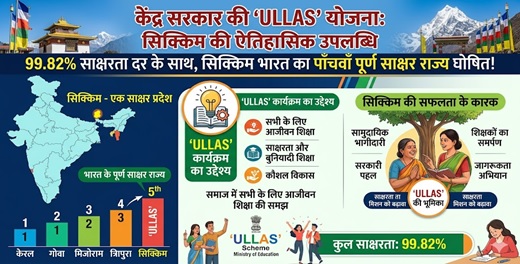
- Under the Central Government’s ULLAS Programme, Sikkim has been declared India’s fifth fully literate state, achieving a literacy rate of 99.82%.
Key Highlights:
- Announcement: Made in the presence of President Droupadi Murmu during the Convocation Ceremony of Sikkim University.
- Eligibility Criterion: According to the Ministry of Education, a State or Union Territory can be declared “Fully Literate” if its adult literacy rate exceeds 95%.
- Benchmark: As per the Ministry’s norms, a State/UT is considered fully literate when the literacy rate among persons aged 15 years and above reaches 95% or more. Sikkim surpassed this benchmark by a significant margin.
- Position/Rank: Sikkim has become the 5th fully literate state in India. It is also the third such state in Northeast India, after Mizoram and Tripura.
- Role of Volunteers: More than 4,000 volunteer teachers contributed to the campaign without receiving any honorarium.
- Sikkim achieved a historic literacy rate of 99.82%, significantly exceeding the Government of India’s benchmark of 95%.
The Sikkim Model Was Based on the Following Pillars:
- Micro-Planning and Intensive Survey: Based on the findings of the Ullas Survey 2022, the Sikkim Government identified 15,361 non-literate adults out of a population of 5,30,046 persons aged above 15 years.
- Targeted Assessment Process: Through five phases of the Foundational Literacy and Numeracy Assessment Test (FLNAT) conducted by the National Institute of Open Schooling (NIOS) between March 2024 and February 2026, 14,447 adults were certified.
- Volunteerism and Jan Bhagidari: More than 4,000 volunteers, including school and college students, teachers, and community members, offered their services without any honorarium.
- Development of Local Learning Material: The State Council of Educational Research and Training (SCERT), Gangtok developed region-specific learning materials and primers in local languages suited to the socio-cultural context of the state.
- Technology Integration: The ULLAS App was effectively used for registration, monitoring, and tracking the progress of learners and volunteers.
Other Fully Literate States/UTs
| State/UT | Declaration Year | Literacy Rate | Key Features |
| Mizoram | 2025 | 98.2% | Community participation and focus on women's education |
| Goa | 2025 | 96% | Administrative efficiency and high investment in education |
| Tripura | 2025 | 95.6% | Cyber literacy campaigns and tribal outreach |
| Himachal Pradesh | 2025 | 99.3% | Rise from 7% literacy at Independence to near-universal literacy |
| Ladakh (UT) | 2024 | 97% | First UT to achieve functional literacy |
| Sikkim | 2026 | 99.82% | Inclusive outreach to remote Himalayan regions |
Note:
- Among Union Territories, Chandigarh has also crossed the 95% literacy mark during 2025-26 and is in the process of being included in this list.
- Kerala (1991): Kerala attained full literacy (above 90%) under the traditional National Literacy Mission (NLM) in 1991. At that time, the benchmark was 90%, whereas the current ULLAS programme uses a 95% benchmark. Therefore, Kerala is widely recognized as India’s first fully literate state, though under a different programme.
ULLAS Initiative
- Full Form: Understanding Lifelong Learning for All in Society – New India Literacy Programme.
- Nature: A Centrally Sponsored Scheme launched in 2022 in line with the recommendations of the National Education Policy (NEP) 2020.
- Nodal Ministry: Ministry of Education.
- Target Group: Non-literate citizens aged 15 years and above who missed the opportunity of formal schooling.
- Tagline: “Jan-Jan Sakshar” (Education for All).
- National Target: To cover 5 crore non-literate individuals during FY 2022–2027 (approximately 1 crore per year).
- Benchmark for Full Literacy: A State/UT can be declared fully literate when the adult literacy rate (15 years and above) reaches 95% or more.
Five Key Components of ULLAS
- Foundational Literacy and Numeracy (FLN): Basic reading, writing and arithmetic skills.
- Critical Life Skills: Financial literacy, digital literacy, legal literacy, electoral literacy, environmental awareness and health awareness.
- Vocational Skills Development: Skill training linked to local employment and livelihood opportunities.
- Basic Education: Providing equivalency at elementary, middle and secondary levels.
- Continuing Education: Lifelong learning opportunities in arts, science, culture, technology and recreation.