


 Don't Have an Account?




SSC Foundation Ramanujam - 21 Offline Cum Online Batch Orai
02 November, 2026



Enter your Email ID and we'll send you a link to get back into your account.

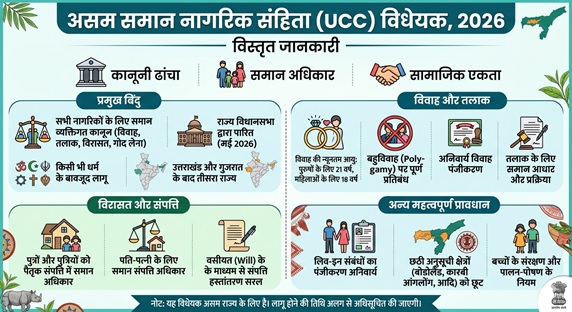

Assam Uniform Civil Code (UCC) Bill, 2026
Fri 29 May, 2026
Context :
• The Assam Legislative Assembly passed the Assam Uniform Civil Code (UCC) Bill, 2026.
Key Highlights :
• The bill seeks to establish a uniform legal framework for marriage, divorce, inheritance and live-in relationships irrespective of religion.
• After Uttarakhand (the first state to implement UCC) and Gujarat, Assam has become the third state in India and the first state in Northeast India to pass such a civil law.
• Goa also follows a Uniform Civil Code inherited from the Portuguese colonial period.
Major Provisions of the Bill :
| Area | Provision Details |
| Marriage Age | The minimum marriage age has been fixed at 21 years for men and 18 years for women. |
| Ban on | Polygamy Polygamy and bigamy have been completely prohibited. Violation may attract imprisonment up to 7 years under the Bharatiya Nyaya Sanhita (BNS), 2023. Existing marriages will remain protected. |
| Mandatory Registration | Registration of all marriages and divorces within 60 days before the Sub-Registrar has been made compulsory. |
| Uniform Divorce Rules | Common grounds for divorce have been prescribed for all religions. No marriage can be dissolved without a court order. Practices such as triple talaq, nikah halala and iddat have been prohibited. |
| Live-in Relationships | Registration of live-in couples within 30 days has been made mandatory. Non-compliance may lead to imprisonment up to 3 months or a fine of ₹10,000. Children born from such relationships will be considered fully legitimate. |
| Inheritance Rights | Equal inheritance rights have been granted to daughters, wives and parents to remove gender inequality. |
Constitutional and Historical Background :
Uniform Civil Code (UCC) :
Important Judicial Decisions :
02 November, 2026
01 November, 2026
10 September, 2026
24 August, 2026
06 August, 2026
28 July, 2026
27 July, 2026
22 July, 2026
20 July, 2026
26 May, 2026
