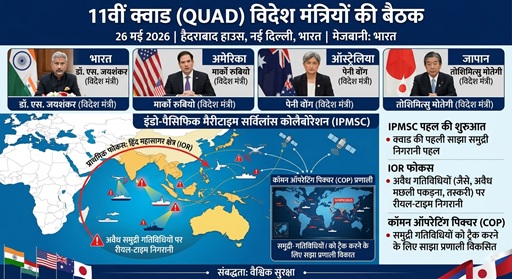
11th QUAD Foreign Ministers’ Meeting
 
  • Mobile Menu
HOME BUY MAGAZINEnew course icon
LOG IN SIGN UP

Sign-Up IcanDon't Have an Account?


SIGN UP


Login Icon

Have an Account?


LOG IN
 

or
By clicking on Register, you are agreeing to our Terms & Conditions.


or


11th QUAD Foreign Ministers’ Meeting

Thu 28 May, 2026

Context:

  • The 11th QUAD (Quadrilateral Security Dialogue) Foreign Ministers’ Meeting was held in New Delhi and hosted by India’s External Affairs Minister Dr. S. Jaishankar.

Key Highlights:

  • Venue of the Meeting: Hyderabad House, New Delhi
  • Participants: US Secretary of State Marco Rubio, Japan’s Toshimitsu Motegi, and Australia’s Penny Wong
  • Hosted by: India’s External Affairs Minister Dr. S. Jaishankar
  • It was the third such meeting since September 2024.
  • The summit focused on promoting regional stability and a free Indo-Pacific against market tensions arising from global conflicts.
  • The QUAD Foreign Ministers’ Meeting (QFMM) acts as the “Sherpa and architect” of the QUAD framework.
  • Frequency: It is a cyclical process under which at least one or two meetings are organized every year, usually during the United Nations General Assembly or as independent ministerial meetings hosted in member countries’ capitals.
  • Counter-Terrorism Exercise: Australia will host a QUAD counter-terrorism tabletop exercise in June 2026.
  • Digital and Port Infrastructure: QUAD countries will develop port infrastructure and undersea cable projects in Pacific Island nations such as Fiji by 2026.

Major Multilateral Frameworks Announced:

  • Indo-Pacific Maritime Surveillance Cooperation Initiative: Aims to improve maritime surveillance and information-sharing in the Indo-Pacific region.
  • Indo-Pacific Maritime Domain Awareness Initiative: Will be expanded to provide near real-time commercial maritime data to countries in the region.
  • QUAD Ports of the Future Partnership: Focused on port infrastructure development in Pacific Island nations. Under this initiative, QUAD will work with Fiji to improve its port infrastructure.
  • QUAD Critical Minerals Framework: Aims to strengthen supply chains and recycling of critical minerals. Currently, China dominates the global supply chain with nearly 85% of processing capacity. Following Beijing’s export restrictions last year, several countries began diversifying their supply sources. Pax Silica was one such initiative, in which India officially participated during the India AI Impact Summit in February this year.

India and the United States Signed a Bilateral Agreement on Critical Minerals:

  • India and the United States finalized a bilateral agreement aimed at ensuring a stable supply of critical minerals.
  • The main objective of the agreement is to ensure the mining, processing, and secure supply of critical minerals and rare earth elements.
  • Official Name: The agreement is officially titled “Security of Supply in Mining and Processing of Critical Minerals and Rare Earth Elements.”
  • Multilateral Engagement: Alongside this bilateral agreement, all four QUAD countries (India, the US, Australia, and Japan) also signed the “QUAD Critical Minerals Initiative Framework,” under which $20 billion investment will be mobilized to strengthen the global supply chain.
  • Areas of Cooperation: Includes mining, processing, recycling (from e-waste), joint investments, and project financing.
  • Background: The agreement follows India’s signing of the US-led “Pax Silica” initiative on 20 February 2026 and ongoing discussions between the two countries since 2025.

QUAD:

  • Full Form: Quadrilateral Security Dialogue (QUAD)
  • Nature: An informal strategic grouping of like-minded countries.
  • Member Countries: India, Australia, Japan, and the United States (USA)
  • Core Objective: To promote peace, security, stability, and a “free, open, and inclusive” Indo-Pacific region while supporting a rules-based international order, especially under UNCLOS.

History of QUAD:

  • 2004 (Foundation): Following the Indian Ocean tsunami, the four countries formed the “Tsunami Core Group” for disaster relief cooperation.
  • 2007 (QUAD 1.0): Formal proposal by Japanese PM Shinzo Abe. The grouping later became inactive due to China’s opposition and Australia’s withdrawal.
  • 2012 (Concept): Shinzo Abe proposed the idea of a “Democratic Security Diamond” for maritime security cooperation.
  • 2017 (QUAD 2.0): The group was revived in Manila during the ASEAN Summit to counter China’s growing influence in the Indo-Pacific.
  • 2021 (Summit): The first QUAD Leaders’ Summit (virtual and in-person) was hosted by US President Joe Biden.
  •  

Latest Courses