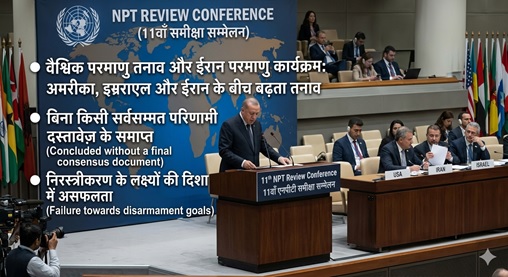
11th Review Conference of NPT Parties
 
  • Mobile Menu
HOME BUY MAGAZINEnew course icon
LOG IN SIGN UP

Sign-Up IcanDon't Have an Account?


SIGN UP


Login Icon

Have an Account?


LOG IN
 

or
By clicking on Register, you are agreeing to our Terms & Conditions.


or


11th Review Conference of NPT Parties

Tue 26 May, 2026

Context:

  • Amid rising global tensions among the United States, Israel and Iran over Iran’s nuclear program, the 11th Review Conference of the Parties to the Nuclear Non-Proliferation Treaty (NPT) concluded without any consensus outcome document.

Key Points:

  • The 11th Review Conference was held from 27 April to 22 May at the United Nations Headquarters in New York.
  • Conference President and Vietnam’s Permanent Representative to the UN, Ambassador Do Hung Viet, expressed disappointment and raised concerns regarding the “future and effectiveness” of the treaty.
  • The meeting held at the UN Headquarters became the third consecutive Review Conference in the last 16 years to fail without a final agreement, after similar failures in 2015 and 2022.

Main Reasons for the Failure of the 11th Review Conference:

  • Nuclear Arsenal Modernization: Non-Nuclear Weapon States (NNWS) accused the P5 countries — United States, Russia, China, United Kingdom and France — of focusing on modernization and expansion of nuclear weapons rather than disarmament.
  • Geopolitical Tensions and US-Iran Conflict: Sharp exchanges occurred between the United States and Iran during the conference. The US accused Iran of violating the treaty, while Iran criticized attacks by the US and Israel on its civilian nuclear facilities.
  • Military Alliances and Security Policies: Several treaty members strongly opposed the AUKUS agreement among Australia, the UK, and the US, as well as NATO’s nuclear-sharing policy.
  • Nuclear Missile Tests: Tests of Russia’s “Sarmat” and the US “Minuteman” intercontinental ballistic missiles (ICBMs) created mistrust in the negotiation environment.
  • Opposition to TPNW: The P5 countries strongly opposed including any factual reference to the Treaty on the Prohibition of Nuclear Weapons (TPNW) in the final draft.

Nuclear Non-Proliferation Treaty (NPT) :

  • Signing Opened: 1968
  • Date of Enforcement: 5 March 1970 (extended indefinitely in 1995).
  • Total Member Countries: 191. It is the world’s most widely adopted arms control agreement.
  • Monitoring Agency: International Atomic Energy Agency monitors its safeguard measures.
  • Nuclear Weapon States (NWS): The treaty recognizes only five countries as nuclear-weapon states that conducted nuclear tests before 1 January 1967 — the United States, Russia, the United Kingdom, France, and China (P5 countries).
  • Three Main Pillars of NPT: Non-proliferation, disarmament, and peaceful use of nuclear energy.

India’s Stand :

  • India is not a member of the NPT and has not signed the treaty.
  • Reason: India considers the NPT a discriminatory treaty because it recognizes only those countries that tested nuclear weapons before 1 January 1967 as legitimate nuclear powers, while restricting other countries from developing nuclear weapons.
  • Other Non-Signatory Countries: Besides India, Pakistan, Israel, North Korea, and South Sudan are also not members of the treaty.

Latest Courses