GK Update
 
  • Mobile Menu
HOME BUY MAGAZINEnew course icon
LOG IN SIGN UP

Sign-Up IcanDon't Have an Account?


SIGN UP


Login Icon

Have an Account?


LOG IN
 

or
By clicking on Register, you are agreeing to our Terms & Conditions.


or


GK Update

Tue 26 May, 2026

National News

Guidelines Issued for the Implementation of the 'BHAVYA' Scheme

  • The Department for Promotion of Industry and Internal Trade (DPIIT) under the Ministry of Commerce and Industry has issued detailed operational guidelines for the implementation of 'BHAVYA' (Bharat Industrial Development Scheme) to strengthen the 'plug-and-play' industrial ecosystem within the country.

The BHAVYA Scheme:

  • Full Name of the BHAVYA Scheme: 'Bharat Industrial Development Scheme'
  • Scheme Type: A Central Sector Scheme
  • Objective: To develop world-class, investment-ready, and 'plug-and-play' (immediately operational) industrial parks across the country, thereby strengthening India's position as a global manufacturing hub.
  • Budgetary Outlay: A total financial allocation of ₹33,660 crore has been made for this scheme.
  • Timeline: From the financial year 2026-27 to 2031-32 (a 6-year implementation period).
  • Target: 100 new industrial parks/smart cities are to be established in India, out of which 50 parks will be selected in the first phase through a 'Challenge Mode'.
  • Project Management Agency (PMA): National Industrial Corridor Development Corporation (NICDC).
  • Implementation Model: Private sector participation for each project through a Special Purpose Vehicle (SPV) and the PPP (Public-Private Partnership) model.
  • Monitoring: Auditing to be conducted by a committee chaired by the DPIIT Secretary.

Land and Eligibility Criteria:

  • Greenfield/Brownfield: Applicable to both types of projects.
  • Area Requirement: A minimum contiguous land area of ​​100 acres for General States, and 25 acres for Hilly/North-Eastern States/Union Territories.
  • Macro-Clusters: Parks covering an area of ​​up to a maximum of 1,000 acres.

Financial Assistance and Subsidy Structure:

  • Internal Infrastructure: Assistance of up to ₹1 crore per acre (covering roads, electricity, waste treatment facilities).
  • Connectivity: External infrastructure support of up to 25% of the project cost.

India’s First Geothermal Energy Project Above 14,000 Feet
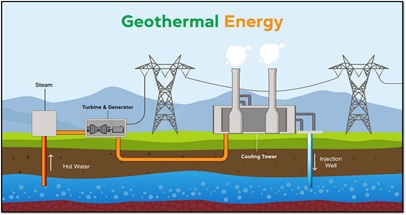
  • Lieutenant Governor (LG) of Ladakh Vinai Kumar Saxena approved a 5-year extension of the Memorandum of Understanding (MoU) signed with Oil and Natural Gas Corporation for India’s first geothermal energy project being developed in the Puga Valley at an altitude of over 14,000 feet.

Related Facts:

  • Tripartite Agreement: The MoU was signed among the Ladakh Administration, Ladakh Autonomous Hill Development Council (LAHDC), Leh, and ONGC. Its first phase began in February 2021 and ended in February 2026.
  • Pilot Plant: Under this project, ONGC will establish a 1 MWe (Megawatt Electric) pilot geothermal power plant.
  • Deep Drilling: In the next phase, existing wells will be deepened up to 1,000 meters and a new 1,000-meter geothermal well will be drilled. Recently, ONGC recorded a subsurface temperature of over 240°C at a depth of 405 meters, considered excellent for power generation.
  • Timeline: The pilot project is expected to become operational by FY 2026–27. After this, a Detailed Project Report (DPR) will be prepared for large-scale commercial utilization.
  • Location: Puga Valley is located in the Changthang region of eastern Ladakh and forms part of the Himalayan Geothermal Belt.
  • Tectonic Setting: The region lies near the Indus Suture Zone (ISZ), where the collision of the Indian and Eurasian tectonic plates causes intense geological activity and brings underground heat closer to the surface.
  • High Potential: It is considered India’s most promising geothermal region, with hot water springs and geothermal reservoirs exceeding 200°C available at shallow depths.

Geothermal Energy :

  • What is it? : Energy generated from the natural heat stored beneath the Earth’s crust in magma and rocks.
  • Nature: A renewable and sustainable source of energy.
  • Advantages: Unlike solar or wind energy, it is not weather-dependent.
  • It can provide continuous 24×7 base-load electricity with zero carbon emissions.
  • India’s Potential: According to the Geological Survey of India, India has an estimated geothermal energy potential of around 10,600 MW.

Other Major Geothermal Regions in India:

  • Chumathang – Ladakh
  • Manikaran – Himachal Pradesh
  • Tattapani – Chhattisgarh
  • Surajkund – Jharkhand
  • Anhoni – Madhya Pradesh
  • Puga Valley – Ladakh (India’s first geothermal field development project)

Tribal Communities Exempted from Uniform Civil Code (UCC)
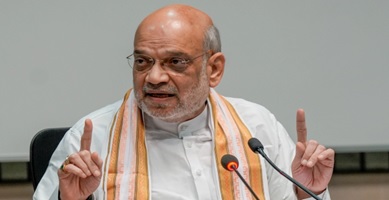
  • Union Home Minister Amit Shah stated that the government has made special provisions to keep all tribal communities outside the ambit of the Uniform Civil Code (UCC), ensuring full protection of their rights.

Related Facts:

Main Reasons for Exemption:

  • Protection of Cultural and Customary Rights: Tribal communities follow their own distinct customary laws related to marriage, divorce, inheritance, and property ownership. For example, the Khasi tribe of Meghalaya follows a matrilineal system, which is completely different from mainstream laws.
  • Respect for the Spirit of the Constitution: The framers of the Constitution had already recognized the unique identity of tribal communities. Imposing the UCC could affect their self-governance systems.
  • Recent Models of Assam and Uttarakhand: The first UCC Act passed by Uttarakhand and the recently introduced “The Uniform Civil Code, Assam, 2026 Bill” in the Assam Assembly also clearly exempt Scheduled Tribes (STs) from its ambit.
  • Article 44 (UCC): Under the Directive Principles of State Policy (DPSP), it directs the state to implement a Uniform Civil Code across the country. However, it is not legally binding and cannot be enforced at the cost of Fundamental Rights.
  • Fifth and Sixth Schedules: These provide administrative and legislative autonomy to Scheduled Areas and tribal regions of the Northeast (Assam, Meghalaya, Tripura, Mizoram). District Councils are empowered to make laws on traditional matters.
  • Article 371 (A to J): States like Nagaland (Article 371A) and Mizoram (Article 371G) enjoy special constitutional status. Parliamentary laws related to their religious, social, and customary practices cannot apply unless approved by the respective State Assemblies.
  • Article 29: Grants every section of citizens the Fundamental Right to preserve its distinct culture, language, and script.

International News

Russia's Use of the Oreshnik Hypersonic Ballistic Missile Against Ukraine
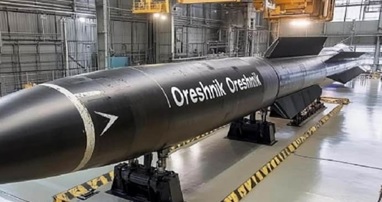
  • The 'Oreshnik' hypersonic ballistic missile was utilized during a large-scale drone and missile attack launched by Russia against Ukraine.

The Oreshnik Missile:

  • Meaning of the Name: In Russian, 'Oreshnik' translates to "hazel tree" or "hazelnut tree."
  • Type: It is an Intermediate-Range Ballistic Missile (IRBM), launched from a road-mobile launcher.
  • Developmental History: According to defense experts, this is not an entirely new missile; rather, it was developed by modifying Russia's predecessor RS-26 Rubezh Intercontinental Ballistic Missile (ICBM) program.
  • Speed: It possesses a speed of Mach 10—that is, 10 times the speed of sound (approximately 12,300 km/h).
  • Strike Capability: Its estimated strike range lies between 3,500 km and 5,500 km, a distance capable of covering the entirety of Europe.
  • Warhead Capacity: It is capable of carrying both conventional high-explosive and nuclear warheads.
  • Technology: It is equipped with MIRV (Multiple Independently Targetable Reentry Vehicle) technology, enabling a single missile to accurately strike multiple distinct targets.
  • Hypersonic Speed: A missile is classified as hypersonic when it travels at a speed of Mach 5 (five times the speed of sound) or higher.
  • Significance of MIRV Technology: During the terminal phase, the missile's main payload section (known as the "Bus") detaches and releases six separate warheads.

11th Review Conference of the Parties to the NPT
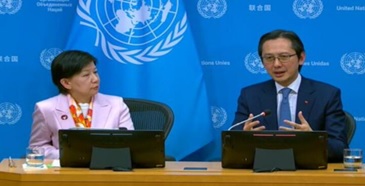
  • The 11th Review Conference of the Parties to the Treaty on the Non-Proliferation of Nuclear Weapons (NPT) concluded without any consensus-based outcome document.
  • This conference was held amidst escalating global tensions involving the United States, Israel, and Iran regarding Iran's nuclear program.

Key Facts:

  • The 11th Review Conference was held at the United Nations Headquarters from April 27 to May 22.
  • The Conference President—Ambassador Do Hung Viet, Vietnam's Permanent Representative to the UN—expressed disappointment over the outcome and voiced concern regarding the "future and effectiveness" of the treaty.
  • Held at the United Nations (UN) Headquarters in New York, this meeting has failed to reach a final agreement for the third consecutive time in the last 16 years (the conferences held in 2015 and 2022 also ended in failure).
  • Main Reasons for the Failure of the 11th Review Conference:
  • Modernization of Nuclear Arsenals: Non-Nuclear-Weapon States (NNWS) allege that the P5 nations (the United States, Russia, China, the United Kingdom, and France) are focusing on modernizing and expanding their nuclear arsenals rather than pursuing disarmament.
  • Geopolitical Tensions and US-Iran Standoff: The conference witnessed heated exchanges between the United States and Iran. The US accused Iran of violating the treaty, while Iran criticized the US and Israel for attacks on its civilian nuclear facilities.
  • Military Alliances and Security Policies: Several signatory nations expressed strong opposition regarding the AUKUS security pact between Australia, the UK, and the US, as well as NATO's nuclear-sharing policy.
  • Rivalry in Nuclear Testing: The testing of the 'Sarmat' intercontinental ballistic missile (ICBM) by Russia and the 'Minuteman' ICBM by the United States fostered an atmosphere of mistrust during the negotiations. Opposition to the TPNW: The P5 nations strongly opposed the inclusion of any factual reference to the 'Treaty on the Prohibition of Nuclear Weapons' (TPNW) in the final draft.

Nuclear Non-Proliferation Treaty (NPT):

  • Opened for Signature: 1968
  • Date of Entry into Force: March 5, 1970 (It was extended indefinitely in 1995)
  • Total Member States: 191 (It is the world's most widely adopted arms control agreement)
  • Monitoring Body: The International Atomic Energy Agency (IAEA) verifies its safeguards.
  • Nuclear-Weapon States (NWS): The Treaty recognizes only those 5 nations as nuclear-weapon states that had conducted a nuclear test prior to January 1, 1967: the United States, Russia, the United Kingdom, France, and China (the P5 nations).
  • 3 Main Pillars of the NPT: Non-proliferation, Disarmament, Peaceful Uses
  • Members: It currently has 191 member states.
  • Nuclear-Weapon States (NWS): This Treaty recognizes only those 5 nations (the P5) as legitimate nuclear powers that had conducted a nuclear test prior to January 1, 1967.

Chinese Coast Guard Intrusion Near Pratas Islands
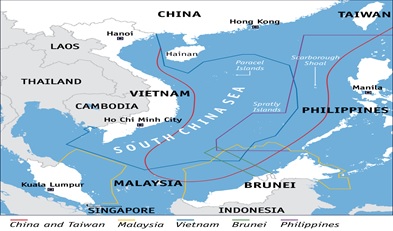
  • A serious two-day maritime standoff occurred between China and Taiwan after a Chinese Coast Guard vessel intruded near the Taiwan-controlled Pratas Islands in the northern part of the South China Sea.
  • The standoff ended after the Chinese vessel withdrew, but the incident has once again heightened geopolitical tensions in the region.

Related Facts:

Pratas Islands :

  • Geographical Location: The Pratas Islands are a coral atoll located in the northern part of the South China Sea. Geopolitically, they lie between Hong Kong and southern Taiwan.
  • Local Name: The islands are also known as Dongsha Islands.
  • Structure: In this circular atoll structure, Dongsha Island is the only visible island above sea level. The other two formations — North Vereker Bank and South Vereker Bank — remain submerged underwater.
  • Administrative Control: The islands are fully administered by Taiwan (Republic of China – ROC) and managed as a national park.
  • However, mainland China (People’s Republic of China – PRC) also claims sovereignty over them.

South China Sea :

  • Overview: An important marginal sea of the western Pacific Ocean.
  • Location: It lies south of China, east and south of Vietnam, west of the Philippines, and north of Borneo Island in Southeast Asia.
  • Bordering Countries: China, Taiwan, Philippines, Malaysia, Brunei, Indonesia, Vietnam, and Singapore share boundaries with the South China Sea.

Major Straits:

  • Taiwan Strait: Connects it with the East China Sea in the north.
  • Luzon Strait: Connects it with the Philippine Sea (Pacific Ocean) in the east.
  • Malacca Strait: Connects it with the Indian Ocean (Andaman Sea) in the southwest.

Disputed Regions :

  • Spratly Islands: Disputed among China, Taiwan, Vietnam, Philippines, Malaysia, and Brunei.
  • Paracel Islands: Disputed among China, Taiwan, and Vietnam.
  • Scarborough Shoal:A major disputed area among China, Taiwan, and the Philippines.

79th World Health Assembly

  • The 79th meeting of the World Health Assembly was organized in Geneva, Switzerland.

Related Facts:

  • Theme: “Reshaping global health: a shared responsibility”
  • Indian Representation: From India, Union Minister of Health and Family Welfare Jagat Prakash Nadda participated in the assembly and addressed various bilateral meetings.
  • Chairmanship: The assembly was chaired by Health Minister Victor Atallah Rajm of the Dominican Republic.
  • Resolutions Passed: During the six-day conference, member countries passed more than 20 decisions and 13 resolutions while enhancing multilateral cooperation for the protection of human health. These mainly included topics such as stroke, tuberculosis (TB), emergency care, hemophilia, and precision medicine.

Major Policy Decisions:

  • Antimicrobial Resistance (AMR): The second version of the “Global Action Plan on AMR” (GAP-AMR) for 2026–2036 was adopted during the meeting. Its target is to reduce deaths caused by bacterial AMR by 10% by 2030, in line with the target of the United Nations General Assembly.
  • Radiation and Health: The first global resolution on ionizing and non-ionizing radiation protection was adopted to strengthen national systems.
  • Economics of Health for All: A new strategy for 2026–2030 was prepared, under which health will be integrated with economic, financial, and industrial policies.
  • World Health Assembly (WHA): It is the highest decision-making governing body of the World Health Organization, which includes representatives of all member countries.

World Health Organization (WHO):

  • Nature: It is a specialized agency of the United Nations responsible for international public health.
  • Headquarters: Geneva, Switzerland.
  • Members: At present, it has 194 member countries.
  • Functions: To provide leadership on global health matters, shape the health research agenda, set standards, and provide evidence-based policy options.
  • India and WHO: India is a member of the WHO South-East Asia Region, and its regional headquarters is located in New Delhi.
  • World Mental Health Day is observed every year on 10 October.

Unveiling of 'Information Agents'

  • Google unveiled 'Information Agents,' a feature built into Search for monitoring the web.
  • In addition to Google, Microsoft (in Outlook and Teams) and Meta (in WhatsApp and Instagram) are also developing similar 'Ambient AI' agents.

Google:

  • Founded: September 4, 1998, by Stanford University PhD students Larry Page and Sergey Brin.
  • Original name: Initially named 'Backrab,' it was later changed to 'Google,' inspired by the mathematical term 'Googol' (1 followed by 100 zeros).
  • Parent company: Alphabet Inc., founded during a restructuring in 2015.
  • Current Chief Executive Officer (CEO): Indian-born Sundar Pichai (CEO of both Alphabet and Google).
  • Headquarters: Mountain View, California, USA

Science and Technology

AI-Powered Health Tool ‘CardiomicScore’ Developed
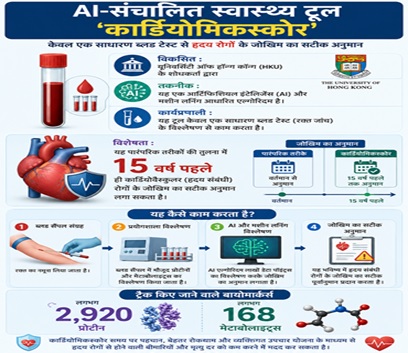
  • Researchers from the University of Hong Kong have developed an AI-powered health tool named ‘CardiomicScore’, which can accurately detect the risk of heart diseases up to 15 years before symptoms appear through a blood test.
  • The results of this tool were published in Nature Communications.

Related Facts:

  • AI-driven Health Tool Name: CardiomicScore
  • Institution: Researchers from the University of Hong Kong (HKU).
  • Technology: It is an Artificial Intelligence (AI) and Machine Learning-based algorithm.
  • Working Mechanism: The tool works through the analysis of a simple blood test.
  • Feature: Compared to traditional methods, it can accurately predict the risk of cardiovascular diseases 15 years earlier.
  • It tracks nearly 2,920 proteins and 168 metabolites in blood samples. This AI system can predict the risk of six major cardiovascular diseases such as heart attack, stroke, and heart failure up to 15 years before symptoms appear.
  • These include coronary artery disease, stroke, heart failure, atrial fibrillation, peripheral artery disease, and venous thromboembolism.

Common Technical Facilities in Gujarat and Tamil Nadu
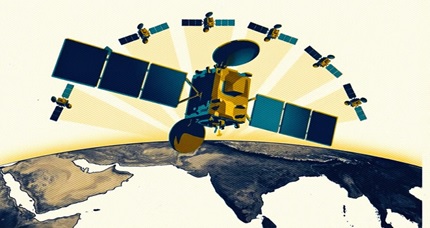
  • The Department of Space (DoS) has granted historic approval for the establishment of Common Technical Facilities (CTF) in Gujarat and Tamil Nadu, aimed at boosting and strengthening the country's private space sector.
  • This project is being executed in collaboration with the Indian National Space Promotion and Authorization Centre (IN-SPACe) and will be situated within dedicated space manufacturing clusters.

Key Highlights:

  • Gujarat (Khoraj, near Ahmedabad): The focus here is on the manufacturing, assembly, and verification of spacecraft and satellite payload systems.
  • Tamil Nadu (Thoothukudi): Strategically located near the new Small Satellite Launch Complex at Kulasekharapatnam, this facility focuses on the manufacturing, structural testing, and propulsion verification of launch vehicles (rockets).
  • PPP/Collaborative Framework: State governments will provide the land and infrastructure, while IN-SPACe will install high-end technical equipment.
  • Plug-and-Play: Private startups and MSMEs will have the facility to conduct testing and verification directly using these facilities, without the need for heavy capital investment.

Appointments

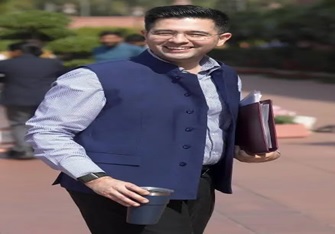
Rajya Sabha MP Raghav Chadha

  • Rajya Sabha MP Raghav Chadha has been appointed as the new Chairman of the Rajya Sabha Committee on Petitions.
  • This appointment, made by the Chairman of the Rajya Sabha, C.P. Radhakrishnan, following the reconstitution of the committee, is effective from May 20, 2026.

Committee on Petitions:

  • It is a significant Standing Parliamentary Committee of the Indian Parliament that serves as a bridge between the public and the Parliament.
  • Origin: It originated during the British era on September 15, 1921, as the "Public Petitions Committee," under a resolution passed in the 'Council of State.'
  • Renaming of the Committee to "Committee on Petitions": 1933.
  • First Constitution: It was constituted for the first time in 1952, comprising a Chairman and four other members.
  • In the year 1964, its membership strength was increased to ten.

Structure and Tenure:

  • Membership Strength: The Rajya Sabha Committee on Petitions consists of a total of 10 members. (Note: The Lok Sabha Committee on Petitions consists of 15 members.)
  • Nomination: All members of the committee are nominated by the Chairman of the Rajya Sabha (the Vice President).
  • Appointment of the Chairman: The Chairman of the committee is also appointed by the Chairman of the Rajya Sabha.
  • Tenure: The committee is generally reconstituted annually (for a term of one year).
  • Quorum: The presence of a minimum of 5 members is mandatory for a meeting of the committee.
  • Matters of Public Interest: Following amendments introduced in 1964, this committee accepts petitions from citizens not only regarding bills but also concerning subjects of general public interest.

Neelam Meena

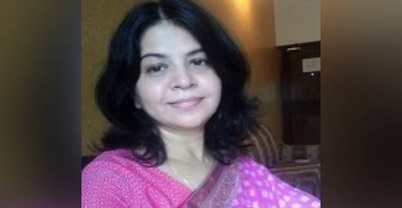
  • The Election Commission of India (ECI) has appointed Neelam Meena, a senior IAS officer of the 1998 batch, as the new Chief Electoral Officer (CEO) of West Bengal.
  • She has become the first woman to serve as the Chief Electoral Officer of West Bengal.

Related Facts:

  • Predecessor: Neelam Meena succeeds Manoj Kumar Agarwal (IAS), who was recently appointed as the new Chief Secretary of the state.
  • Selection Process: The West Bengal government had submitted a panel of three senior IAS officers (Neelam Meena, Tanmay Chakraborty, and Moumita Godara Basu), from which the Election Commission approved Meena's name.
  • Previous Post: Prior to this appointment, she was serving as the Principal Secretary in the Department of Consumer Affairs.
  • Conditions: Upon assuming office, she will not hold any other additional charge under the state government, ensuring the impartiality of the electoral process.

Chief Electoral Officer (CEO):

  • Constitutional/Legal Provisions: The post of Chief Electoral Officer is statutorily defined under Section 13A of the Representation of the People Act, 1950.
  • Who Appoints?: The Election Commission of India (ECI), in consultation with the respective state government, designates or appoints the Chief Electoral Officer (CEO) for a state or Union Territory.
  • Functions: The CEO oversees the functioning of the Election Commission at the state level. It coordinates the conduct of elections for the President, Vice President, Parliament, and State Legislative Assemblies within the state, as well as the revision of electoral rolls.

Election Commission of India (ECI):

  • Establishment: January 25, 1950 (Hence, January 25 is celebrated as National Voters' Day).
  • Part of the Constitution: Part XV (Part 15).
  • Important Articles: Articles 324 to 329.
  • Article 324: Outlines the establishment, composition, and powers of the Election Commission.
  • Headquarters: New Delhi.
  • Number of Members: Currently, it is a three-member body (comprising 1 Chief Election Commissioner and 2 other Election Commissioners).
  • Inception: Originally, the Commission consisted of only one Commissioner; however, since 1993, it has been permanently constituted as a multi-member body.
  • Appointment: By the President of India.
  • Tenure: 6 years or until attaining the age of 65 years (whichever occurs earlier).
  • Status: They enjoy a status and receive a salary equivalent to that of Judges of the Supreme Court of India.
  • First Chief Election Commissioner (First CEC): Sukumar Sen was India's first Chief Election Commissioner.
  • Current CEC (2026): Currently, the Chief Election Commissioner of India is Shri Gyanesh Kumar.
  • Subordinate Officers: At the district level, subordinate to the CEO, are the District Election Officers (DEOs), who are typically the District Magistrates (DM/Collector) of the respective districts.
  • 61st Constitutional Amendment (1989): Under this amendment, the voting age was reduced from 21 years to 18 years.
  • Use of EVMs: Electronic Voting Machines (EVMs) were used comprehensively across the entire country for the first time during the 2004 Lok Sabha elections.
  • First Female Chief Election Commissioner: V.S. Ramadevi.

Books and Authors

'Apnapan: My Experiences with Narendra Modi'
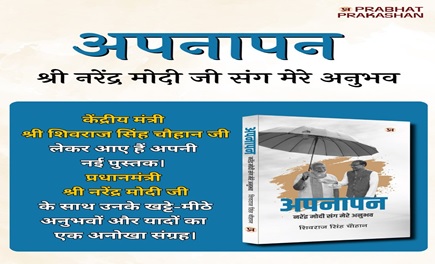
  • Former Vice President M. Venkaiah Naidu unveiled the book 'Apnapan' (Affection/Belonging), authored by Union Minister Shivraj Singh Chouhan, at the Pusa campus in New Delhi.

Key Facts:

  • Full Title of the Book: 'Apnapan: My Experiences with Narendra Modi'
  • Author: Shivraj Singh Chouhan (Current Union Minister of Agriculture & Farmers Welfare and Rural Development, and former Chief Minister of Madhya Pradesh)
  • Core Theme: This book is a heartfelt account of the author's long association—spanning over 35 years—personal experiences, and political journey alongside Prime Minister Narendra Modi.
  • Timeline: The book covers three and a half decades of public life, ranging from the 'Ekta Yatra' (Unity March) of 1991—led by Murli Manohar Joshi, with Narendra Modi serving as the organizational in-charge—up to the present day.

Shivraj Singh Chouhan:

  • Shivraj Singh Chouhan was born on March 5, 1959, in the village of Jait, located in the Budhni tehsil of the Sehore district in Madhya Pradesh.
  • He joined the Rashtriya Swayamsevak Sangh (RSS) at the age of 15, where he imbibed the values ​​of discipline, patriotism, and service.
  • In 1975, he became active in the Akhil Bharatiya Vidyarthi Parishad (ABVP) and subsequently held several significant positions within the Bharatiya Janata Yuva Morcha (BJYM), including State President, National General Secretary, and National President.
  • His electoral journey began in 1990, when he was elected as a Member of the Legislative Assembly (MLA) from Budhni.
  • A year later, in 1991, he was elected to the Lok Sabha from the Vidisha constituency.
  • In November 2005, he took the oath as the Chief Minister of Madhya Pradesh.
  • Serving for four terms—from 2005 to 2018, and again from 2020 to 2023—he became the longest-serving Chief Minister in the history of the state.
  • In 2024, he was once again elected to the Lok Sabha from Vidisha and currently serves as the Union Minister of Agriculture & Farmers Welfare and Rural Development in the Government of India.

Awards and Honours

First Civilian Investiture Ceremony 2026
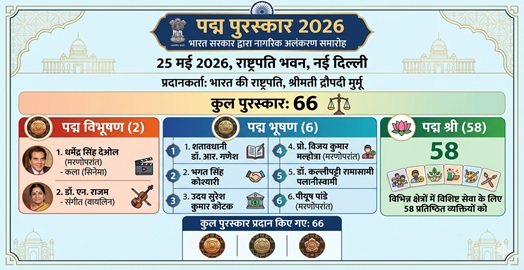
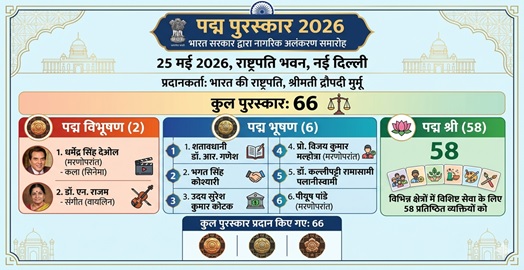
  • President Droupadi Murmu conferred the 2026 Padma Awards upon 66 distinguished personalities during the First Civilian Investiture Ceremony; the recipients include 02 Padma Vibhushan, 06 Padma Bhushan, and 58 Padma Shri awardees.

Related Facts:

Padma Vibhushan:

Dharmendra Singh Deol (Posthumous):

  • Field: Art (Cinema)
  • Distinction: For his unparalleled contribution to Indian cinema spanning over six decades.

Dr. N. Rajam:

  • Field: Music (Violinist)
  • Distinction: For developing the 'Gayaki Ang' (vocal style) on the violin and for enriching classical music.

Padma Bhushan:

  • Shatavadhani Dr. R. Ganesh: Art (Literature and Avadhanam Art)
  • Bhagat Singh Koshyari: Public Affairs
  • Uday Suresh Kumar Kotak: Trade and Industry (Banking Sector)
  • Prof. Vijay Kumar Malhotra (Posthumous): Public Affairs and Sports Administration
  • Dr. Kallipatti Ramasamy Palaniswami: Medicine
  • Piyush Pandey (Posthumous): Art (Advertising and Creative World)


Latest Courses