‘World Cities Report 2026’
 
  • Mobile Menu
HOME BUY MAGAZINEnew course icon
LOG IN SIGN UP

Sign-Up IcanDon't Have an Account?


SIGN UP


Login Icon

Have an Account?


LOG IN
 

or
By clicking on Register, you are agreeing to our Terms & Conditions.


or


‘World Cities Report 2026’

Sat 23 May, 2026

Context:

  • The United Nations Human Settlements Programme (UN-Habitat) released the ‘World Cities Report 2026’ during the 13th World Urban Forum (WUF13) held in Baku, Azerbaijan.

Key Points:

  • Issuing Organization: United Nations Human Settlements Programme (UN-Habitat)
  • Nature of Report: A biennial report released once every two years.
  • Launch Venue: Released during the 13th World Urban Forum (WUF13) in Baku, the capital of Azerbaijan.
  • Theme of WUF13: “Housing the World: Safe and Resilient Cities and Communities”
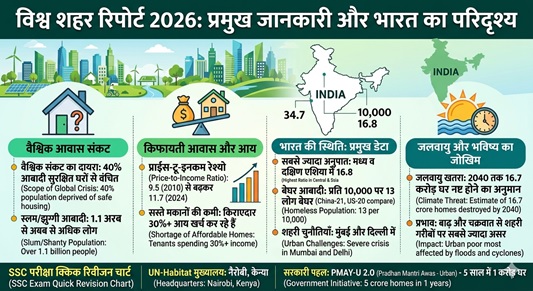
  • Main Theme of Report 2026: “The Global Housing Crisis: Pathways to Action”
  • Major Global Findings of the Report:
  • 40% of Global Population Affected: Around 40% of the world’s population (approximately 3.4 billion people) is struggling with inadequate housing and lack of basic services.
  • Situation of Slums: More than 1.1 billion people are living in informal settlements and slums at record-high levels.
  • Price-to-Income Ratio: Globally, the average house price-to-income ratio increased from 9.5 in 2010 to 11.7 in 2023, reflecting declining affordability.
  • Rental Burden: Around 44% of households worldwide spend more than 30% of their income on housing/rent.
  • Climate Change Threat: Climate hazards and natural disasters could destroy nearly 167 million homes by 2040.

Global Homelessness Rate:

  • China: 21 per 10,000 people
  • India: 13 per 10,000 people
  • United States: 20 per 10,000 people
  • Brazil: 11 per 10,000 people

Key Statistics and Situation in India:

  • Severe Crisis in Metro Cities: India’s major cities are witnessing alarming price-to-income ratios. Mumbai recorded 14.3, while Delhi recorded 10.1.
  • Decline in Affordable Housing: In India’s 8 largest cities, the share of affordable housing projects declined from 52% in 2018 to only 17% in 2025 as developers shifted focus toward luxury housing.
  • Regional Stress: South and Central Asia, including India, recorded the highest price-to-income ratio at 16.8.

Status of Major Cities:

  • Mumbai: Housing price-to-income ratio stands at 14.3.
  • Delhi: The ratio stands at 10.1.
  • Homelessness: India has 13 homeless persons per 10,000 population (compared to 21 in China and 20 in the US).
  • Impact of Government Schemes: The report appreciated the Pradhan Mantri Awas Yojana (PMAY), under which subsidized housing coverage increased from 0.3% in 2010 to 7% in 2023.
  • Ahmedabad Model: Ahmedabad’s “Slum Networking Project” was praised as an effective demand-side intervention.

Urbanization and Challenges:

  • Construction Cost: Due to economies of scale, construction costs per square meter in India and China are lower compared to African countries such as Chad and Zambia.
  • Planning and Investment: Cities require annual investments of $4.5–5.4 trillion to become climate-resilient, whereas current investments are only about $831 billion.

Related Government Schemes in India:

  • Pradhan Mantri Awas Yojana–Urban (PMAY-U) 2.0: Launched in 2024 under the “Housing for All” mission to support 1 crore additional urban beneficiaries over the next five years.
  • Affordable Rental Housing Complexes (ARHCs): A scheme under PMAY-U to provide affordable rental housing near workplaces for migrant workers and the urban poor.
  • Smart Cities Mission (2015): Focused on developing 100 cities with sustainable urban planning and improved infrastructure.
  • AMRUT Scheme (2015): Focused on improving water supply, sewerage networks, and civic amenities in urban areas.

UN-Habitat:

  • Established: 1978 (after the 1976 Vancouver Conference).
  • Headquarters: Nairobi, Kenya.
  • Objective: To promote socially and environmentally sustainable cities and ensure adequate shelter for all.
  • India and UN-Habitat: India is one of its founding members and served as the Chair of its Governing Council during 2017–19.

Latest Courses