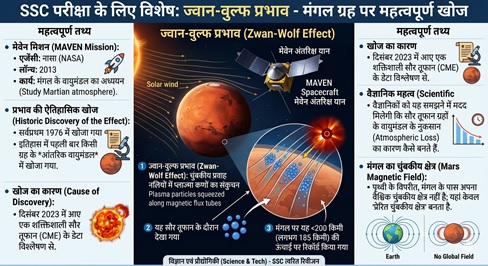
Discovery of ‘Zwan-Wolf Plasma Effect’ in Mars’ Thin Atmosphere
 
  • Mobile Menu
HOME BUY MAGAZINEnew course icon
LOG IN SIGN UP

Sign-Up IcanDon't Have an Account?


SIGN UP


Login Icon

Have an Account?


LOG IN
 

or
By clicking on Register, you are agreeing to our Terms & Conditions.


or


Discovery of ‘Zwan-Wolf Plasma Effect’ in Mars’ Thin Atmosphere

Thu 21 May, 2026

Context :

  • NASA’s MAVEN spacecraft has discovered the rare ‘Zwan-Wolf Effect’ in Mars’ atmosphere (ionosphere) for the first time.

Key Points :

  • Report published in: Nature Communications
  • Discovery by: Researchers from France, the UK, and the USA using NASA’s MAVEN spacecraft.
  • Why this discovery is important: Because Mars does not have a strong global magnetic field like Earth.
  • According to researchers, the Zwan-Wolf Effect on Mars may remain continuously active, but it is often too weak to be detected by most scientific instruments.
  • MAVEN recorded related data in December 2023 during a powerful solar storm on Mars known as a Coronal Mass Ejection (CME).
  • This event generated intense magnetic structures in Mars’ magnetic field that moved downward into the planet’s ionosphere.
  • These structures pushed charged particles toward the darker side of the planet, reducing the local particle density by nearly 50%.
  • Atmospheric loss: This discovery will help scientists understand how solar storms are stripping away Mars’ atmosphere and how Mars transformed from a green/wet planet into a cold desert.
  • Study of other planets: This physics can also help study atmospheres of bodies without magnetic fields, such as Venus and Titan, the moon of Saturn.

Zwan-Wolf Effect :

  • Discovery history: This effect was first discovered in 1976.
  • Basic phenomenon: When strong solar winds or Coronal Mass Ejections (CMEs) from the Sun collide with a planet’s magnetic field, the magnetic field becomes compressed.
  • Pressure condition: Due to this compression, charged particles (plasma) inside magnetic structures called flux tubes experience extreme pressure.
  • Particle displacement: Similar to toothpaste being squeezed out of a tube, these charged particles are rapidly pushed along magnetic field lines, causing plasma density in that region to suddenly decrease.
  • Why this discovery is historic: For the last 50 years, this effect had only been observed in outer space around planets with strong global magnetic fields like Earth. For the first time in history, it has now been observed inside a planet’s inner atmosphere (ionosphere) at an altitude below 200 km.

MAVEN Mission :

  • Full name: Mars Atmosphere and Volatile EvolutioN (MAVEN)
  • Agency: NASA (USA)
  • Launch: 18 November 2013
  • Entered Mars orbit: September 2014
  • Main objective: To study how Mars’ atmosphere and water escaped into space over time. It specifically studies Mars’ upper atmosphere and its interaction with solar wind.

Mars :

  • Nickname: Known as the Red Planet.
  • Reason for red color: High concentration of iron oxide (rust) in surface rocks.
  • Position: Fourth planet from the Sun and the second-smallest planet in the Solar System after Mercury.
  • Terrestrial planet: Like Mercury, Venus, and Earth, Mars is a rocky inner planet.

Rotation and Revolution :

  • Length of day (rotation): Mars completes one rotation in 24 hours 37 minutes (almost similar to Earth).
  • Length of year (revolution): Mars takes 687 Earth days to complete one orbit around the Sun.

Moons :

Mars has only two natural satellites (moons):

  • Phobos: Larger in size.
  • Deimos: One of the smallest moons in the Solar System.

Major Geographical Features :

  • Olympus Mons: The largest and tallest volcano (and mountain) in the Solar System. It is nearly three times taller than Mount Everest (about 24–25 km).
  • Vallis Marineris: One of the largest canyon systems in the Solar System.

Atmosphere :

  • Atmospheric density: Mars has a very thin atmosphere, about 1% the density of Earth’s atmosphere.
  • Gas composition: The atmosphere mainly contains carbon dioxide (about 95%), along with nitrogen, argon, and trace amounts of oxygen.

Important Space Missions :

  • Mars Orbiter Mission (MOM/Mangalyaan): Launched by Indian Space Research Organisation on 5 November 2013 using the PSLV-C25 rocket.
  • India became the first country in the world to reach Mars orbit on its very first attempt.
  • India became the fourth space agency to reach Mars after the Soviet Union, NASA, and the European Space Agency.
  • NASA missions: Curiosity rover, Perseverance rover, and InSight lander.
  • Tianwen-1: China’s Mars mission.
  • Hope Mission: The first interplanetary mission of the UAE.

Latest Courses