08 May, 2026
SMILE Mission
Wed 20 May, 2026
Context :
- Chinese and European space agencies launched the SMILE mission to study the interaction between charged particles coming from the Sun and Earth’s magnetic shield.
Key Points :
- Full Form of SMILE : Solar Wind Magnetosphere Ionosphere Link Explorer
- Launch : Through Vega-C rocket
- This mission is the first fully joint space science mission of the Chinese Academy of Sciences (CAS) and the European Space Agency (ESA).
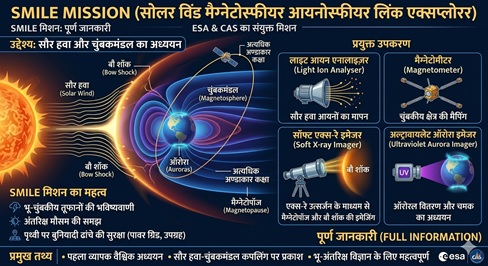
- Main Objective : To conduct a live and comprehensive study of the global interaction between the Solar Wind and Earth’s protective shield, the Magnetosphere.
- Visibility : For the first time in history, real-time X-ray and ultraviolet images of Earth’s invisible magnetic shield will be captured.
- Understanding Variability : To observe how Earth’s magnetosphere gets distorted during solar storms or Coronal Mass Ejections (CMEs) and how it recovers itself.
- Orbital Position : For broad observation of the magnetosphere, the spacecraft will operate about 1.21 lakh km above Earth’s northern pole.
- Mission Duration : Its expected operational life is around three years.
- Weight of SMILE : Approximately 2,600 kg.
Four Scientific Payloads of the SMILE Mission :
- Soft X-ray Imager (SXI)
- Developer : European Space Agency (ESA)
- Main Function : It is the world’s first space-based soft X-ray imager. It will capture soft X-rays generated by collisions between solar wind ions and Earth’s atmosphere. Its main task is to map the real boundaries of the Magnetosphere.
Ultraviolet Aurora Imager (UVI) :
- Developer : Chinese Academy of Sciences (CAS / China)
- Main Function : It will capture ultra-high-resolution images of auroras (Northern and Southern Lights) formed over Earth’s polar regions in ultraviolet wavelengths.
Light Ion Analyzer (LIA) :
- Developer : Chinese Academy of Sciences (CAS / China)
- Main Function : It will directly measure the velocity, density, and temperature of solar wind particles (mainly ions) passing near the satellite in-situ.
Magnetometer (MAG) :
- Developer : Chinese Academy of Sciences (CAS / China)
- Main Function : It will accurately measure real-time changes in the strength and direction of the local magnetic field around the spacecraft.
Unique Orbit of the Satellite :
- SMILE is being placed in a Highly Elliptical Northern Polar Orbit.
- Apogee : Earth’s northern pole above, it will reach a maximum altitude of about 1,21,000 km (nearly one-third of the Earth-Moon distance). Due to this unique height, it will continuously observe Earth’s magnetic shield and auroras for 40–45 hours without interruption.
- Perigee : Above the southern pole, its minimum altitude will be around 5,000 km, from where it will rapidly transfer data to Antarctica and other ground stations.
Space Weather and Its Importance for Earth :
- Geomagnetic Storms : Strong solar winds colliding with Earth’s magnetosphere create large-scale magnetic disturbances.
- Infrastructural Damage : Solar storms can disrupt Earth’s power grids, global communication networks, mobile signals, and GPS systems (as seen during the 1859 Carrington Event).
- Protection of Space Assets : Accurate predictions help protect billion-dollar satellites and astronauts aboard the International Space Station (ISS) from harmful radiation.
Impact on Global Geopolitics and Space Diplomacy :
- China-Europe Strategic Cooperation : At a time when space rivalry between the US and China is intensifying, the joint ESA-CAS mission shows that geopolitical differences can be bridged for scientific research.
- Data Democratisation : Data obtained from the mission will be shared with the global scientific community, strengthening global space weather modelling.
Magnetosphere :
- It is the vast invisible region around Earth or any other celestial body where its own magnetic field dominates.
How is it Formed? :
- Internal Source : Movements of molten iron and nickel in Earth’s core generate a powerful magnetic field, known as the geodynamo effect.
- External Collision : When the highly energetic charged particles from the Sun, known as Solar Wind, collide with Earth’s magnetic field, a protective shield forms in space called the Magnetosphere.
Its Unique Structure and Shape :
- Bow Shock : The outermost boundary where the solar wind first collides with Earth’s magnetic field and slows down.
- Magnetopause : The actual boundary where solar wind pressure and Earth’s magnetic pressure balance each other.
- Magnetotail : On the side opposite the Sun (night side), Earth’s magnetic field stretches millions of kilometres into space like a long tail.
Significance for Earth :
- Life-saving Shield : It prevents harmful cosmic radiation and highly charged particles from reaching Earth’s surface. Without it, solar winds could strip away Earth’s atmosphere, as happened on Mars.
- Aurora Formation : When some solar wind particles enter Earth’s atmosphere near the poles through magnetic field lines, they collide with gases and create colourful lights known as Auroras or Polar Lights.