GK Update
 
  • Mobile Menu
HOME BUY MAGAZINEnew course icon
LOG IN SIGN UP

Sign-Up IcanDon't Have an Account?


SIGN UP


Login Icon

Have an Account?


LOG IN
 

or
By clicking on Register, you are agreeing to our Terms & Conditions.


or


GK Update

Sun 17 May, 2026

National News

President Gives Assent to the Supreme Court (Number of Judges) Amendment Ordinance, 2026
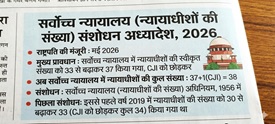
  • President Droupadi Murmu has given her assent to an Ordinance increasing the number of Supreme Court judges from 33 to 37.

Supreme Court (Number of Judges) Amendment Ordinance, 2026:

  • President's Assent: May 2026
  • Key Provision: The sanctioned strength of judges in the Supreme Court has been increased from 33 to 37 (excluding the Chief Justice of India).
  • Current Total Number of Judges in the Supreme Court: 37 + 1 (CJI) = 38
  • Amendment: To the Supreme Court (Number of Judges) Act, 1956.
  • Previous Amendment: Prior to this, in the year 2019, the number of judges was increased from 30 to 33 (totaling 34, excluding the CJI).
  • Article 124(1) – Power to Determine the Number of Judges: According to Article 124(1) of the Constitution, Parliament possesses the authority to alter the number of judges in the Supreme Court by enacting a law. The original Constitution provided for 1 Chief Justice and 7 other judges (totaling 8).
  • Article 123 – Power to Promulgate Ordinances: Since Parliament is not currently in session, the President—acting on the recommendation of the Union Cabinet—has promulgated this Ordinance under Article 123. Once the upcoming session of Parliament commences, this measure will be passed as a Bill.

Historical Evolution of the Number of Judges:

  • 1950: 8 Judges (CJI + 7)
  • 1956: 11 Judges (CJI + 10)
  • 1960: 14 Judges (CJI + 13)
  • 1977: 18 Judges (CJI + 17)
  • 1986: 26 Judges (CJI + 25)
  • 2009: 31 Judges (CJI + 30)
  • 2019: 34 Judges (CJI + 33)
  • 2026 (Present): 38 Judges (CJI + 37)

'Dam Rehabilitation and Improvement Project'
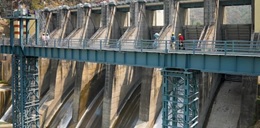
  • With 6,628 designated dams, India ranks third globally in terms of large dams.
  • More than 26 percent of these dams are over 50 years old, necessitating systematic rehabilitation and safety upgrades.

Relevant Facts:

  • India's dams play a crucial role in irrigation, hydroelectric power generation, flood control, drinking water supply, and overall water security.

Status of Dams in India:

  • India ranks third, following China and the United States.
  • Total Dams in India: 6,628 designated dams.
  • Operational Dams in India: 6,545.
  • Dams Under Construction in India: 83.
  • Gross Water Storage Capacity of these Dams: Approximately 330 billion cubic meters.
  • Dams Over 50 Years Old: 26 percent (1,681 dams).
  • Dams Over 100 Years Old: 291.
  • Approximately 42 percent of the dams are between 25 and 50 years old.
  • India's oldest dam—the Kallanai (Grand Anicut) in Tamil Nadu—has been operational for nearly 2,000 years.
  • Ownership by State Governments: State governments own approximately 98.5% of the dams in India (6,448 dams).
  • Central Public Sector Undertakings own 49 dams, or 0.7 percent.
  • Private entities own 0.6 percent, or 36 dams.
  • The Central Government owns 0.2 percent, or 12 dams.
  • Maharashtra has the highest number of designated dams, followed by Madhya Pradesh, Gujarat, Chhattisgarh, Rajasthan, Karnataka, and Odisha.

Bhojshala Complex Declared a Hindu Temple
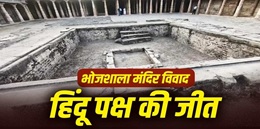
  • Delivering a historic verdict, the Indore Bench of the Madhya Pradesh High Court has declared the disputed Bhojshala-Kamal Maula Mosque complex, located in the Dhar district, to be a temple dedicated to Goddess Vagdevi (Saraswati).

Key Facts:

  • Construction and Original Form: Built in the 11th century by the Parmar King Bhoj, it was originally a Saraswati temple (Sharda Sadan) and a university for Sanskrit education.
  • Islamic Transformation: During the reigns of Khilji and Dilawar Khan, the site was converted into a mosque using the ruins of the original temple.
  • Status of the Idol: The original idol of Goddess Vagdevi (Saraswati) from the temple is currently housed in the British Museum in London.
  • New Court Order: The Court has set aside the 2003 ASI order regarding 'shared worship' and has declared the site to be exclusively a Hindu temple.

This verdict is entirely based on the scientific survey report—spanning over 2,200 pages—submitted by the ASI in 2024, which revealed the following findings:

  • Pre-existing Structure: The current structure has been erected upon the ruins and pillars of a massive temple dating back to the 10th–11th centuries.
  • Remains of Idols: More than 94 idols and fragmented parts of Hindu deities—such as Vishnu, Ganesha, Brahma, and Narasimha—were discovered within the complex.
  • Inscriptions: Over 150 inscriptions in Sanskrit and Prakrit languages ​​were found on the walls and stones, containing references to literary texts.
  • Architecture: The primary architectural elements of the mosque (such as the arches) were subsequently and forcibly integrated by cutting into the existing temple pillars.

Indian Soft-shell Turtle

  • India's first satellite-tagged Indian Soft-shell Turtle was released in Kaziranga National Park.

Indian Soft-shell Turtle:

  • Scientific Name: Nilssonia gangetica
  • Also known as the Ganges Soft-shell Turtle.
  • It is a prominent species of freshwater turtle found in South Asia.
  • Distribution: Abundant in the major river basins of South Asia (India, Bangladesh, Pakistan, and Afghanistan), such as the Ganges, Indus, Brahmaputra, Yamuna, and Mahanadi.
  • Significance of Assam: Assam is considered a global priority area for the conservation of freshwater turtles; 5 of India's 8 soft-shell turtle species are present in the Kaziranga region alone.

Conservation Status:

  • IUCN Red List: Vulnerable (Note: Due to certain reports and local threats, it is also sometimes considered Endangered).
  • Wildlife Protection Act (WPA), 1972: Schedule I — It enjoys the highest level of legal protection in India.
  • CITES: Appendix I — There is a complete ban on its international commercial trade.
  • Kaziranga National Park
  • Location: It is situated in the Golaghat and Nagaon districts of Assam.
  • Key Feature: It is home to two-thirds of the world's one-horned rhinoceroses.
  • UNESCO: It was declared a 'World Heritage Site' in 1985.
  • Tiger Reserve: It was designated as a Tiger Reserve in 2006. It possesses a very high density of tigers.
  • River: The Brahmaputra River flows through its northern boundary.

Other Important National Parks of Assam (Trick: K-M-O-N-D-R-D):

  • Kaziranga
  • Manas – Famous for wild buffaloes
  • Orang – Also known as 'Mini Kaziranga'
  • Nameri
  • Dibru-Saikhowa
  • Raimona – Established in 2021
  • Dehing Patkai – Established in 2021

International News

Iraq's New Prime Minister: Ali Falih Kadhim Al-Zaidi

  • Ali Falih Kadhim Al-Zaidi has assumed office as the Prime Minister of Iraq.
  • He was nominated by the 'Coordination Framework,' a coalition of Iraq's largest Shia political parties.
  • At the age of 40, Al-Zaidi has become the youngest Prime Minister in Iraq's history.

Iraq:

  • Capital: Baghdad
  • Largest City: Baghdad
  • Currency: Iraqi Dinar (IQD)
  • Official Languages: Arabic and Kurdish
  • President: Abdul Latif Rashid
  • Continent: Asia
  • Major Rivers: Tigris and Euphrates
  • Major Religion: Islam
  • Neighboring Countries: Iran, Kuwait, Saudi Arabia, Jordan, Syria, and Türkiye
  • Famous For: Oil reserves, Ancient Mesopotamian civilization
  • Maritime Border: It possesses a very short coastline (approximately 58 km) in the south, bordering the Persian Gulf.
  • Mountain Range: The Zagros Mountains are located in the northeastern part of the country. Iraq's highest peak, Cheekha Dar, is situated in this region.
  • Mesopotamian Civilization: In ancient times, the land of Iraq was known as 'Mesopotamia' (the land between two rivers). It was here that the world's most ancient civilizations—Sumer, Akkad, Babylon, and Assyria—flourished.

Important Days

'World Telecommunication and Information Society Day'
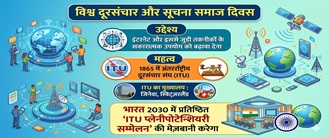
  • 'World Telecommunication and Information Society Day' is observed annually on May 17th to commemorate the founding of the International Telecommunication Union in 1865.

Background and History:

  • Key Date: On May 17, 1865, the first International Telegraph Convention was signed in Paris, and on this very day, the International Telecommunication Union (ITU) was established.
  • Inception: From the year 1969 onwards, this day began to be celebrated as 'World Telecommunication Day'.
  • Change in Name: In November 2005, the 'World Summit on the Information Society' (WSIS) called upon the United Nations General Assembly to declare May 17th as 'World Information Society Day'. Subsequently, in November 2006, during the ITU Plenipotentiary Conference held in Antalya (Turkey), a decision was taken to combine both observances and celebrate them jointly as 'World Telecommunication and Information Society Day'.

International Telecommunication Union (ITU):

  • It is a specialized agency of the United Nations for Information and Communication Technologies (ICT), which regulates and coordinates telecommunication networks and services at a global level.
  • Establishment: May 17, 1865, as the 'International Telegraph Union'.
  • Headquarters: Geneva, Switzerland.
  • Affiliation with the UN: In 1947, it became a specialized agency of the United Nations (UN).
  • India has been a member since 1869 and has served continuously as an elected member of the 'ITU Council' since 1952.
  • India will host the prestigious 'ITU Plenipotentiary Conference' in 2030.

'World Hypertension Day'

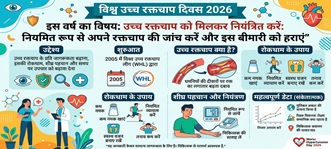
  • 'World Hypertension Day' is observed annually on May 17th with the aim of promoting global awareness, prevention, detection, and control of high blood pressure.

World Hypertension Day 2026:

  • Objective: To raise awareness regarding high blood pressure and to promote its prevention, early detection, and timely treatment.
  • Initiation: By the World Hypertension League (WHL) in 2005.
  • Theme for this year (2026): "Control High Blood Pressure Together: Check Your Blood Pressure Regularly and Beat This Disease."

Blood Pressure:

  • Blood pressure is defined as the force or pressure exerted by circulating blood against the walls of blood vessels (specifically arteries).
  • This pressure is at its highest when the heart contracts and pumps blood into the arteries.
  • Unit of Measurement: Millimeters of Mercury (mmHg).
  • Normal Value: 120/80 mmHg.
  • Instrument Name: Blood pressure is measured using an instrument called a Sphygmomanometer.
  • Auxiliary Instrument: Along with this, doctors use a Stethoscope to listen to the sounds of the arteries.
  • Hypertension (High Blood Pressure): 140/90 mmHg or higher (referred to as Hypertension); it is also known as the "Silent Killer" because its early symptoms are not easily apparent.
  • Hypotension (Low Blood Pressure): Less than 90/60 mmHg (referred to as Hypotension).

Economy and Banking

Inauguration of India's First AI-Powered 'Physical' Banking Branch

  • Assam Chief Minister Himanta Biswa Sarma inaugurated India's first AI-powered 'physical' banking branch in Guwahati.

Key Facts:

  • Inauguration: By Assam Chief Minister Himanta Biswa Sarma
  • Location: Guwahati (Assam), GS Road
  • Bank Name: Slice Small Finance Bank (Slice SFB)
  • Former Name / Merger: North East Small Finance Bank and Slice Fintech
  • Regulatory Body: Regulated by the Reserve Bank of India (RBI)

Slice Small Finance Bank:

  • Inception (2016): The fintech company 'Slice' (SlicePay) provided credit and BNPL services to the youth.
  • Merger (2024): With approvals from the RBI and NCLT, 'Slice' and 'North East Small Finance Bank' merged.
  • New Name and Headquarters: 'Slice Small Finance Bank'; Headquarters: Guwahati (Assam).
  • Regulation: It is a Scheduled Bank regulated by the Reserve Bank of India (RBI).

Defense News

Approval Granted for the Formation of an ‘India Reserve Battalion’ in Tripura

  • The Ministry of Home Affairs has approved the formation of an additional ‘India Reserve Battalion’ in Tripura.
  • The Union Ministry of Home Affairs has approved the raising of an additional ‘India Reserve Battalion’ (IRBn) with the objective of strengthening law and order and security in Tripura.
  • This battalion will form part of the ‘Tripura State Rifles’ (TSR) within the state.

Key Facts:

  • Central Financial Assistance: The Central Government will provide a one-time financial grant of ₹50 crore for the raising of this battalion.
  • Infrastructure Development: An additional sum of up to ₹30 crore has been sanctioned for infrastructure development—specifically for the construction of the battalion headquarters and other facilities (this excludes the cost of land, which will be provided free of cost by the State Government).
  • Expenditure Sharing: The one-time establishment cost will be borne by the Central Government, while the annual recurring expenditure and maintenance costs will be borne by the Government of Tripura.
  • Current Status: Previously, the force in Tripura comprised up to the level of 15 battalions; following the disbandment of two units, there are currently 13 active battalions (including one all-women battalion). With the addition of this new unit, it will effectively become the state's 16th battalion.
  • Deployment Protocol: While these units form part of the state forces (such as the Tripura State Rifles), the Central Government retains the ‘first right of decision’ regarding their deployment. The Centre may deploy them to any part of the country or to other states as per its requirements.


Latest Courses