08 May, 2026
'Logistics Ease Across Different States' (LEADS) 2025 Report
Sat 16 May, 2026
Context:
- The Department for Promotion of Industry and Internal Trade (DPIIT) under the Ministry of Commerce and Industry released the 7th edition of the ‘Logistics Ease Across Different States’ (LEADS) 2025 Report.
Key Points:
- The report is a national index that assesses logistics infrastructure, services, and the regulatory ecosystem across Indian States and Union Territories.
- Origin and Inspiration: The index was launched in 2018.
- It is modeled on the World Bank’s renowned ‘Logistics Performance Index’ (LPI).
- Assessment Pillars: The report evaluates logistics ease based on three major pillars — Infrastructure, Services, and Regulatory Environment.
- Objective: To promote healthy competition among states and guide policy reforms aimed at reducing logistics costs.
- Full Form: LEADS stands for Logistics Ease Across Different States.
- Issuing Ministry: Ministry of Commerce and Industry.
- Nodal Department: Prepared by DPIIT under the Ministry of Commerce and Industry.
- Edition: The 2025 report is the 7th edition of LEADS.
- Inception: The index was launched in 2018.
- Global Benchmark: Based on the World Bank’s Logistics Performance Index (LPI).
- New Classification Framework: LEADS 2025 replaced the earlier 3-tier model with a new 4-tier performance framework.
- Weightage of Objective Indicators: Evidence-based and measurable indicators have been assigned 59% weightage.
- Technical Evaluation: API-enabled speed tracking has been used to monitor vehicle speed on major road corridors.
LEADS 2025: Performance of States/UTs
| State/UT Category | Achievers (Top Performing States/UTs) | High Performers (Strong and Consistent Performance) | Fast Movers (Remarkable Improvement) | Aspirers (At Initial Stage of Development) |
| Coastal States | Tamil Nadu | Gujarat, Kerala, Maharashtra | Andhra Pradesh, Odisha, Goa, Karnataka | West Bengal |
| Landlocked States | Uttar Pradesh | Haryana, Telangana, Chhattisgarh, Bihar | Punjab, Jharkhand, Madhya Pradesh, Uttarakhand, Himachal Pradesh | Rajasthan |
| North-Eastern States | Mizoram | Tripura, Meghalaya | Nagaland, Arunachal Pradesh, Manipur, Assam | Sikkim |
| Union Territories | Delhi | Jammu & Kashmir, Puducherry | Dadra & Nagar Haveli and Daman & Diu, Chandigarh, Ladakh, Lakshadweep | Andaman & Nicobar Islands |
LEAPS 2025 Winners
A. Core Logistics:
- Air Freight Service Provider – FedEx Express Transportation and Supply Chain Services (India) Pvt. Ltd.
- Maritime Freight Service Provider – MSC Agency India Pvt. Ltd.
- Road Freight Service Provider – Safexpress Pvt. Ltd.
- Rail Freight Service Provider – DP World Rail Logistics Pvt. Ltd.
- Multimodal Transport Operator (MTO) – Paradip Parivahan Ltd.
- Warehouse Service Provider (Industrial & Consumer Goods) – TVS Industrial & Logistics Parks
- Warehouse Service Provider (Agriculture) – Indicold Pvt. Ltd.
B. MSME:
- MSME Logistics Service Provider – Shipwaves Online Ltd.
C. Startup:
- Startup – Logistics Technology Service Provider – MatchLog Solutions Pvt. Ltd.
- Startup – Logistics Operations Service Provider – Yellowings Delivery Services Pvt. Ltd.
D. Institution:
- Educational Institution Promoting Logistics Sector – IIM Mumbai
E. Special Categories:
- Logistics Service Delivery for E-Commerce Operations – Delhivery Ltd.
- Multimodal Logistics Service Provider (3PL Service Provider, Freight Forwarder, Customs Broker/Agent) – Indev Infra Pvt. Ltd.
Current Status and Challenges of India’s Logistics Sector
- According to FY 2023-24 data, India aims to reduce logistics costs to below 7–8% of GDP.
- The logistics sector is rapidly expanding; however, it continues to face several structural and operational challenges.
Major Challenges:
- Infrastructure Gaps: Poor roads, congestion at ports, and inadequate rail connectivity affect logistics efficiency.
- Overdependence on Road Transport: More than 60% of freight movement in India takes place through roads, increasing fuel consumption, traffic congestion, and transportation costs.
- Dominance of the Unorganized Sector: A large number of small operators and firms lead to coordination and operational inefficiencies.
- Other Challenges: Complex regulatory procedures and the slow adoption of advanced technologies hinder sectoral growth.
Policy and Digital Initiatives :
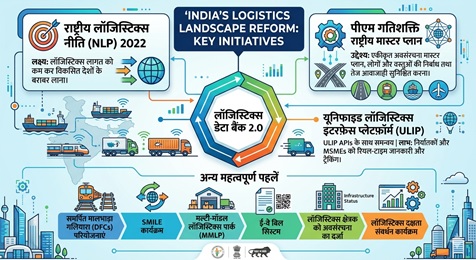
National Logistics Policy (NLP), 2022:
- Objective: To reduce logistics costs to global standards (7–8% of GDP) and place India among the top 25 countries in the LPI rankings by 2030.
CLAP (Comprehensive Logistics Action Plan):
- Focuses on 8 major areas such as digital logistics, human resource development, and freight efficiency.
ULIP (Unified Logistics Interface Platform):
- An integrated digital platform that brings together data from multiple government departments such as transport, civil aviation, shipping, and railways.
- It enables real-time cargo tracking and reduces paperwork.
e-Logs Portal:
- A digital grievance redressal system that allows logistics industry associations to directly raise operational and regulatory issues with the government.
Integrated Infrastructure Development :
PM GatiShakti National Master Plan:
- A digital platform for infrastructure projects integrating 16 ministries for coordinated planning and implementation.
- It aims to eliminate departmental silos.
Multi-Modal Logistics Parks (MMLPs):
- Developed under the Bharatmala Project at strategic locations across the country.
- These parks facilitate warehousing, customs clearance, and seamless transfer between different transport modes (road, rail, air).
Modernisation of Transport Modes :
Railways:
- • Dedicated Freight Corridors (DFCs): The Eastern and Western DFCs are significantly increasing freight speed and reducing congestion on passenger lines.
Roadways:
- Bharatmala Project: Development of economic corridors, expressways, and border roads to improve freight movement.
- FASTag and e-Way Bill: Have significantly reduced waiting time at toll plazas and state borders.
Shipping and Waterways:
- Sagarmala Project: Focused on port modernization, improving port connectivity, and promoting coastal shipping.
- National Waterways: Development of inland waterways such as the Ganga and Brahmaputra, which are cost-effective and environmentally friendly freight transport modes.