PSBs Record All-Time High Net Profit in FY26
 
  • Mobile Menu
HOME BUY MAGAZINEnew course icon
LOG IN SIGN UP

Sign-Up IcanDon't Have an Account?


SIGN UP


Login Icon

Have an Account?


LOG IN
 

or
By clicking on Register, you are agreeing to our Terms & Conditions.


or


PSBs Record All-Time High Net Profit in FY26

Wed 13 May, 2026

Context :

  • Public Sector Banks (PSBs) recorded an all-time high net profit of ₹1.98 lakh crore in Financial Year 2025-26 (FY26), reflecting an 11.1% year-on-year (y-o-y) growth compared to the previous year.

Key Points :

  • This is the fourth consecutive year in which government banks have collectively shown strong profitability, indicating that the Indian banking sector has fully recovered from the “Twin Balance Sheet Crisis.”
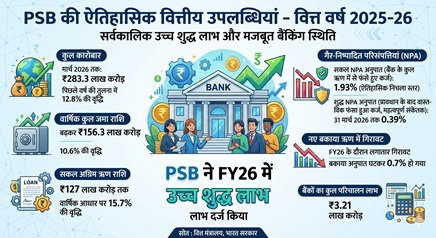
  • Total business, as of March 2026 : increased to ₹283.3 lakh crore, registering 12.8% growth over the previous year
  • Total deposits on annual basis : increased to ₹156.3 lakh crore, showing 10.6% growth
  • Gross advances recorded annual growth : reached ₹127 lakh crore, with 15.7% growth
  • Growth in loans for Retail, Agriculture and Micro, Small & Medium Enterprises (MSMEs) : 18.1%, 15.5% and 18.2% respectively
  • Gross Non-Performing Assets (GNPA) ratio (stressed loans not repaid by borrowers out of total loans) : declined to 1.93%
  • Net NPA ratio (important banking sector indicator showing actual stressed loans after provisioning) : stood at 0.39% as on 31 March 2026
  • During FY26, fresh slippages continued to decline, reducing the slippage ratio to 0.7%
  • Total operating profit of banks : ₹3.21 lakh crore
  • Annual growth in total net profit : 11.1%, reaching a historic high of ₹1.98 lakh crore (fourth consecutive year of profitability)
  • Total CRAR (Capital to Risk Weighted Assets Ratio) : increased to 16.6%
  • Cost-to-income ratio : increased to 49.67%

NPA :

  • Full form of NPA : Non-Performing Asset
  • NPA rule duration : when an installment or interest on a loan remains overdue for 90 days, it is officially declared as NPA.
  • Rule for agricultural loans : for short-term crops, non-payment for 2 crop seasons and for long-term crops, non-payment for 1 crop season makes the loan an NPA.
  • What is a Bad Bank? : It is a financial institution that purchases bad loans (NPAs) from banks so that banks can focus on their core business of lending. India’s official bad bank is NARCL (National Asset Reconstruction Company Limited).

Other Important Banking Terminologies :

  • CRAR / CAR (Capital Adequacy Ratio) : It is the ratio of a bank’s available capital against its risk-weighted assets, which protects banks from insolvency.
  • Twin Balance Sheet Problem : A situation in the Indian economy where both banks (due to NPAs) and private corporate companies (due to excessive debt) face financial stress simultaneously.
  • Wilful Defaulter : A person or entity that deliberately does not repay bank loans despite having the capacity to repay (e.g., Vijay Mallya, Nirav Modi).

Public Sector Banks (PSBs) :

  • These are commercial banks in which 51% or more majority stake is held by the Government of India or public sector undertakings.
  • These banks are regulated by the Reserve Bank of India (RBI).
  • Currently, there are 12 Public Sector Banks operating in India.

State Bank of India (SBI) :

  • Headquarters : Mumbai, Maharashtra
  • Special Fact : It is India’s largest public sector bank in terms of market capitalization and assets.

Punjab National Bank (PNB) :

  • Headquarters : New Delhi
  • Special Fact : Oriental Bank of Commerce and United Bank of India were merged into it.

Bank of Baroda (BoB) :

  • Headquarters : Vadodara, Gujarat
  • Special Fact : Dena Bank and Vijaya Bank were merged into it.

Canara Bank :

  • Headquarters : Bengaluru, Karnataka
  • Special Fact : Syndicate Bank was merged into it.

Union Bank of India :

  • Headquarters : Mumbai, Maharashtra
  • Special Fact : Andhra Bank and Corporation Bank were merged into it.

Indian Bank :

  • Headquarters : Chennai, Tamil Nadu
  • Special Fact : Allahabad Bank was merged into it.

Bank of India (BoI) :

  • Headquarters : Mumbai, Maharashtra

Central Bank of India :

  • Headquarters : Mumbai, Maharashtra

Indian Overseas Bank (IOB) :

  • Headquarters : Chennai, Tamil Nadu

UCO Bank :

  • Headquarters : Kolkata, West Bengal

Bank of Maharashtra :

  • Headquarters : Pune, Maharashtra

Punjab & Sind Bank :

  • Headquarters : New Delhi

Important Facts Related to Indian Banking System

Current RBI Policies and Rates :

  • Latest rates decided by the Monetary Policy Committee (MPC) of RBI :
  • Repo Rate : 5.25% (the rate at which RBI provides short-term loans to commercial banks)
  • Reverse Repo Rate : 3.35% (the rate at which RBI accepts surplus funds from banks)
  • Bank Rate : 5.50% (the rate for long-term loans without any securities/collateral)
  • Cash Reserve Ratio (CRR) : Commercial banks are required to keep a certain percentage of their total deposits with RBI in cash.
  • Statutory Liquidity Ratio (SLR) : Banks are required to maintain a certain portion of deposits in the form of gold, cash or government securities.

History of Indian Banking (Historical Facts) :

  • First bank in India : Bank of Hindustan (1770), established in Calcutta
  • First completely Indian bank : Punjab National Bank (PNB - 1894), with major contribution from Lala Lajpat Rai
  • Presidency Banks : Bank of Bengal (1806), Bank of Bombay (1840) and Bank of Madras (1843)
  • Imperial Bank of India : Formed in 1921 by merging the three Presidency Banks
  • State Bank of India (SBI) : On 1 July 1955, Imperial Bank was nationalized and renamed SBI (on the recommendation of the Gorewala Committee)

Reserve Bank of India (RBI) :

  • Establishment : 1 April 1935 on the recommendation of the Hilton Young Commission (Royal Commission) with an authorized capital of ₹5 crore
  • Nationalisation : 1 January 1949
  • Headquarters : Initially in Calcutta, permanently shifted to Mumbai in 1937
  • First Governor : Sir Osborne Smith
  • First Indian Governor : C. D. Deshmukh
  • Current Governor : Sanjay Malhotra

Nationalisation of Banks :

  • First Phase (19 July 1969) : 14 major private banks were nationalized by the government of Indira Gandhi (banks with deposits above ₹50 crore)
  • Second Phase (15 April 1980) : 6 more private banks were nationalized (banks with deposits above ₹200 crore)

Digital Banking and Payment Systems :

  • Full form of MICR : Magnetic Ink Character Recognition (9-digit code used for cheque scanning)
  • Full form of IFSC : Indian Financial System Code (11-digit alphanumeric code used for fund transfer, first 4 letters represent the bank name)
  • NEFT : National Electronic Funds Transfer (available 24x7 since December 2019)
  • RTGS : Real Time Gross Settlement (minimum transfer limit ₹2 lakh, used for instant large-value transfers)
  • UPI : Unified Payments Interface (developed by National Payments Corporation of India - NPCI)

Special Financial Institutions :

NABARD

• Establishment : 12 July 1982

• Headquarters : Mumbai

• Main Function : Apex bank for rural and agricultural development (on recommendation of the Shivaraman Committee)

SIDBI

  • Establishment : 2 April 1990
  • Headquarters : Lucknow
  • Main Function : Financial assistance to Micro, Small and Medium Enterprises (MSMEs)

EXIM Bank

  • Establishment : 1 January 1982
  • Headquarters : Mumbai
  • Main Function : Promotion of India’s foreign trade (imports and exports)

NHB

  • Establishment : 9 July 1988
  • Headquarters : New Delhi
  • Main Function : Regulating housing finance institutions

Latest Courses