Context :
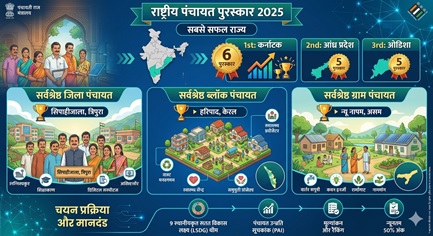
- The Ministry of Panchayati Raj has announced the winners of the ‘National Panchayat Awards 2025’, in which 42 Panchayats from 17 States and Union Territories have been selected.
Key Points :
- Award Ceremony: To be held on 3 June in New Delhi.
- These awards are given for outstanding performance in the localization of Sustainable Development Goals (SDGs) in rural areas.
- Award Categories: Deen Dayal Upadhyay Panchayat Satat Vikas Puraskar and Nanaji Deshmukh Sarvottam Panchayat Satat Vikas Puraskar.
- The Deen Dayal Upadhyay Awards honour outstanding Gram Panchayats that have performed exceptionally well in SDG-related themes such as poverty-free livelihood, health, water sufficiency, sanitation, women-friendly governance, and social justice.
- Under the Nanaji Deshmukh Sarvottam Panchayat Satat Vikas Puraskar, awards are given to the best-performing Panchayats at district, block, and village levels. A total of eight Panchayats have been selected under this category, including three District Panchayats, two Block Panchayats, and three Gram Panchayats.
- Launch of ‘National Panchayat Awards’: These awards were started in 2011.
- Most Successful State: Karnataka secured the first position by winning the highest number of 6 awards.
- Andhra Pradesh and Odisha received 5 awards each.
- Best District Panchayat: Sepahijala, Tripura
- Best Block Panchayat: Harippad, Kerala
- Best Gram Panchayat: New Napam, Assam
Winners of Deen Dayal Upadhyay Panchayat Satat Vikas Puraskar–2025
Poverty-Free and Enhanced Livelihood Panchayat :
- First Position: Karnataka – Mudradi Gram Panchayat (Hebri, Udupi) – ₹1.00 crore
- Second Position: Andhra Pradesh – Chemmullapalli Gram Panchayat (Khajipet, YSR) – ₹0.75 crore
- Third Position: Sikkim – Gyalshing Omchung Gram Panchayat (Gyalshing) – ₹0.50 crore
Healthy Panchayat :
- First Position: Tripura – Kanchanbari Gram Panchayat (Kumarghat, Unakoti) – ₹1.00 crore
- Second Position: Karnataka – Vandse Gram Panchayat (Kundapura, Udupi) – ₹0.75 crore
- Third Position: Kerala – Niranam Gram Panchayat (Pulikeezhu, Pathanamthitta) – ₹0.25 crore
- Third Position: Odisha – Potlampur Gram Panchayat (Chhatrapur, Ganjam) – ₹0.25 crore
Child-Friendly Panchayat :
- First Position: Maharashtra – Itgaon (Pu) Gram Panchayat (Bhandara, Bhandara) – ₹1.00 crore
- Second Position: Karnataka – Halanayakanahalli Gram Panchayat (Bengaluru East, Bengaluru Urban) – ₹0.75 crore
- Third Position: Kerala – Ottur Gram Panchayat (Varkala, Thiruvananthapuram) – ₹0.50 crore
Water-Sufficient Panchayat :
- First Position: Maharashtra – Khariwali Gram Panchayat (Khalapur, Raigad) – ₹1.00 crore
- Second Position: Karnataka – Madamakki Gram Panchayat (Hebri, Udupi) – ₹0.75 crore
- Third Position: Odisha – Padua Gram Panchayat (Champua, Kendujhar) – ₹0.50 crore
Clean and Green Panchayat :
- First Position: Mizoram – Kawrthah North – ₹1.00 crore
- Second Position: Assam – Jumarmur Gram Panchayat (Kathiatoli, Nagaon) – ₹0.375 crore
- Second Position: Odisha – Hathibandha Gram Panchayat (Lathikata, Sundargarh) – ₹0.375 crore
- Third Position: Chhattisgarh – Sardih Gram Panchayat (Bagicha, Jashpur) – ₹0.25 crore
- Third Position: Himachal Pradesh – Lohardi Gram Panchayat (Balh, Mandi) – ₹0.25 crore
Self-Reliant Infrastructure in Panchayat :
- First Position: Kerala – Melukavu Gram Panchayat (Erattupetta, Kottayam) – ₹1.00 crore
- Second Position: Assam – Hugrijan Gram Panchayat (Tengakhat, Dibrugarh) – ₹0.75 crore
- Third Position: Andhra Pradesh – Gundamala Gram Panchayat (Kotha Patnam, Prakasam) – ₹0.25 crore
- Third Position: Karnataka – Sanoor Gram Panchayat (Karkala, Udupi) – ₹0.25 crore
Socially Just and Socially Secure Panchayat :
- First Position: Himachal Pradesh – Shansha Gram Panchayat (Lahaul, Lahaul and Spiti) – ₹1.00 crore
- Second Position: Maharashtra – Chambharli Gram Panchayat (Khalapur, Raigad) – ₹0.375 crore
- Second Position: Odisha – Mandar Gram Panchayat (Polosara, Ganjam) – ₹0.375 crore
- Third Position: Jammu and Kashmir – Wagura Gram Panchayat (BK Pora, Budgam) – ₹0.25 crore
- Third Position: Karnataka – Hakladi Gram Panchayat (Kundapura, Udupi) – ₹0.25 crore
Good Governance Panchayat :
- First Position: Andhra Pradesh – Sringavaram Gram Panchayat (Nathavaram, Visakhapatnam) – ₹1.00 crore
- Second Position: Maharashtra – Nimbale Gram Panchayat (Chandwad, Nashik) – ₹0.75 crore
- Third Position: Telangana – Mothukupalle Gram Panchayat (Kotepally, Vikarabad) – ₹0.50 crore
Women-Friendly Panchayat :
- First Position: Andhra Pradesh – Bokkasam Palem Gram Panchayat (Srikalahasti, Tirupati) – ₹1.00 crore
- Second Position: Jharkhand – Jhikrahati Purvi Gram Panchayat (Pakur, Pakur) – ₹0.75 crore
- Third Position: Telangana – Fasalwadi Gram Panchayat (Sangareddy, Sangareddy) – ₹0.25 crore
- Third Position: Tripura – Baikunthpur Gram Panchayat (Hezamara, West Tripura) – ₹0.25 crore
Nanaji Deshmukh Sarvottam Panchayat Satat Vikas Puraskar–2025
Best District Panchayat :
- First Position: Tripura – Sepahijala – ₹5.00 crore
- Second Position: Odisha – Ganjam – ₹3.00 crore
- Third Position: Tamil Nadu – Coimbatore – ₹2.00 crore
Best Block Panchayat :
- First Position: Kerala – Harippad (Alappuzha) – ₹2.00 crore
- Third Position: Andhra Pradesh – Kuppam (Chittoor) – ₹1.50 crore
Best Gram Panchayat :
- First Position: Assam – New Napam Gram Panchayat (Gabhoru, Sonitpur) – ₹1.50 crore
- Second Position: Bihar – Telkap Gram Panchayat (Rohtas, Rohtas) – ₹1.25 crore
- Third Position: Uttar Pradesh – Birharu Gram Panchayat (Saiyan, Agra) – ₹1.00 crore
Panchayati Raj
Panchayati Raj is a system of rural local self-government in India, which was granted constitutional status through the 73rd Constitutional Amendment Act, 1992.
Three-Tier Structure :
1. Gram Level (Gram Panchayat) :
- Unit: Gram Panchayat
- Head: Mukhiya/Sarpanch/Pradhan (elected directly or indirectly according to state law)
- Members: Ward members elected directly by village voters.
- Role: Implementation of local development schemes and management of basic services such as sanitation, lighting, and water supply.
2. Intermediate Level (Block/Mandal Level) :
- Unit: Panchayat Samiti (also known as Janpad Panchayat or Mandal Parishad in different states)
- Head: Chairperson/Pradhan (elected indirectly by elected members)
- Members: Directly elected representatives along with MLAs and MPs of the area.
- Role: Acts as a link between Gram Panchayats and Zila Parishad and coordinates development schemes at the block level.
3. District Level (District Panchayat) :
- Unit: Zila Parishad
- Head: Chairperson/Chairman (elected indirectly by elected members)
- Members: Directly elected district members, all Panchayat Samiti chairpersons, and MPs/MLAs of the district.
- Role: Supervises activities of Panchayat Samitis, approves budgets, and advises the state government.
Important Committees :
- Balwant Rai Mehta Committee (1957): Recommended the three-tier Panchayati Raj system.
- Ashok Mehta Committee (1977): Recommended a two-tier structure.
- L.M. Singhvi Committee (1986): Strongly recommended constitutional status for Panchayats.
Constitutional Provisions :
- Part of Constitution: Included in Part IX (Articles 243 to 243O) of the Constitution.
- Article 243 (Definitions): Defines important terms such as ‘Gram Sabha’, ‘Panchayat’, and ‘Panchayat Area’.
- Article 243A (Gram Sabha): Gram Sabha is the basic unit of Panchayati Raj and includes all registered voters of the village. Its powers are determined by the State Legislature.
- Article 243B (Constitution of Panchayats): Provides for a three-tier system (village, intermediate, and district levels). Exception: Intermediate level is not mandatory in states with population below 20 lakh.
- Article 243C (Composition of Panchayats): Elections to all seats shall be through direct voting. The procedure for electing chairpersons is decided by the State Legislature.
- Article 243D (Reservation of Seats):
- Reservation for SC/ST in proportion to their population.
- At least one-third (33%) seats reserved for women, including chairperson posts.
- Article 243E (Duration of Panchayats): Tenure of 5 years. If dissolved, elections must be conducted within 6 months.
- Article 243F (Disqualification for Membership): No person above 21 years of age can be disqualified from contesting Panchayat elections.
- Article 243G (Powers, Authority and Responsibilities): Panchayats are empowered to prepare plans for economic development and social justice. Includes 29 subjects of the 11th Schedule.
- Article 243H (Power to Levy Taxes): Panchayats can levy taxes, duties, tolls, and receive grants-in-aid from government funds.
- Article 243I (State Finance Commission): Constituted by the Governor every 5 years to review the financial position of Panchayats.
- Article 243K (State Election Commission): Independent body responsible for conduct, direction, and control of Panchayat elections.
- Article 243O (Bar to Interference by Courts): Courts cannot interfere in matters related to delimitation of constituencies or allocation of seats.


 Don't Have an Account?