08 May, 2026
World Migration Report 2026
Fri 08 May, 2026
Context :
- The International Organization for Migration (IOM) has released the World Migration Report 2026.
Key Points :
- Edition: 13th
- The report is divided into two parts: Part I (Data and Statistics) and Part II (Analysis of complex issues such as climate mobility, impact of AI, and disability).
- The report discusses the growing use of Artificial Intelligence (AI) in migration governance and related challenges such as privacy and bias.
- Analysis: It examines changing migration patterns, economic contributions, and displacement challenges worldwide.
- Migrant Population: By mid-2024, the number of international migrants worldwide reached 304 million, accounting for about 3.7% of the global population.
- Migrant Workers: Around 168 million (60%) of all migrants are migrant workers.
- Remittances: Global remittance flows reached nearly $905 billion in 2024, of which $685 billion went to low- and middle-income countries.
- Top Remittance Recipient: India remained the world’s top remittance recipient with $137.67 billion. (2020: $83.15 billion)
India’s Major Corridors :
- The India-UAE corridor became the world’s fifth-largest migration corridor.
- The India-US corridor is the world’s sixth-largest migration corridor.
- Indian Diaspora: The Indian community is the second-largest foreign-origin group in the United States (about 3.2 million people).
Major Global Migration Corridors :
- Mexico–US: World’s largest corridor (about 11 million migrants)
- Afghanistan–Iran
- Syria–Türkiye
- Russia–Ukraine
- India–UAE
- India–US
The India–US corridor was the world’s sixth-largest migration corridor and the second-largest North America-linked corridor after the Mexico–US corridor.
Strategic Influence of Indian Diaspora (Soft Power) :
- Role of USINPAC: The organization plays a major role in lobbying for Indian interests in the US. It is an example of “Track II Diplomacy,” helping shape visa policies (H-1B) and trade agreements in India’s favor.
- Defence and Technology: The presence of Indian-origin professionals has supported defence and technology cooperation such as iCET (Initiative on Critical and Emerging Technology).
Major Asian Migration Corridors :
- Bangladesh–India (11th largest): Remains South Asia’s largest corridor. Important for UPSC from the perspective of Neighborhood First policy and border management.
- India–Saudi Arabia (14th largest): Strengthens India’s energy security and economic ties with GCC countries. After India–UAE, it is the second most important Gulf migration corridor.
Major Conflicts Contributing to Displacement :
- Sudan: One of the fastest-growing displacement crises in recent years. Millions have fled to Chad, Egypt, and South Sudan.
- Ukraine: Europe’s biggest displacement crisis after the Russian invasion.
- Gaza: Almost the entire population has become internally displaced, creating a severe humanitarian crisis.
- Myanmar: Military coup and Rohingya crisis continue to destabilize Southeast Asia. Important for India and Bangladesh.
- Syria and Yemen: Among the world’s longest-running displacement crises, with millions living as refugees in neighboring countries such as Türkiye and Jordan.
- Democratic Republic of the Congo (DRC): Resource-based conflicts have displaced millions.
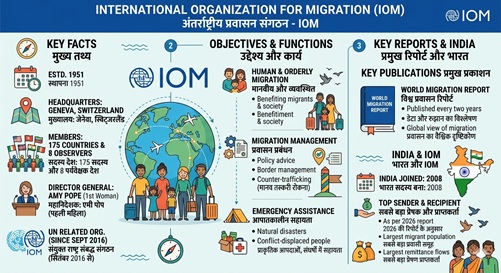
- International Organization for Migration (IOM)
Key Facts :
- Established: 1951
- Headquarters: Geneva, Switzerland
- Membership: 175 member countries and 8 observer countries
- Current Director General: Amy Pope — the first woman to hold this position
- Relation with UN: Became a related organization of the United Nations in September 2016.
- Major Reports and Initiatives :
- World Migration Report: IOM’s flagship publication presenting global migration trends and data.
- Global Compact for Migration (GCM): IOM plays a key role in implementing and reviewing this first intergovernmental migration agreement.
- Displacement Tracking Matrix (DTM): A major IOM tool used to track movements and needs of displaced populations during crises.