Context:
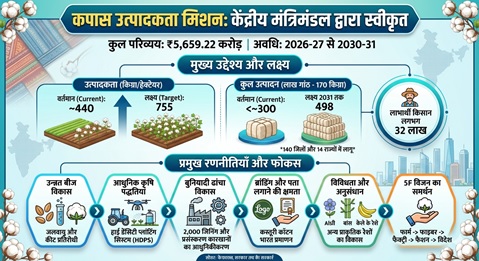
- On 5 May 2026, the Union Cabinet approved the ‘Cotton Productivity Mission’ (2026–27 to 2030–31) with a total outlay of ₹5,659.22 crore.
Key Points:
- Total Outlay: ₹5,659.22 crore
- Duration: 5 years (2026–27 to 2030–31)
- Productivity Target: Increase lint productivity from 440 kg/hectare to 755 kg/hectare
- Production Target: Increase total production to 498 lakh bales (170 kg per bale) by 2030–31
- Beneficiaries: Around 3.2 million (32 lakh) farmers will directly benefit from this mission
Major Strategies and Features:
This mission is based on the Prime Minister’s ‘5F’ vision (Farm to Fibre, Fibre to Factory, Factory to Fashion, Fashion to Foreign):
- Advanced Seed Technology: Development of climate-resilient, high-yielding, and pest-resistant (such as Pink Bollworm-resistant) seed varieties.
Modern Farming Practices:
- HDPS (High-Density Planting System): Increasing yield by planting more plants per unit area.
- ELS (Extra Long Staple) Cotton: Promotion of high-quality long-fibre cotton to reduce import dependence.
Infrastructure and Quality:
- Modernization of about 2,000 ginning and processing units
- Kasturi Cotton Bharat: Branding, traceability, and certification of Indian cotton
- Target to reduce trash content in cotton to below 2%
- Digitization and Market: Digital integration of local mandis for transparent price discovery
- Diversification: Promotion of natural fibres such as flax, bamboo, banana, and sisal
Implementation Mechanism:
- Nodal Ministries: Ministry of Agriculture & Farmers’ Welfare and Ministry of Textiles (jointly)
- Institutional Support: Includes 10 ICAR institutes, 1 CSIR institute, and 10 All India Coordinated Research Project (AICRP) centres
- Geographical Coverage: Initially focused on 140 districts in 14 states
Cotton Productivity Mission:
- Announcement: Union Budget 2025–26
- Budget Outlay: ₹5,659.22 crore
- Time Period: 5 years (2026–27 to 2030–31)
- Nodal Ministries: Ministry of Agriculture + Ministry of Textiles (Jointly)
- Supporting Institutions: 10 ICAR institutes + 1 CSIR institute
- Coverage: 140 districts in 14 states
Cotton:
- Type of Crop: It is a Kharif crop
- Known as: “White Gold”
- India is the second-largest producer and consumer of cotton after China, with the largest cultivation area globally (however, its productivity is relatively low). It contributes about 20% to global cotton production.
- Cotton Producing States: As per 2024–25 estimates, the largest cotton-producing states in India are Maharashtra, Gujarat, Telangana, and Karnataka.
- Most of India’s cotton production comes from 9 major cotton-producing states.
- These are classified into three distinct agro-ecological zones as follows:
Northern Zone: Punjab, Haryana, and Rajasthan
Central Zone: Gujarat, Maharashtra, and Madhya Pradesh
Southern Zone: Telangana, Andhra Pradesh, and Karnataka
- Soil: ‘Regur’ or Black Soil is most suitable, also called cotton soil
- Climate: Tropical and Subtropical (21°C to 30°C temperature)
- Rainfall: 50 to 100 cm
- Special Condition: About 210 frost-free days and bright sunshine are essential during crop maturity
Important Measurements and Institutions:
- Bale: Cotton is measured in ‘bales’; in India, 1 bale = 170 kg
- Uses: Fibre is used in the textile industry, and seeds (binola) are used for oil and cattle feed
Institutions:
- Central Institute for Cotton Research (CICR): Nagpur, Maharashtra
- Cotton Corporation of India (CCI): Navi Mumbai
The Government of India has launched several important initiatives to make the cotton industry globally competitive and increase farmers’ income.
Cotton Development Programme under NFSM (2014–15):
- Implemented under the National Food Security Mission (NFSM) in cotton-growing states to increase productivity
- Objective: Increase per hectare yield through improved agricultural techniques
- Strategy: Focus on frontline demonstrations, farmer training, and Integrated Pest Management (IPM), mainly in rainfed areas
National Technical Textiles Mission (NTTM) – 2020:
- Objective: To make India a global leader in technical textiles (such as medical, military, and automobile-grade fabrics)
- Duration: 4 years (2020–21 to 2023–24)
- Four Pillars: Research & Development (R&D), promotion and market development, export promotion, and education/training
- Goal: Expand the domestic market and reduce dependence on imports of technical textiles
Mega Investment Textile Parks (MITRA):
- Also known as ‘PM MITRA’ scheme to make the Indian textile industry globally competitive
- 5F Vision: Farm to Fibre, Fibre to Factory, Factory to Fashion, Fashion to Foreign
- Facility: Integrated parks where spinning, weaving, processing, and printing are located at one place, significantly reducing logistics cost
Cott-Ally Mobile App:
- A digital platform developed by the Cotton Corporation of India (CCI)
- Benefit: Farmers can get information about crop sale status, payments, nearby procurement centres, and cotton quality on their phones
- Transparency: Helps reduce middlemen and ensures direct MSP benefits to farmers
Committee on Cotton Production and Consumption (COCPC):
- An advisory body under the Ministry of Textiles (earlier known as the Cotton Advisory Board)
- Function: Prepares official data/estimates on production, consumption, imports, and exports of cotton
- Importance: Its reports help the government in policy decisions like export policy and market intervention (such as MSP operations), ensuring coordination among government, industry, and farmers


 Don't Have an Account?