20 April, 2026
India’s First Integrated Basmati and Organic Training-cum-Demonstration Farm
Tue 05 May, 2026
Context:
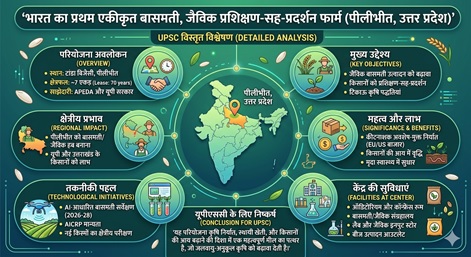
- India’s first integrated basmati and organic training-cum-demonstration farm will be established in Pilibhit, Uttar Pradesh.
Key Points:
- Objective: To provide training and demonstration of traditional and organic basmati farming, benefiting farmers of Uttar Pradesh and Uttarakhand.
- Agreement for Establishment: A lease agreement of 70 years has been signed between the Agricultural and Processed Food Products Export Development Authority and the Agriculture Department of the Uttar Pradesh Government.
- Area and Investment: The center will be developed on approximately 7 acres of land with an investment of around ₹15 crore.
- Facilities: The center will include a laboratory, museum, auditorium, and an AICRP (All India Coordinated Research Project) center for basmati.
- AI Survey: Along with this project, the first AI-based basmati survey (2026–2028) has also been launched, which will cover 4 million hectares.
Regional Impact:
- Pilibhit will be developed as a hub for basmati and organic farming, benefiting not only Uttar Pradesh but also farmers of Uttarakhand.
- The center will act as a dedicated outlet for seed production and quality organic inputs.
Note: This initiative aligns with the government’s vision of “Vocal for Local” and organic farming. It will not only technologically enhance agricultural production but also empower small farmers’ livelihoods through climate-smart agriculture, providing a sustainable base for exports.
Basmati Rice:
- It is one of India's most significant agricultural export products. To uphold its quality and global demand, the Government of India and APEDA (Agricultural and Processed Food Products Export Development Authority) have launched several strategic initiatives and schemes.
Institutional Framework:
- Basmati Export Development Foundation (BEDF): This is an autonomous body established by APEDA. Its primary mandate is to maintain the purity of Basmati, provide training to farmers, and raise awareness regarding export standards (such as pesticide residue control).
- GI Tag for Basmati Rice: India has secured a Geographical Indication (GI) tag for Basmati rice. Currently, this covers specific regions across 7 states (Punjab, Haryana, Himachal Pradesh, Delhi, Uttarakhand, Western Uttar Pradesh, and certain parts of Jammu & Kashmir). This designation prevents the misuse of the name 'Basmati' in the global market.
Export Promotion & Quality Control:
- Pesticide Residue Management: To meet the stringent standards set by nations such as the European Union (EU) and the USA, the government is actively promoting Integrated Pest Management (IPM). Farmers are encouraged to limit their use of chemicals such as Tricyclazole and Buprofezin.
- Traceability System: Digital platforms—such as 'Basmati.net'—are utilized for Basmati exports, enabling the monitoring of the product's journey from the farm to the international market.
Major Government Schemes:
- Agri Export Policy (2018): The objective of this policy is to double the exports of 'strategic products'—such as Basmati—and to address and resolve bottlenecks within the export value chain.
- Paramparagat Krishi Vikas Yojana (PKVY): This scheme promotes the production of Organic Basmati. The new farm currently being established in Pilibhit represents a significant step forward in this direction. Rashtriya Krishi Vikas Yojana (RKVY): Through this scheme, financial assistance is provided to states for the establishment of Basmati processing units and seed production centers.
Technological and Digital Initiatives:
- AI-based Basmati Paddy Survey (2026-28): Recently, APEDA announced the launch of AI-based crop mapping to accurately estimate the crop's acreage, health, and yield.
- Development of Improved Varieties: ICAR-IARI (Indian Agricultural Research Institute) has developed varieties such as 'Pusa Basmati 1121', 'Pusa Basmati 1509', and—most recently—'Pusa Basmati 1847' (which is resistant to leaf blight), thereby enhancing both yield and quality.
International Market Access:
- Rice Export Promotion Forum (REPF): The government has constituted this forum to facilitate coordination among all stakeholders involved in rice exports, with the aim of resolving logistical and global trade-related bottlenecks.
About APEDA:
- It is a statutory body under the Ministry of Commerce and Industry.
- Established: In 1986 under the APEDA Act, 1985.
- Nodal Ministry: Ministry of Commerce and Industry.
- Headquarters: New Delhi.