20 April, 2026
Reconstitution of Four Major Parliamentary Committees
Sat 02 May, 2026
Context :
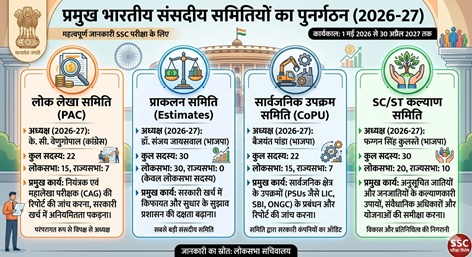
- Om Birla, the Speaker of Lok Sabha, reconstituted four major Parliamentary Committees (three financial and one standing committee) for the year 2026–27.
Reconstituted Major Committees and their Chairpersons (2026–27):
- Public Accounts Committee (PAC):
- Chairman: K. C. Venugopal (Congress)
- Composition: It consists of a total of 22 members (15 from Lok Sabha and 7 from Rajya Sabha)
- Main Function: Examines the Appropriation Accounts of the Government of India and the reports of the Comptroller and Auditor General (CAG)
Estimates Committee:
- Chairman: Sanjay Jaiswal (BJP)
- Composition: It is the largest Parliamentary Committee with 30 members, all elected from Lok Sabha
- Main Function: Examines budget estimates and suggests measures for economy in public expenditure
- Committee on Public Undertakings:
- Chairman: Baijayant Panda (BJP)
- Composition: It consists of 22 members (15 from Lok Sabha and 7 from Rajya Sabha)
- Main Function: Examines accounts and reports of Public Sector Undertakings (PSUs)
- Committee on Welfare of Scheduled Castes and Scheduled Tribes:
- Chairman: Faggan Singh Kulaste (BJP)
- Composition: It consists of a total of 30 members (20 from Lok Sabha and 10 from Rajya Sabha)
- Main Function: Monitors implementation of constitutional and legal safeguards for SCs and STs
-
- Tenure: These standing committees generally have a tenure of 1 year.
- Appointment: The Chairpersons are appointed by the Speaker of Lok Sabha.
- Convention: The Chairman of the Public Accounts Committee is usually from the opposition party.
- Eligibility: No minister can be a member of these committees.
Constitutional Basis :
- Article 105: Relates to the privileges of Members of Parliament and powers of committees.
- Article 118: Empowers Parliament to make rules for regulating its procedure and conduct of business; committees are constituted under these rules.
Detailed Working of Committees :
- These committees function as a “Mini-Parliament”. Their working involves the following key stages:
- Election and Appointment: Members are elected through the system of proportional representation, ensuring representation of all parties according to their strength. The Chairman is appointed by the Speaker.
- Restriction on Ministers: No minister can be made a member of these financial committees to ensure impartial scrutiny of the executive.
- Examination of Evidence: Committees can summon government officials, question them, and demand files or documents.
- Report Preparation: After detailed discussion and examination, committees present their reports before the House (Lok Sabha/Rajya Sabha).
- Advisory Nature: Recommendations of these committees are not binding on the government but are taken very seriously.
Specific Functions of Major Committees :
| Committee | Nature of Work |
| Public Accounts Committee (PAC) | Examines the CAG reports in detail and ensures that money is spent for the purpose approved; known as the “watchdog of Parliament”. |
| Estimates Committee | Examines budget estimates and aims to bring economy in administration; also known as the “continuous economy committee”. |
| Committee on Public Undertakings | Examines whether public sector enterprises (e.g., ONGC, BHEL) are run on sound business principles and prudent practices. |