20 April, 2026
Citizenship (Amendment) Act, 2026
Fri 01 May, 2026
Context :
- The Central Government has notified the Citizenship (Amendment) Act, 2026, which primarily amends the Citizenship Rules, 2009.
Key Points :
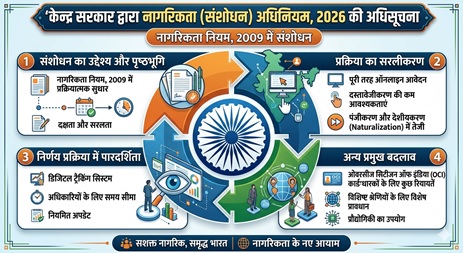
- Primary Objective: To digitize and streamline processes for Overseas Citizen of India (OCI) cardholders, making them simpler, transparent, and faster.
- It includes revised provisions related to OCI cardholders and citizenship applications.
Major Provisions and Changes :
- Complete Digitization of OCI Registration: The entire process of obtaining an OCI card will now be online through a new portal (ociservices.gov.in).
- Introduction of e-OCI: Along with the traditional physical card, OCI cardholders can now also obtain their status in electronic (e-OCI) form.
- Restriction on Dual Passports for Minors: As per new rules, minor children born outside India cannot hold both an Indian passport and a passport of another country simultaneously. They are allowed to hold only one passport at a time.
- Digital Renunciation: The process of renouncing OCI status has been simplified and allowed in digital form; however, submission of the physical card remains mandatory.
- Biometric Fast Track Immigration (FTI): OCI applicants are given the option to consent to sharing biometric information, enabling faster immigration processing at airports.
- Cancellation Process: If the government cancels OCI registration, the concerned individual must mandatorily return the card.
Policy Analysis :
- Transparency and Simplicity: The rules aim to reduce bureaucratic procedures and make processes related to citizenship and OCI faster and more transparent.
- Security and Integrity: By restricting dual passports for minors, the government strengthens the integrity of Indian citizenship and addresses national security concerns.
- Digital India Initiative: These changes align with the Digital India initiative, promoting accessible and digitized government services.
- Citizenship Act, 1955: The amendment modifies rules framed under the Citizenship Act, 1955.
- Definition and Rights of OCI: OCI is a foreign citizen of Indian origin who gets a lifelong visa and economic/educational benefits similar to NRIs but does not have political rights (like voting).
- Termination of Citizenship: Any person who voluntarily renounces Indian citizenship or whose OCI status is cancelled must comply with the relevant rules.
Overseas Citizen of India (OCI) Scheme :
- A multipurpose visa status that allows foreign citizens of Indian origin to live and work in India.
- Introduced through the Citizenship (Amendment) Act, 2005 under the Citizenship Act, 1955.
- In 2015, the Person of Indian Origin (PIO) Card scheme was merged with it.
Eligibility :
- A person who was a citizen of India on or after 26 January 1950.
- A person who was eligible to become a citizen of India at that time.
- Children, grandchildren, or great-grandchildren of such persons.
- Foreign-origin spouse of an Indian citizen or OCI cardholder (provided the marriage has subsisted for at least 2 years).
- Exception: Persons who have ever been citizens of Pakistan, Bangladesh, or any other country as notified by the Government are not eligible.
Benefits :
- Lifelong Visa: Multiple-entry, multipurpose, lifelong visa for visiting India.
- Exemption from Police Reporting: No requirement to register with local police authorities (FRRO), regardless of duration of stay.
- Economic and Educational Parity: Same financial, economic, and educational rights as NRIs (except purchase of agricultural land).
- Domestic Airfare: Same airfare as Indian citizens for domestic flights within India.
- Entry Fees: Same entry fees as Indians for national parks, museums, and monuments.
Restrictions (What They Cannot Do) :
- Right to Vote: OCI cardholders cannot vote in India.
- Public Office: They cannot become President, Vice-President, Judges of Supreme Court/High Court, or Members of Parliament/Legislature.
- Government Jobs: Not eligible for public services (government jobs).
- Agricultural Land: Cannot purchase agricultural or plantation property in India.
- Restricted Areas: Require special permits (PAP/RAP) to visit restricted/protected areas (e.g., Ladakh or parts of the North-East).
Essential Facts :
- No Dual Citizenship: India does not allow dual citizenship.
- OCI is only a special visa status, not citizenship.
- Application Process: Completely online (at ociservices.gov.in).
- Cancellation: OCI can be cancelled if obtained fraudulently or if the cardholder shows disrespect to the Constitution of India.