GK Update
 
  • Mobile Menu
HOME BUY MAGAZINEnew course icon
LOG IN SIGN UP

Sign-Up IcanDon't Have an Account?


SIGN UP


Login Icon

Have an Account?


LOG IN
 

or
By clicking on Register, you are agreeing to our Terms & Conditions.


or


GK Update

Wed 29 Apr, 2026

National News

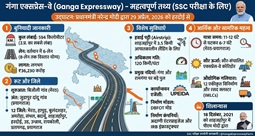
Inauguration of the Ganga Expressway

  • Prime Minister Narendra Modi inaugurated the Ganga Expressway on April 29, 2026, from Hardoi district in Uttar Pradesh.

Related Facts:

  • The 594-kilometer-long expressway is the longest in Uttar Pradesh and connects Meerut in western UP to Prayagraj in eastern UP.

Basic Information:

  • Total Length: 594 km (Longest expressway in Uttar Pradesh)
  • Lanes: Currently 6-lane (expandable to 8-lane in future)
  • Cost: Approximately ₹36,230 crore
  • Inauguration Date: April 29, 2026 (by Prime Minister Narendra Modi from Hardoi)
  • Foundation Stone Laid: December 18, 2021 (in Shahjahanpur by PM Narendra Modi)

Route & Districts:

  • Starting Point: Bijoli village (Meerut)
  • Ending Point: Judapur Dandu village (Prayagraj)
  • Total Districts (12): Meerut, Hapur, Bulandshahr, Amroha, Sambhal, Badaun, Shahjahanpur, Hardoi, Unnao, Raebareli, Pratapgarh, and Prayagraj
  • Connectivity: Links western Uttar Pradesh with eastern Uttar Pradesh

Special Features:

  • Airstrip: A 3.5 km long airstrip has been built in Shahjahanpur for emergency landings
  • Maximum Speed: 120 km/h for vehicles
  • Major Rivers: Passes over major bridges on the Ganga and Ramganga rivers
  • Implementing Agency: Uttar Pradesh Expressways Industrial Development Authority
  • Construction Model: DBFOT (Design, Build, Finance, Operate, and Transfer)
  • Construction Companies: Adani Enterprises and IRB Infrastructure Developers

Economic and Strategic Significance:

  • Travel Time: Travel time between Meerut and Prayagraj will reduce from 11–12 hours to about 6–7 hours
  • Solar Energy: Proposed to be developed as a “solar-powered expressway corridor”
  • Industrial Corridor: Plan to develop 12 Integrated Manufacturing and Logistics Clusters (IMLCs) along the expressway

‘Namo Stall Distribution Scheme’

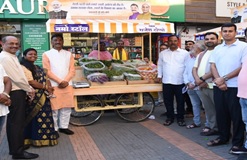
  • Union Minister of State for Defence, Sanjay Seth, launched the ‘Namo Stall Distribution Scheme’ for fruit and vegetable vendors in Ranchi.
  • In the first phase, free stalls worth ₹50,000 each have been provided to five vendors.

Key Facts:

  • Objective: To prevent street vendors from sitting near open drains or in unsafe roadside conditions, to improve their livelihoods, and to facilitate smoother city traffic flow.
  • Implementation: The distribution of the scheme commenced from the MP's Office in Argora (Ranchi). In the first phase, the selected vendors were provided with these stalls free of cost.
  • Eligibility and Priority: Priority is being accorded to women and persons with disabilities under this initiative.
  • Conditions: Beneficiaries receiving a stall are neither permitted to sell it for the next five years nor to alter the contact details inscribed on the stall.
  • This initiative aligns with the objectives of the PM SVANidhi Scheme, which focuses on providing financial and social security to small traders.

Jharkhand:

  • Formation: November 15, 2000 (Separated from Bihar on the birth anniversary of Lord Birsa Munda to become the 28th state of India).
  • Capital: Ranchi (The City of Waterfalls).
  • Sub-capital: Dumka.
  • Literacy Rate: 66.41% (Male: 76.84%, Female: 55.42%).
  • State Animal: Elephant (Elephas maximus indicus*).
  • State Bird: Koel (Eudynamys scolopaceus).
  • State Flower: Palash (Butea monosperma).
  • State Tree: Sal (Shorea robusta).
  • Major Rivers: Damodar (the longest river), Subarnarekha, Barakar, North Koel, South Koel, and Ajay.
  • Dhanbad is known as the "Coal Capital of India."
  • Mineral Reserves: Jharkhand alone accounts for approximately 40% of India's total mineral resources.

Patent Applications in FY 2025-26

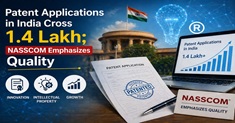
  • In India, the number of patent applications filed during the financial year 2025-26 has crossed the 140,000 mark.
  • Patent applications witnessed a growth of 30.2% in FY26, whereas this growth stood at 19.8% in FY25.

Key Facts:

  • A major driver behind this surge was the rise in applications originating from within the country (resident filings), which recorded a growth of 46.2% in FY26.
  • Indian applicants—comprising startups, MSMEs, educational institutions, and individual innovators—accounted for approximately 70% of the total applications.
  • The share of patents related to computer technology also rose to 19.1%.
  • In FY26, approximately 21,400 patents were granted, compared to 33,500 in FY25.

Launch of Asia's First UNESCO Chair

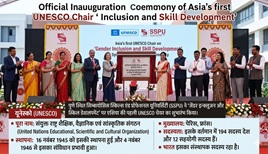
  • Pune-based Symbiosis Skills and Professional University (SSPU) has launched Asia's first UNESCO Chair on 'Gender Inclusion and Skill Development'.

Key Facts:

  • Main Objective: To reduce the prevailing gender gap in technical and vocational education and to empower women to play leading roles in emerging economic sectors.
  • Focus on Sunrise Sectors: This Chair will primarily focus on the skill development of women in new-age sectors such as Semiconductors, Advanced Manufacturing, AI (Artificial Intelligence), Robotics, and Defense Technology.
  • Leadership: This initiative is being led by SSPU's Pro-Chancellor, Dr. Swati Mujumdar.
  • Inauguration: The Chair was formally inaugurated by Jayant Chaudhary, the Union Minister of State for Skill Development and Entrepreneurship.
  • International Conference: The announcement was made during an international conference held on the theme "Women Leading the Future of Work."
  • SDG 5 and 8: This initiative is a significant step towards achieving the United Nations' Sustainable Development Goals (SDGs), specifically Gender Equality (SDG 5) and Decent Work and Economic Growth (SDG 8).

UNESCO:

  • Full Name: United Nations Educational, Scientific and Cultural Organization.
  • Establishment: It was established on November 16, 1945, and its Constitution came into force on November 4, 1946.
  • Headquarters: Paris, France.
  • Membership: It currently has 194 member states and 12 associate members. India has been a founding member.

'Annu' AI Software

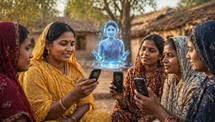
  • Hyderabad-based company 'B-Well' has developed an AI software named 'Annu' to address the health issues faced by rural women and adolescent girls.

Key Facts:

  • Objective: To provide easy, accessible, and private consultation regarding health-related issues to women and adolescent girls in rural India.
  • Technology (AI): This is an AI-based tool designed specifically with the needs of rural environments in mind.
  • Targeted Issues: It offers awareness and advice regarding menstrual health, nutrition, reproductive health, and other health issues among rural women that are typically overlooked.

Significance:

  • Helps address the shortage of specialists (gynecologists) in rural areas.
  • Reduces hesitation regarding health-related matters.
  • Promotes digital literacy and the democratization of healthcare services.

International News

Announcement to Exit OPEC and OPEC+

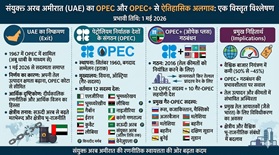
  • The United Arab Emirates has announced its decision to exit the Organization of the Petroleum Exporting Countries and the broader OPEC+ alliance, effective from May 1, 2026.

Related Facts:

  • Effective Date: The withdrawal will come into effect from May 1, 2026.
  • Membership History: The UAE (through Abu Dhabi) joined OPEC in 1967.

Reasons for Exit:

  • Production Capacity: The UAE aims to expand its oil production capacity, which was restricted due to OPEC’s strict quotas.
  • Economic Perspective: The decision aligns with the country’s long-term strategic and economic vision, focusing on flexibility in response to changing market dynamics.
  • Regional Tensions: Analysts also link this move to rising differences with Saudi Arabia and shifting geopolitics in the region, including tensions involving Iran.
  • Founding Members of OPEC: Iran, Iraq, Kuwait, Saudi Arabia, and Venezuela

About OPEC:

  • Establishment: September 1960 at the Baghdad Conference in Baghdad
  • Headquarters: Vienna (Austria itself is not a member)
  • Current Members (12):
  • Algeria, Equatorial Guinea, Gabon, Iran, Iraq, Kuwait, Libya, Nigeria, Republic of the Congo, Saudi Arabia, United Arab Emirates, Venezuela

About OPEC+:

  • Formation: 2016, when OPEC partnered with Russia and other nations to control falling oil prices
  • Composition: Includes 12 OPEC members (as of May 2026) and 10 non-OPEC countries
  • Major Non-OPEC Members: Russia (most significant), Kazakhstan, Mexico, Azerbaijan, Malaysia, Oman, Bahrain, Brunei, South Sudan, and Sudan

Nepal Opposes Construction of Security Wall
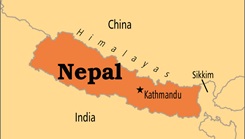
  • Nepal has strongly opposed the construction of a security wall being built by China on the Chinese side of the Nepal-China border, along the banks of the Bhote Koshi River.

Relevant Facts:

  • Violation of the 1963 Boundary Protocol: Nepali officials argue that this construction work constitutes a violation of the 1963 Boundary Protocol. According to this protocol, it is mandatory for both countries to inform each other before constructing any structure near the international border.
  • Fear of Alteration in the River's Course: Nepal apprehends that the construction of this wall could alter the natural flow of the Bhote Koshi River. This could heighten the risk of large-scale landslides and flooding in Nepali territory during the monsoon season.
  • Location: This disputed area is situated near the Tatopani border point in the Sindhupalchok district.

Nepal:

  • Official Name: Federal Democratic Republic of Nepal
  • Capital: Kathmandu (Situated on the banks of the Bagmati River)
  • Currency: Nepali Rupee (NPR)
  • Official Language: Nepali
  • Name of Parliament: Federal Parliament (Bicameral). It consists of two houses—the House of Representatives (275 members) and the National Assembly (59 members).
  • President: Ram Chandra Poudel
  • Prime Minister: Balendra Shah
  • Borders: Nepal is a landlocked country. It is bordered by China (Tibet) to the north, and by India to the south, east, and west.
  • Indian States: Nepal shares its border with five Indian states—Uttar Pradesh, Uttarakhand, Bihar, Sikkim, and West Bengal.
  • World's Highest Peak: Mount Everest (8,849 meters) is located in Nepal, where it is known locally as 'Sagarmatha'. Major Rivers: Koshi (Nepal's largest river), Gandaki, and Karnali (Nepal's longest river).
  • Lumbini: The birthplace of Lord Buddha, located in southern Nepal.
  • Pashupatinath Temple: A renowned temple dedicated to Lord Shiva, situated in Kathmandu, which is a UNESCO World Heritage Site.
  • Major Festivals: Dashain, Tihar, Losar, and Holi.
  • The 'Treaty of Peace and Friendship' between India and Nepal was signed in 1950.
  • Surya Kiran: An annual joint military exercise conducted between India and Nepal. (The 19th edition was held in Pithoragarh, Uttarakhand.)

Appointments

Dr. Nikhil Tandon

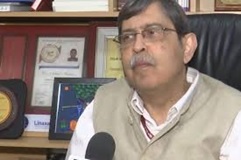
  • The All India Institute of Medical Sciences (AIIMS), Delhi, has appointed Dr. Nikhil Tandon as the Institute's Interim (Acting) Director.

Key Facts:

  • Reason: This appointment follows the departure of the previous Director, Dr. M. Srinivas, who has been appointed as a Full-time Member at NITI Aayog.
  • Tenure: Dr. Tandon will serve in this capacity for a period of six months or until the appointment of a regular Director, whichever occurs earlier.
  • Specialization: Dr. Nikhil Tandon is a renowned endocrinologist and has also been honored with the Padma Shri award.
  • Regulation: This appointment has been made as a 'Working Arrangement' under Rule 9(4) of the AIIMS Regulations, 2019.

AIIMS:

  • The All India Institute of Medical Sciences (AIIMS) is a group of India's most prestigious medical institutions, accorded the status of 'Institutes of National Importance.'
  • Establishment: The first AIIMS (AIIMS Delhi) was established in 1956 through an Act of Parliament (the AIIMS Act, 1956).
  • Autonomous Body: AIIMS functions as an autonomous institution under the Ministry of Health and Family Welfare.

Dinesh Trivedi

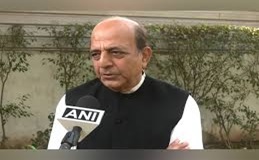
  • Former Union Minister and Bharatiya Janata Party (BJP) leader Dinesh Trivedi has been appointed as India's next High Commissioner to Bangladesh.

Key Facts:

  • Non-IFS Appointment: Dinesh Trivedi's appointment is a political appointment. Typically, heads of foreign missions are Indian Foreign Service (IFS) officers; however, entrusting this responsibility to an experienced politician like Trivedi underscores the strategic importance of Bangladesh to India.
  • Successor to: He will replace Pranay Verma, who has now been appointed as India's Ambassador to the European Union (EU) and Belgium.
  • Experience: Dinesh Trivedi has served in the Central Government as the Minister of Railways (2011) and as the Minister of State for Health and Family Welfare.

Bangladesh:

  • Capital: Dhaka
  • Prime Minister: Tarique Rahman. He assumed office on February 17, 2026, after his party, the BNP, secured a landslide victory in the elections.
  • President: Mohammed Shahabuddin
  • Parliament: 'Jatiya Sangsad'. It comprises a total of 350 seats (300 elected + 50 reserved for women).
  • Borders: Bangladesh is bordered by India on three sides and shares a border with Myanmar in the southeast.
  • Border with India: It shares the longest land border (4,096.7 km) with India. Indian States: West Bengal, Assam, Meghalaya, Tripura, and Mizoram.
  • Rivers: It is known as the "Land of Rivers." Major Rivers: Padma (the main course of the Ganges), Jamuna (the Brahmaputra), and Meghna.
  • Sundarbans: Home to the world's largest mangrove forest.
  • Independence: March 26, 1971 (from Pakistan). India played a pivotal role in its liberation through the 1971 war.
  • National Anthem: 'Amar Sonar Bangla' (written by Rabindranath Tagore).

Sports News

Inauguration of MNCA's State-of-the-Art Indoor Cricket Academy
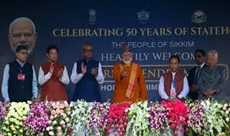
  • Prime Minister Narendra Modi virtually inaugurated the Manipur Cricket Association's (MNCA) state-of-the-art Indoor Cricket Academy.
  • This academy is situated within the premises of the Luwangpokpa Cricket Stadium in Imphal.
Regional Expansion: It is part of a network of six indoor academies launched simultaneously across six states of Northeast India (Manipur, Arunachal Pradesh, Meghalaya, Mizoram, Nagaland, and Sikkim).

Important Days

'International Dance Day'

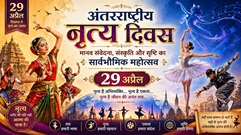
  • 'International Dance Day' is celebrated annually on April 29th with the objective of honoring the art of dance and promoting its significance.

Related Facts:

  • Establishment: In 1982, by the Dance Committee of the ITI (International Theatre Institute).
  • Objective: To raise awareness regarding the art of dance and to promote it as a universal language.
  • In whose memory?: On the occasion of the birth anniversary of Jean-Georges Noverre, the pioneer of modern ballet.
  • This day is organized by the 'International Theatre Institute' (ITI), a key partner organization of UNESCO.
  • The International Dance Council (CID) also collaborates in its promotion and dissemination.

Indian Classical Dances:

  • According to the Sangeet Natak Akademi, there are 8 classical dance forms in India:
  • Bharatanatyam (Tamil Nadu)
  • Kathak (Uttar Pradesh)
  • Kathakali (Kerala)
  • Kuchipudi (Andhra Pradesh)
  • Odissi (Odisha)
  • Manipuri (Manipur)
  • Mohiniyattam (Kerala)
  • Sattriya (Assam)
  • UNESCO's list holds immense significance in the context of dance. Recently, India's Garba (Gujarat) was included in this list in 2023. Prior to this, Chhau dance and Kalbelia had also been included.
  • In India, the credit for modern dance is attributed to Uday Shankar, who developed a new style by blending Indian classical dance forms with Western techniques.

Reports and Indices

SIPRI Report

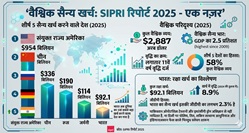
  • According to the Stockholm International Peace Research Institute (SIPRI), India spent $92.1 billion on defense in the year 2025.

Related Facts:

  • Global Ranking: India has now become the world's 5th largest military spender.
  • Increase in Spending: Compared to the year 2024, India's military expenditure has increased by 8.9%.

Top 5 Countries:

  • These 5 countries account for 58% of global military spending.
  • United States ($954 billion)
  • China ($336 billion)
  • Russia ($190 billion)
  • Germany ($114 billion)
  • Share of GDP: India's military expenditure constitutes approximately 2.3% of its GDP.
  • Reference Year: 2025
  • Total Global Expenditure: $2,887 billion
  • Growth Trend: Growth recorded for the 11th consecutive year.
  • Global Military Burden: 2.5 percent of GDP (the highest since 2009).

Economy and Banking

MobiKwik Approved to Obtain NBFC License
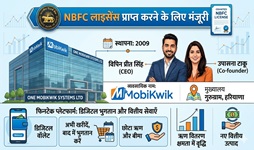
  • The Reserve Bank of India (RBI) has granted approval to One MobiKwik Systems Ltd to obtain a Non-Banking Financial Company (NBFC) license.

Key Highlights:

  • New Subsidiary: MobiKwik will commence its lending operations through its wholly-owned subsidiary, MobiKwik Financial Services Private Limited (MFSPL).
  • Approval Timeline: This license was secured within just four months of the application, reflecting regulatory confidence.
  • Proposed Products: The company will focus on offering both secured and unsecured credit products to consumers and Micro, Small, and Medium Enterprises (MSMEs).
  • Operational Conditions: Actual lending operations will commence only after obtaining a Certificate of Registration (CoR) from the RBI and fulfilling other regulatory conditions.

Non-Banking Financial Company (NBFC):

  • An entity registered under the Companies Act, 1956/2013, that provides banking-like financial services despite not holding a full banking license.
  • Registration: These companies are registered with the Reserve Bank of India under Section 45-IA of the RBI Act, 1934.
  • Principal Business (50-50 Test): A company is classified as an NBFC if its financial assets constitute more than 50% of its total assets, and the income derived from those assets exceeds 50% of its gross income.
  • Services: They engage in activities such as lending (loans), the acquisition of shares/bonds, leasing, insurance, and chit fund business.

Key Differences Between Banks and NBFC:

  • Banks can accept demand deposits (such as savings accounts), whereas NBFCs cannot.
  • Banks can issue checks drawn on themselves, whereas NBFCs are not part of the payment system and cannot issue checks. Depositors in banks receive insurance coverage of up to ₹5 lakh under the Deposit Insurance and Credit Guarantee Corporation, whereas no such insurance protection exists for NBFCs.
  • It is mandatory for banks to maintain a Cash Reserve Ratio (CRR), whereas this is not required for NBFC.

One MobiKwik Systems Limited:

  • Trade Name: MobiKwik
  • It is one of India's leading fintech platforms, operating in the digital payments and financial services sectors.
  • MobiKwik was founded in 2009 by Bipin Preet Singh and Upasana Taku.
  • Founders: Bipin Preet Singh (CEO) and Upasana Taku (Co-founder).
  • Headquarters: Gurugram, Haryana


Latest Courses