GK Update
 
  • Mobile Menu
HOME BUY MAGAZINEnew course icon
LOG IN SIGN UP

Sign-Up IcanDon't Have an Account?


SIGN UP


Login Icon

Have an Account?


LOG IN
 

or
By clicking on Register, you are agreeing to our Terms & Conditions.


or


GK Update

Sun 19 Apr, 2026

National News

Launch of the ‘Vishwa Sutra – India’s Weave for the World’ Initiative
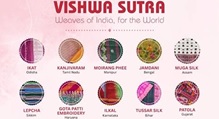
  • The Office of the Development Commissioner for Handlooms, under the Union Ministry of Textiles, has launched an initiative titled ‘Vishwa Sutra – India’s Weave for the World’.

Key Highlights:

  • Objective: To garner international recognition for the diversity of Indian handlooms and the artistry of its weavers, while simultaneously enhancing their visibility among the youth and within the fashion fraternity.
  • Partnership: For this initiative, the Ministry of Textiles has collaborated—for the very first time—with ‘Femina Miss India’ (61st Edition).
  • Creative Concept: The initiative incorporates handloom weaves from 30 distinct states (such as Varanasi Brocade, Kanchipuram, Patola, Pashmina, etc.). The weave from each state has been presented as a contemporary design, drawing inspiration from the cultural aesthetics of 30 different countries.
  • Strategic Approach: This initiative aligns with the government’s ‘Vocal for Local to Global’ campaign and its ‘5F’ vision (Farm to Fibre to Factory to Fashion to Foreign). Some prominent weaving styles included: Ikat – Odisha, Kanjeevaram – Tamil Nadu, Moirang Phee – Manipur, Jamdani – Bengal, Muga Silk – Assam, Lepcha – Sikkim, Gota Patti – Haryana, Ilkal – Karnataka, Tussar – Bihar, Patola – Gujarat, Banarasi – Uttar Pradesh, Pashmina – Leh, Uppada – Andhra Pradesh, Ryndia – Meghalaya, Kota Doria – Rajasthan, Naga Mekhela – Nagaland, Panchachuli – Uttarakhand, Monpa – Arunachal Pradesh, Kunbi – Goa, Kasavu – Kerala, Tripura Silk – Tripura, Maheshwari – Madhya Pradesh, Kullu – Himachal, Pochampally – Telangana, Kosa – Chhattisgarh, Puan – Mizoram, Ghicha – Jharkhand, Paithani – Maharashtra, Phulkari – Punjab, Khunn – Karnataka.

PM Vishwakarma Scheme

  • Under the PM Vishwakarma Scheme, the Union Ministry of Micro, Small and Medium Enterprises (MSME) has so far trained over 2,500 artisans and craftspeople in the use of Artificial Intelligence (AI) tools.
  • The objective of this initiative is to empower traditional artisans and craftspeople by enhancing their livelihoods and professional capabilities through technology.
  • This initiative aligns with the vision of "AI for Social Good," which was emphasized by the Honorable Prime Minister during the IndiaAI Impact Summit and is also reflected in the Delhi Declaration.

PM Vishwakarma Scheme:

  • Launch: 2023
  • Type: Central Sector Scheme
  • Financial Outlay: A budget of ₹13,000 crore over a period of 5 years (2023-24 to 2027-28)
  • Target Beneficiaries: Artisans associated with 18 traditional trades (such as carpenters, blacksmiths, potters, sculptors, etc.)
  • In terms of pan-India coverage, Telangana led the way with 387 beneficiaries, followed by Maharashtra (295), Gujarat (262), Rajasthan (251), Bihar (250), Karnataka (248), and Uttar Pradesh (210); the total number of beneficiaries across various states and Union Territories amounted to 2,543.

Approval for the Formation of the 'India Marine Insurance Pool'
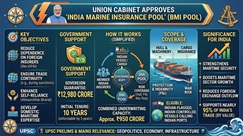
  • The Union Cabinet, chaired by Prime Minister Narendra Modi, has approved the formation of the 'India Marine Insurance Pool' (BMI Pool).
  • Its primary objective is to ensure affordable and continuous marine insurance coverage for Indian trade, notwithstanding global geopolitical instability.

Key Facts:

Financial Structure and Administration:

  • Sovereign Guarantee: The Pool is backed by a government guarantee of ₹12,980 crore.
  • Underwriting Capacity: The combined underwriting capacity of the member insurers will be approximately ₹950 crore.
  • Administrator: GIC Re, a public sector reinsurer, will serve as the administrator of the Pool.
  • Tenure: The Pool will initially operate for a period of 10 years, which may be extended for a further 5 years.
  • Coverage Scope: It will cover Indian-flagged vessels, Indian-controlled vessels, and cargo vessels trading with India (even if they traverse through volatile maritime corridors).
  • Types of Risks Covered: It encompasses key risks associated with marine trade: Hull & Machinery (the vessel's structure and machinery), Cargo, Protection & Indemnity (P&I – third-party liabilities), and War Risks.
  • Self-Reliance: This initiative will reduce India's dependence on international insurers (such as IGP&I Clubs).
  • Foreign Exchange Savings: There will be a reduction in the outflow of foreign currency in the form of insurance premiums.
  • Cost Reduction: It is estimated that this could lead to a reduction of approximately 25% in insurance costs.
  • Development of Expertise: It will facilitate the development of indigenous expertise within India regarding marine underwriting, claims management, and maritime law.
  • Supply Chain Security: Indian trade operations will continue to function smoothly, even during times of global sanctions or crises in conflict-prone regions, such as Western Asia.

Approval for Salary Hike for Central Government Employees
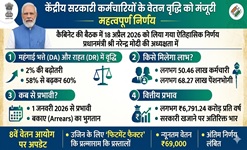
  • Presided over by Prime Minister Narendra Modi, the Union Cabinet has approved the release of an additional installment of Dearness Allowance (DA) for central government employees and Dearness Relief (DR) for pensioners.

Key Facts:

  • Rate of Increase: The existing rate of 58% of the Basic Pay/Pension has been increased by 2%, bringing the total to 60%.
  • Effective Date: This increase shall be deemed effective from January 1, 2026.
  • Beneficiaries: This decision will benefit approximately 50.46 lakh central government employees and 68.27 lakh pensioners.
  • Financial Impact: This increase will impose an additional burden of ₹6,791.24 crore per annum on the government exchequer.
  • Basis: This increase is in accordance with the approved formula based on the recommendations of the 7th Central Pay Commission (7th CPC), which is granted to compensate for the rise in prices (inflation).
  • Dearness Allowance (DA): This varies across urban, semi-urban, and rural areas and is calculated based on the All India Consumer Price Index (AICPI-IW).
  • Pay Commission: This constitutes a part of the constitutional and statutory bodies falling under the purview of governance and public administration.

Approval for Continuation of PMGSY-III until 2028
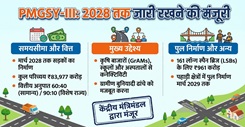
  • The Union Cabinet, chaired by Prime Minister Narendra Modi, has approved the continuation of the Pradhan Mantri Gram Sadak Yojana (PMGSY-III) beyond March 2025, extending it up to March 2028.
  • This includes the consolidation of 'Through Routes' and 'Major Rural Links' that connect rural habitations to rural agricultural markets, senior secondary schools, and hospitals.

Key Facts:

  • Revised Financial Outlay: The total outlay for the scheme has been increased from ₹80,250 crore to ₹83,977 crore.
  • The deadline for the construction of roads and bridges in plain areas, as well as for completing the remaining road construction works in hilly areas, has been set for March 2028.
  • For the construction of bridges in hilly areas, considering the challenging geographical conditions, the deadline has been extended to March 2029.
  • Approval for Long Span Bridges (LSBs): Approval has been granted for the construction of 161 new Long Span Bridges located along the alignment of previously sanctioned roads, at an estimated cost of approximately ₹961 crore.
  • Execution of Pending Works: Works sanctioned prior to March 31, 2025—for which allocations had not yet been made—are now permitted to undergo the tendering and allocation process.

Pradhan Mantri Gram Sadak Yojana (PMGSY-I):

  • Launch: December 25, 2000, by the then Prime Minister, Atal Bihari Vajpayee.

Key Objectives of the Scheme:

  • To provide all-weather road connectivity to rural habitations.
  • To promote economic, social, and educational development in rural areas.
  • To facilitate access to the transportation of agricultural produce, healthcare services, education, and employment opportunities.
  • To reduce rural-urban disparities.
  • Ministry: Ministry of Rural Development, Government of India.

Funding Pattern:

  • General States: The expenditure ratio between the Centre and the State is 60:40. North-Eastern and Himalayan States: For these states, the ratio is 90:10 (90% borne by the Centre).
  • Union Territories without a Legislature: 100% borne by the Central Government.

Maintenance and Quality:

  • Maintenance: The responsibility for maintaining roads constructed under the scheme for a period of 5 years lies with the contractor.
  • Digital Monitoring: The 'Meri Sadak' (My Road) mobile app and the 'OMMS' portal are utilized to monitor the quality and progress of road construction.
  • Rural Roads Sanctioned to Date: A total of 825,114 kilometers.
  • Roads Completed by December 2025: 787,520 kilometers, reflecting a physical progress of approximately 95%.
  • Sanctions under PMGSY-III: 122,393 km of road length; Constructed: 101,623 km.
  • Expenditure Allocated for the Period of FY 2025-26: ₹19,000 crore.
  • Outlay under PMGSY-IV (2024-29): ₹70,125 crore; Settlements to be Connected: 25,000 settlements via 62,500 kilometers of roads.

PMGSY Phase-II:

  • Launch: 2013.
  • Main Objective of Phase-II: To strengthen and consolidate the existing rural road network.
  • Its aim was to improve transport efficiency and accelerate rural economic growth.

PMGSY Phase-IV:

  • Launch: 2024.
  • Proposed Road Length: 62,500 km.
  • Implementation Period: From FY 2024-25 to 2028-29.
  • Total Outlay: ₹70,125 crore.
  • Eligibility for these projects is based on population data from the 2011 Census.

Approval Granted for Two Major Railway Multi-Tracking Projects in Uttar Pradesh and Andhra Pradesh
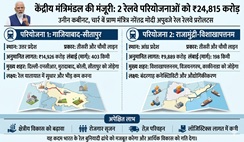
  • The Union Cabinet, chaired by Prime Minister Narendra Modi, has approved two major multi-tracking projects with a total estimated cost of ₹24,815 crore to strengthen railway infrastructure in Uttar Pradesh and Andhra Pradesh.

Key Highlights of the Projects:

  • Total Cost: Approximately ₹24,815 crore
  • Coverage: These projects will span across 15 districts in Uttar Pradesh and Andhra Pradesh.
  • Network Expansion: Approximately 601 kilometers of new lines (multi-tracking) will be added to the Indian Railways network.
  • Timeline: These projects are targeted for completion by 2030-31.
  • Objective: To enhance rail connectivity, facilitate freight movement, and alleviate congestion under the PM Gati Shakti National Master Plan.

The Two Approved Projects:

  • Ghaziabad–Sitapur 3rd and 4th Line (Uttar Pradesh):
  • Length: 403 kilometers
  • Cost: Approximately ₹14,926 crore
  • Significance: This project forms part of the high-density Delhi–Guwahati corridor, providing connectivity to key industrial hubs in Uttar Pradesh.

Rajamundry (Nidadavolu)–Visakhapatnam (Duvvada) 3rd and 4th Line (Andhra Pradesh):

  • Length: 198 kilometers
  • Cost: Approximately ₹9,889 crore
  • Significance: This project is part of the high-density Howrah–Chennai network, which connects major ports along the eastern coast.

International News

South Korean President on a Visit to India

  • South Korean President Lee Jae-myung is on a three-day visit to India.

Key Facts:

  • First Visit to India: This marks President Lee's first visit to India since assuming office in June 2025. Furthermore, it is also the first visit by a South Korean President to India in the last eight years.
  • Strategic Discussions: High-level summit talks will be held between Prime Minister Narendra Modi and President Lee at Hyderabad House.
  • Relations between India and South Korea were elevated to the level of a 'Special Strategic Partnership' in 2015. Both nations share a common vision for peace and stability in the "Indo-Pacific Region."

South Korea (Republic of Korea):

  • A developed democratic nation located in East Asia, covering the southern part of the Korean Peninsula.
  • Official Name: Republic of Korea (ROK)
  • Capital: Seoul, which is one of the world's largest metropolitan areas.
  • Official Language: Korean (written in the Hangul script).
  • Currency: South Korean Won (KRW)
  • Borders: North Korea to the north (separated by the DMZ), the Yellow Sea to the west, and the Sea of ​​Japan (East Sea) to the east.
  • Geography: Approximately 70% of the country's terrain is mountainous. Hallasan is the highest peak, located on Jeju Island.
  • Major Cities: Apart from Seoul, the main urban centers include Busan, Incheon, Daegu, and Gwangju.

India–South Korea Relations:

  • Historical and Cultural: Suriratna (Heo Hwang-ok): It is historically accurate that a princess from Ayodhya traveled to Korea in 48 AD. According to India's Ministry of External Affairs (MEA), she married King Kim Suro there. To this day, a memorial dedicated to her stands in the city of Gimhae, Korea. Monk Hyecho: The 8th-century Buddhist monk Hyecho traveled to India and provided a vivid account of ancient India in his travelogue, Wang Ocheonchukguk Jeon.
  • Nobel Laureate Rabindranath Tagore composed The Lamp of the East*—a short yet thought-provoking poem—in 1929, reflecting on Korea's glorious past and its bright future.
  • To foster cultural exchange between India and the Republic of Korea, Indian Cultural Centers (ICCs) were established in Seoul in April 2011 and in Busan in December 2013.
  • During the Korean War (1950–53), India played a pivotal role in facilitating a ceasefire agreement between the two warring factions (North Korea and South Korea).
  • This resolution, sponsored by India, was adopted, and a ceasefire was declared on July 27, 1953.
  • Bilateral Trade: $26.89 billion
  • Trade Target: Both nations have set a target to boost bilateral trade to $50 billion by 2030.
  • CEPA: The 'Comprehensive Economic Partnership Agreement' (CEPA), effective since 2010, serves as the bedrock of bilateral trade.

Awards and Honors

Femina Miss India Pageant 2026

  • The 61st Femina Miss India pageant was held in Bhubaneswar.

Key Highlights:

  • Winner: Sadhvi Sail (Goa) – She was crowned Femina Miss India World 2026 and will now represent India at the Miss World pageant.
  • Sadhvi Satish Sail wore a skirt crafted from traditional Kunbi weave, reimagined in a Central European style.
  • Renowned for its rich heritage, the Kunbi weave—derived from the words *Kun* (family) and *Bi* (seed)—symbolizes skills passed down through generations and the unbreakable bonds of the community.
  • First Runner-up: Rajnandini Panwar (Maharashtra)
  • Second Runner-up: Advaita (Jammu & Kashmir)
  • Theme: Connecting the DOTS
  • Venue: Kalinga Institute of Industrial Technology (KIIT), Bhubaneswar
  • This pageant is organized by a company owned by the Times Group.
  • India has won 6 Miss World titles to date, including those won by Reita Faria (the first winner), Aishwarya Rai, Diana Hayden, Yukta Mookhey, Priyanka Chopra, and Manushi Chhillar.

Sports News

BCCI Extends Ajit Agarkar's Contract by One Year
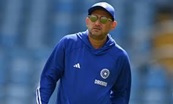
  • The Board of Control for Cricket in India (BCCI) has extended the contract of Ajit Agarkar, Chairman of the Senior Men's Selection Committee, by one year; consequently, he will now continue to hold this position until June 2027.
  • This decision has been taken specifically with the 2027 ODI World Cup—scheduled to be hosted jointly by South Africa, Zimbabwe, and Namibia—in mind.

Key Facts:

  • Successful Tenure: Under his leadership, the Indian team has secured three major ICC titles, including the 2024 and 2026 T20 World Cups and the 2025 Champions Trophy.
  • Continuity and Bold Decisions: The BCCI has lauded the "bold decisions" taken during his tenure, particularly regarding the T20 retirements of stalwarts like Rohit Sharma and Virat Kohli, and the smooth transition of the team.
  • Appointment: He assumed the role of Chief Selector in July 2023, following the resignation of Chetan Sharma.

Board of Control for Cricket in India (BCCI):

  • It is the national governing body for cricket in India.
  • It is the wealthiest cricket board in the world and forms part of the "Big Three" of international cricket (alongside Australia and England).
  • Establishment: Founded in December 1928 as a society under the Tamil Nadu Societies Registration Act.
  • Headquarters: Cricket Centre, Wankhede Stadium, Churchgate, Mumbai.
  • Affiliation: It is a full member of the International Cricket Council (ICC).
  • Current President: Mithun Manhas
  • First President: R.E. Grant Govan

Important Days

World Liver Day

  • World Liver Day is observed annually on April 19th with the objective of raising global awareness regarding the importance of liver health, liver-related diseases, and their prevention.

Related Facts:

  • Introduction: It is the body's largest gland and its largest internal organ.
  • Location: It is situated in the upper right section of the abdominal cavity, directly beneath the diaphragm.
  • Weight: In an adult human, it weighs approximately 1.2 to 1.5 kilograms.
  • Structure: The liver is divided into two main parts (lobes)—the right lobe and the left lobe.
  • Blood Supply: The liver receives a dual blood supply—approximately 75% from the Portal Vein and 25% from the Hepatic Artery.

Major Functions:

  • Bile Production: The liver secretes bile juice, which is essential for the digestion (emulsification) of fats. This bile is stored in the 'Gallbladder'.
  • Detoxification: It filters and removes toxins, medications, and harmful chemicals from the blood.
  • Glucose Control: It stores excess glucose in the form of glycogen and converts it back into glucose when needed.
  • Storage of Vitamins and Minerals: It stores Vitamins A, D, E, K, B12, and Iron.
  • Protein Synthesis: It produces proteins responsible for blood clotting (such as fibrinogen and prothrombin) as well as albumin.
  • Destruction of RBCs: In adulthood, it performs the function of destroying dead red blood cells (RBCs).


Latest Courses