Startups in FY 2025–26
 
  • Mobile Menu
HOME BUY MAGAZINEnew course icon
LOG IN SIGN UP

Sign-Up IcanDon't Have an Account?


SIGN UP


Login Icon

Have an Account?


LOG IN
 

or
By clicking on Register, you are agreeing to our Terms & Conditions.


or


Startups in FY 2025–26

Sat 18 Apr, 2026

Context:

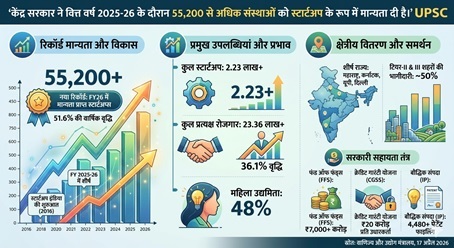
  • The Government of India recognized more than 55,200 entities as startups during FY 2025–26.

Key Points:

  • Highest Annual Recognition: This is the highest number of startups recognized in a single year since the launch of the Startup India initiative in 2016.
  • Annual Growth: There has been a significant growth of 51.6% compared to the previous financial year (2024–25).
  • Total Number: As of 31 March 2026, the total number of recognized startups in India has crossed 2.23 lakh.
  • Employment Generation: These startups have created more than 23.36 lakh direct jobs, with a 36.1% increase in employment during FY 2025–26 alone.
  • Women Entrepreneurship: Around 48% (over 1.07 lakh) of recognized startups have at least one woman director or partner.

Regional Performance (Leading States):

1. Maharashtra (Top with over 38,660 startups)

2. Karnataka (22,600)

3. Uttar Pradesh (21,960)

4. Delhi (21,120)

5. Gujarat

Startup India Initiative:

  • Launched on 16 January 2016
  • Hence, 16 January is celebrated as National Startup Day
  • Recognizing Authority:

Startups are officially recognized by the Department for Promotion of Industry and Internal Trade (DPIIT).

What is a Startup? (As per DPIIT Definition):

An entity is considered a startup if it fulfills the following conditions:

  • Duration: Up to 10 years from the date of incorporation
  • Type: Registered as a Private Limited Company, Partnership Firm, or LLP
  • Turnover: Annual turnover should not exceed ₹100 crore in any financial year since incorporation
  • Objective: Should work towards innovation, development, or commercialization of products/services with potential for employment generation

Key Benefits for Startups:

  • Ease of Compliance: Self-certification under environmental and labour laws for 3–5 years
  • Tax Exemption: 3 consecutive years of income tax exemption under Section 80-IAC (for eligible startups)
  • IPR Support:
  • 80% rebate on patent filing fees
  • 50% rebate on trademark filing
  • Funding Support:
  • ₹10,000 crore “Fund of Funds”
  • Startup India Seed Fund Scheme (SISFS)
    • Public Procurement: Relaxation in experience and turnover criteria in government tenders

Important Terminologies:

  • Unicorn: A startup with valuation exceeding $1 billion
  • Decacorn: A startup with valuation exceeding $10 billion
  • Angel Investors: Wealthy individuals who invest in early-stage startups

Additional Insights:

  • India is currently the third-largest startup ecosystem in the world after the United States and China.
  • Nearly 50% of startups are now emerging from Tier-2 and Tier-3 cities, indicating deeper regional penetration.

Latest Courses