Harivansh Narayan Singh
 
  • Mobile Menu
HOME BUY MAGAZINEnew course icon
LOG IN SIGN UP

Sign-Up IcanDon't Have an Account?


SIGN UP


Login Icon

Have an Account?


LOG IN
 

or
By clicking on Register, you are agreeing to our Terms & Conditions.


or


Harivansh Narayan Singh

Fri 17 Apr, 2026

Context:

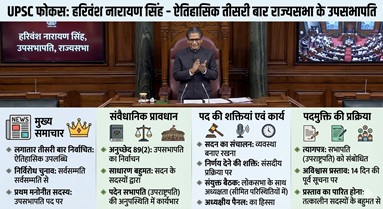
  • Harivansh Narayan Singh has been elected as the Deputy Chairman of the Rajya Sabha for the third consecutive term.

Key Points:

  • Unopposed Election: He was elected unanimously as no opposition candidate was fielded.
  • Proposal: The Leader of the House in Rajya Sabha, Jagat Prakash Nadda, moved the motion for his name, which was adopted by the House through a voice vote.
  • Nomination as Member: His previous term ended on 9 April 2026. Thereafter, the President Droupadi Murmu nominated him to the Rajya Sabha against the vacancy caused by the retirement of former Chief Justice Ranjan Gogoi.
  • Prime Minister’s Congratulations: Prime Minister Narendra Modi congratulated him, stating that being elected for the third consecutive term reflects the deep trust of the House in him.
  • Tenure: His third term as Deputy Chairman will continue till 2032.
  • He was first elected as Deputy Chairman in 2018 and has been serving in this role since then.

Deputy Chairman of Rajya Sabha: Constitutional Position and Functions

Article 89:

  • Article 89(1): The Vice-President of India acts as the ex-officio Chairman of the Rajya Sabha.
  • Article 89(2): The Rajya Sabha elects one of its members as the Deputy Chairman. Whenever the office falls vacant, the House elects another member.

Article 90:

  • Vacation of Office: If the Deputy Chairman ceases to be a member of the Rajya Sabha, the office becomes vacant.
  • Resignation: He may resign by writing to the Chairman.
  • Removal: He may be removed by a resolution passed by a majority of all the then members of the Rajya Sabha, with a prior notice of 14 days.

Article 91:

  • When Office of Chairman is Vacant: The Deputy Chairman performs the duties of the Chairman if the office is vacant or if the Vice-President acts as President.
  • In Absence of Both: If both Chairman and Deputy Chairman are absent, a member appointed by the President performs the duties.

Article 92:

  • Restriction on Presiding: When a resolution for removal of the Chairman or Deputy Chairman is under consideration, they shall not preside.
  • Right to Speak: The Chairman can participate and speak but cannot exercise a casting vote.

Role and Functions:

  • The Deputy Chairman presides over the House in the absence of the Chairman and enjoys all powers and privileges during that period.
  • Casting Vote: He does not vote in the first instance but can exercise a casting vote in case of a tie.
  • Independent Position: The office is independent and not subordinate to the Chairman; it is directly accountable to the Rajya Sabha.
  • As a Member: When not presiding, he functions as a normal member and can participate in debates and voting.

Vacancy and Resignation:

The office may fall vacant under three conditions:

  • If he ceases to be a member of the Rajya Sabha.
  • If he resigns by addressing the Chairman in writing.
  • If removed by a resolution of the House.
  • Removal Process: Requires an effective majority of all the then members with 14 days’ prior notice.
  • Restriction on Presiding: During consideration of a removal motion, he cannot preside but can participate.

Salary and Allowances:

  • Determined by Parliament by law.
  • Charged on the Consolidated Fund of India (not subject to vote in Parliament).

Panel of Vice-Chairpersons:

  • The Chairman nominates a panel of members.
  • Any member from this panel may preside in absence of both Chairman and Deputy Chairman.
  • Important: If both offices are vacant, a member appointed by the President discharges the functions (not the panel).

Important Firsts:

  • First Deputy Chairman: S. V. Krishnamoorthy Rao (1952–1962).
  • First Woman Deputy Chairman: Violet Alva (1962–1969).
  • First from Non-Ruling Party: B. D. Khobragade (associated with the Republican Party of India).
  • Contested Election: Although usually elected unopposed, the office saw a contest for the first time in 1969.

Latest Courses