01 April, 2026
Indian Space Situational Assessment Report 2025
Sun 12 Apr, 2026
Context :
- Indian Space Research Organisation (ISRO) has released the Indian Space Situational Assessment Report 2025 (ISSAR 2025), which presents an account of space debris and the safety of Indian space assets.
Global Launch Scenario (2025) :
- Space agencies worldwide carried out 315 rocket launches in 2025.
- This is the highest number of launches conducted in a single year since the beginning of the space age.
- The net growth recorded in the space sector is 74.5%.
ISSAR-2025 Report (Publication & Basis) :
- The Indian Space Situational Assessment Report (ISSAR)-2025 is based on data related to space debris management, which was released during the three-day International Spacecraft Mission Operations Conference, SMOPS-2026, held in Bengaluru.
Launch Data for 2024 :
- In 2024, a total of 261 launches were conducted, out of which 254 were successful, and 2,578 operational satellites were placed in space.
- This number is lower than in 2023, when 3,135 satellites were launched through 212 launches.
Objects in Orbit & Re-entry :
- A total of 4,651 objects were launched into orbit, and 1,911 objects re-entered Earth’s atmosphere.
Natural & Technical Events :
- The report also mentions severe geomagnetic storms and a delay of 41 seconds in the launch of the LVM-3-M6 mission.
Low Earth Orbit (LEO) Satellite Status :
- The presence of 86 Low Earth Orbit satellites (LEOS) has been noted, out of which 27 are operational and 23 are non-operational.
- Currently, 50 LEOS are present in orbit, out of which 36 are decayed.
- Out of these 86 LEOS, 60 are government satellites and 26 are non-government satellites.
Geostationary Earth Orbit (GEO) Satellite Status :
- There are 32 operational geostationary Earth orbit satellites in space, out of which 26 are non-operational.
Indian Rocket Structures (Orbital Debris) :
According to the report, Indian rocket structures present in orbit include:
- 42 parts of the Polar Satellite Launch Vehicle (PSLV)
- 3 parts of the Launch Vehicle Mark-3 (LVM-3)
- 4 parts of geostationary satellites
- The Geosynchronous Satellite Launch Vehicle (GSLV) is still present in orbit.
Efforts for Space Debris Management :
- ISRO scientists have stated that efforts are being made to bring back defunct satellites to reduce space debris.
Collision Avoidance :
- The ISSAR report mentions that four cases each of collision avoidance were recorded in LEO and geostationary Earth orbit missions.
India’s Initiatives for Space Safety :
- IS4OM (ISRO System for Safe and Sustainable Space Operations Management): This system functions as a nodal center to protect national space assets from debris and other threats.
- Project NETRA: An early warning system for monitoring space debris. Approximately ₹67.77 crore has been spent on it as of February 2026.
- Debris Free Space Mission (DFSM 2030): India has set a target to make all its space missions “debris-free” by 2030.
- SpaDeX Mission (2025): India successfully demonstrated autonomous docking and undocking of satellites in space, which is crucial for future in-orbit servicing and debris removal.
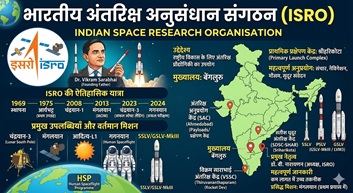
Indian Space Research Organisation (ISRO)
Basic Details :
- It is India’s national space agency.
- Established: 1969
- Origin: 1962 (as INCOSPAR under Dr. Vikram Sarabhai)
- Headquarters: Karnataka, Bengaluru
Objectives :
- Development of indigenous satellite and launch vehicle technology for India
- Use of space technology for social and economic development
- Support in telecommunications, weather forecasting, telemedicine, and resource survey
Major Achievements :
- India’s first satellite Aryabhata (1975)
- Major missions such as Chandrayaan-1 (2008), Mangalyaan (2013), Chandrayaan-2 (2019)
- World record in 2017 under PSLV-C37 mission by launching 104 satellites in a single mission
- Upcoming missions like Aditya-L1, Gaganyaan, Mangalyaan-2
- Development of PSLV and GSLV launch vehicles
Major Centres :
- Vikram Sarabhai Space Centre (VSSC), Thiruvananthapuram – Rocket development
- U.R. Rao Satellite Centre (URSC), Bengaluru – Satellite design & development
- Satish Dhawan Space Centre (SDSC), Sriharikota – Launch operations
- Liquid Propulsion Systems Centre (LPSC), Valiamala & Bengaluru – Cryogenic engine development
- National Remote Sensing Centre (NRSC), Hyderabad – Remote sensing data
- Space Applications Centre (SAC), Ahmedabad – Communication & applications
Leadership :
- ISRO Chairman is also the Secretary of the Department of Space
- Since January 2025, Dr. V. Narayanan is the Chairman of ISRO, succeeding S. Somanath
Commercial Arm :
- Antrix Corporation Limited is the commercial arm of ISRO, responsible for marketing space products and services and facilitating technology transfer.
Launch Vehicles :
| Launch Vehicle | Description |
| SLV | First launch vehicle of ISRO, developed in the 1980s, capable of launching ~40 kg payload |
| ASLV | Advanced version of SLV, capable of launching up to 150 kg |
| PSLV | Most reliable and widely used launch vehicle, can launch 500–1500 kg payload; used in Chandrayaan-1 and Mangalyaan |
| GSLV | Suitable for geostationary orbit, can launch 2–4 ton payload; uses cryogenic engine |
| GSLV Mk III (LVM-3) | Heaviest launch vehicle, can launch up to 8 tons to LEO and 4 tons to GEO; developed for human spaceflight |
| SSLV | Latest vehicle for small satellites (10–500 kg); low cost, quick launch, flexible |
Historic Missions
Chandrayaan-1 (2008) :
- India’s first lunar mission
- Successfully reached lunar orbit and collected scientific data
- Included a Moon Impact Probe that made a hard landing on the lunar surface
Mangalyaan / Mars Orbiter Mission (2013) :
- India’s first Mars mission
- Successfully reached Mars orbit in the first attempt
- Became the first Asian country to do so
Chandrayaan-2 (2019) :
- Orbiter is still operational
- Lander ‘Vikram’ crashed during landing
- Orbiter continues to study the lunar surface
Aditya-L1 (2023) :
- Mission for studying the Sun
- Positioned at the Sun-Earth L1 point
Chandrayaan-3 (2023) :
- India’s third lunar mission
- Launched on 14 July 2023
- Successfully soft-landed near the lunar south pole on 23 August 2023
- India became the first country to land near the lunar south pole
- Includes a lander and rover, but no orbiter