01 April, 2026
Renewable Energy Statistics 2026
Fri 10 Apr, 2026
Context:
- International Renewable Energy Agency released the ‘Renewable Energy Statistics 2026’, according to which India ranks third globally in renewable energy capacity after China and the United States.
Global Ranking:
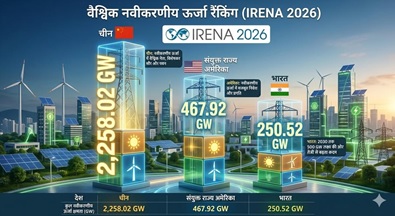
- China: 2,258.02 GW
- United States: 467.92 GW
- India: 250.52 GW
Current Status of Renewable Energy in India:
- As of 31 March 2026, India’s total installed capacity from non-fossil fuel sources stands at 283.46 GW.
- During 2025–26, India generated 1,845.92 billion units (BU) of electricity, with 29.2% (538.97 BU) from non-fossil sources.
- Total renewable energy contribution: 274.68 GW
Break-up:
- Solar Energy: 150.26 GW
- Wind Energy: 56.09 GW
- Bio Energy: 11.75 GW
- Small Hydro: 5.17 GW
- Large Hydro: 51.41 GW
- Nuclear Energy: 8.78 GW
Key Highlights:
- Over 70% of renewable energy capacity is concentrated in six states: Rajasthan, Maharashtra, Gujarat, Andhra Pradesh, Karnataka, and Madhya Pradesh.
- Installed renewable capacity grew at a CAGR of 10.93% (2016–2025), while total renewable electricity generation reached 416,823 GWh in FY 2024–25.
- Per capita energy consumption increased from 15,296 MJ (2015–16) to 18,096 MJ (2024–25).
- Transmission & Distribution (T&D) losses declined from 22% (FY16) to 17% (FY25).
- Coal remains the dominant energy source, with supply rising to 552,315 kilotonnes of oil equivalent in FY 2024–25.
- Financial growth: Credit flow to the energy sector increased more than sixfold—from ₹1,688 crore (2021) to ₹10,325 crore (2025).
Panchamrit Targets:
- Announced by Narendra Modi at COP26 (Glasgow, 2021)
- Non-fossil capacity: Achieve 500 GW by 2030
- Renewable share: Meet 50% of energy requirements from renewables by 2030
- Emission reduction: Reduce projected carbon emissions by 1 billion tonnes by 2030
- Carbon intensity: Reduce by over 45% (from 2005 levels) by 2030
- Net Zero: Achieve net zero emissions by 2070