GK Update
 
  • Mobile Menu
HOME BUY MAGAZINEnew course icon
LOG IN SIGN UP

Sign-Up IcanDon't Have an Account?


SIGN UP


Login Icon

Have an Account?


LOG IN
 

or
By clicking on Register, you are agreeing to our Terms & Conditions.


or


GK Update

Sat 11 Apr, 2026

National News

Inauguration of ‘Unnat Krishi Mahotsav’
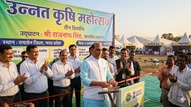
  • Defense Minister Rajnath Singh inaugurated the three-day ‘Unnat Krishi Mahotsav’ (Advanced Agriculture Festival) in the Raisen district of Madhya Pradesh.

Key Details:


  • Venue: Dussehra Ground, Raisen (Madhya Pradesh).
  • Objective: To promote modern agricultural technologies (AI, drones, solar pumps), reduce farming costs, and increase farmers' income.
  • Key Sessions: The festival will feature approximately 20 thematic sessions covering topics such as post-harvest management, natural farming, horticulture, and animal husbandry.
  • Conclusion: The festival will conclude on April 13 in the presence of the Union Minister for Road Transport and Highways, Nitin Gadkari.
  • Highlights: More than 300 exhibitors are participating in this event, and over 50,000 farmers are expected to attend. The event is being organized at the initiative of the Union Agriculture Minister, Shivraj Singh Chouhan.

Tax and Registration Exemptions for Electric Cars Priced Up to ₹30 Lakhs
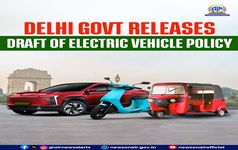
  • In Delhi, electric cars priced up to ₹30 lakhs will receive a 100% exemption on taxes and registration fees until 2030.

Key Facts:


  • The government has stated this in the draft Electric Vehicle Policy—valid until 2030—with the objective of promoting clean transportation.
  • Under this policy, an allocation of over ₹3,900 crores has been made to promote electric vehicles.
  • In the first year, a financial incentive of ₹10,000 per kilowatt-hour will be provided for electric two-wheelers priced up to ₹2.25 lakhs.
  • For electric three-wheelers—including electric auto-rickshaws—financial incentives ranging from ₹50,000 in the first year down to ₹30,000 by the third year will be provided.
  • For electric four-wheeled commercial vehicles (cargo carriers), the initial financial incentive will be up to ₹1 lakh.

Achievements of Vande Bharat Express Trains in the Financial Year 2025-26
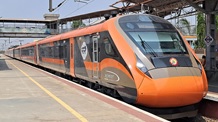
  • In the financial year 2025-26, approximately 39.8 million people traveled on the Vande Bharat Express.

Related Facts:


  • This represents an increase of approximately 34 percent compared to the 29.7 million passengers recorded in the previous year.
  • Since its inception, the Vande Bharat Express has served over 91 million passengers across 100,000 trips.
  • India's first indigenously designed and manufactured semi-high-speed train, the Vande Bharat Express, was launched in February 2019 on the New Delhi–Varanasi route.
  • The New Delhi–Varanasi route remains the busiest route to date, having served over 7.3 million passengers.
  • Further strengthening long-distance connectivity, Indian Railways launched the Vande Bharat Sleeper Service in January 2026.

Achievements of the Womaniya Initiative
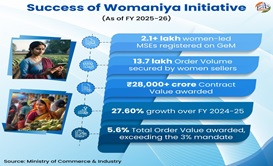
  • The 'Womaniya' initiative of the Government e-Marketplace (GeM) has provided an unprecedented boost to women entrepreneurs, with over 2.1 lakh registered Women Micro and Small Enterprises (MSEs) receiving more than 13.7 lakh orders in the financial year 2025-26.

Womaniya Initiative:


  • Launched by the Government e-Marketplace (GeM) in 2019, this is a flagship initiative that empowers women-led Micro and Small Enterprises (MSEs), Self-Help Groups (SHGs), and women artisans to sell their products directly to government buyers.
  • By eliminating intermediaries, this initiative ensures access to markets, finance, and value addition for women entrepreneurs, thereby helping to fulfill the 3% public procurement target.

National Scheduled Castes Finance and Development Corporation (NSFDC)
  • The National Scheduled Castes Finance and Development Corporation (NSFDC) disbursed a record amount of funds during the financial year 2025-26.

Key Facts:


  • According to the Ministry of Social Justice and Empowerment, the NSFDC disbursed funds exceeding ₹775 crore during the financial year 2025-26.
  • The National Scheduled Castes Finance and Development Corporation (NSFDC) is a Section 8 (non-profit) company established in 1989 under the Ministry of Social Justice and Empowerment. It is wholly owned by the Government of India and provides concessional loans and skill training for the economic empowerment of Scheduled Caste (SC) families with an annual income of up to ₹3 lakh.
  • Nodal Ministry: Ministry of Social Justice and Empowerment
  • Target Group: Scheduled Caste (SC) beneficiaries only
  • Implementation: Loan disbursement is carried out through State Channeling Agencies (SCAs), Regional Rural Banks (RRBs), and Public Sector Banks.
  • Important Information: On April 10, 2001, the NSFDC underwent a bifurcation; subsequently, the National Scheduled Castes Finance and Development Corporation (NSFDC) began working exclusively for Scheduled Castes (SC), while the National Scheduled Tribes Finance and Development Corporation (NSTFDC) began working for Scheduled Tribes (ST).

Economy and Banking

10 Years of UPI

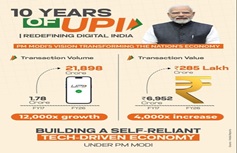
  • On April 11, 2026, India's Unified Payments Interface (UPI) completed 10 years of successful operations.

Related Facts:


Key Achievements:

  • During this period, the volume of UPI transactions has surged more than 12,000-fold, while the value of these transactions has grown by over 4,000 times.
  • According to data from the analytics firm Tracxn, 218.98 billion transactions were conducted via UPI in FY26, with a total value of ₹285 lakh crore.
  • In FY17, this figure stood at 17.86 million transactions, valued at ₹6,952 crore.
  • Transaction volumes grew gradually during the initial years, reaching 915 million in FY18 and 5.39 billion in FY19.
  • In FY20, the transaction count reached 12.52 billion, with a total value exceeding ₹21 lakh crore.
  • UPI usage accelerated during the pandemic years; the number of transactions rose to 22.33 billion in FY21 and 45.97 billion in FY22. In FY23, this figure doubled once again, reaching 83.75 billion transactions.
  • UPI recorded 130.13 billion transactions in FY24 and 185.87 billion transactions in FY25.
  • In 2025, the merchant base accepting payments also expanded; the number of UPI QR codes increased by 15 percent compared to the previous year, reaching 731.3 million.
  • The number of Point-of-Sale (POS) terminals also saw a 15 percent increase, rising to 11.48 million.
  • According to data released by the National Payments Corporation of India (NPCI), UPI recorded its highest-ever monthly transaction volume in March 2026—a new milestone since its launch in 2016.
  • UPI processed 22.64 billion transactions in March, a significant increase from the 20.39 billion transactions recorded in February. The March figure also surpassed the previous high of 21.70 billion transactions recorded in January.
  • During this period, transaction volume increased by 24 percent on an annual basis.

Unified Payments Interface (UPI):

  • Launch: April 11, 2016, by the then RBI Governor, Raghuram राजन.
  • Developer Entity: National Payments Corporation of India (NPCI).
  • Regulatory Body: Reserve Bank of India (RBI).
  • Objective: To facilitate instant, secure, and unified banking transactions on mobile platforms.
  • Transaction Types: Person-to-Person (P2P) and Person-to-Merchant (P2M).
  • Nature of Transactions: 24×7 instant money transfers (interbank transfers) and QR code-based payments.
  • Key Feature: Payments can be made using only a Virtual Payment Address (VPA) or a mobile number.
  • Popular Apps Associated with UPI: PhonePe, Google Pay, Paytm, BHIM, Amazon Pay, etc.
  • BHIM App: A government-backed, UPI-based application developed by the NPCI (Launched: December 30, 2016).

India's Foreign Exchange Reserves: April 2026
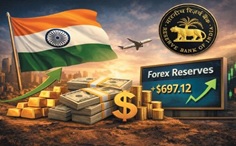
  • For the week ending April 3, 2026, India's foreign exchange reserves rose by $9.063 billion to reach $697.121 billion.

Related Facts:


  • Foreign Currency Assets (FCA): $552.856 billion
  • Gold Reserves: $120.742 billion (Increase: $7.21 billion)
  • Special Drawing Rights (SDR): $18.707 billion
  • Reserve Position with the IMF (RTP): $4.816 billion
  • The country's foreign exchange reserves witnessed robust growth during the first week of April.
  • This increase follows a significant decline of over $10 billion in the previous week.
  • In the preceding week, the foreign exchange reserves stood at over $688 billion.

Key Components of India's Foreign Exchange Reserves (under the RBI Act, 1934):

  • Foreign Currency Assets (FCA): This is the largest component, comprising foreign currencies other than the US dollar (such as the Euro, Pound, and Yen).
  • Gold Reserves: This component has witnessed rapid growth and now accounts for over 12% of the total reserves.
  • Special Drawing Rights (SDRs): Holdings deposited with the International Monetary Fund (IMF).
  • Reserve Tranche Position with the IMF: The reserved portion available to member countries of the IMF.

India's Growth Forecast: ADB

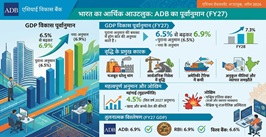
  • The ADB has raised India's growth forecast for the current fiscal year (2026-27) from 6.5% to 6.9%.

Related Facts:


  • Growth in India is expected to remain robust in the current fiscal year, driven by strong domestic demand, accommodative financing conditions, and a reduction in U.S. tariffs on Indian goods.
  • Most economies in the Asia and Pacific region are expected to experience a slowdown this year and the next.
  • Due to conflicts in West Asia and persistent trade uncertainties, the economic growth rate in the region is projected to decline from 5.4% last year to 5.1% this year and the next.

Asian Development Bank (ADB):

  • Type: Multilateral Development Bank
  • Established: December 19, 1966
  • Headquarters: Mandaluyong City, Metro Manila, Philippines
  • Member Countries: 68
  • Current President: Masato Kanda (11th President)
  • Administration: Governed by a Board of Governors comprising representatives from member countries
  • Operations: Provides financial assistance through loans, technical assistance, grants, guarantees, and equity investments
  • Focus Area: Promoting sustainable, inclusive, and resilient development in the Asia-Pacific region
  • Major Shareholders: Japan, USA, China, India, Australia
  • India's Status: Founding Member

Integrated Air-Drop Test Completed

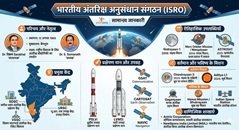
  • ISRO has successfully completed the second Integrated Air-Drop Test (IADT-02) for the Gaganyaan mission at Sriharikota, Andhra Pradesh.

Key Highlights of the IADT-02 Test:


  • Objective: The primary objective of this test was to validate the functionality and reliability of the Crew Module's parachute-based deceleration system, which is crucial for the safe return of astronauts.
  • Procedure: An Indian Air Force Chinook helicopter lifted a 'simulated Crew Module'—weighing approximately 5.7 tons—to an altitude of about 3 kilometers and subsequently dropped it into the sea.
  • Parachute System: During the descent, 10 parachutes (of 4 different types) were deployed in a precise sequence, effectively reducing the module's velocity to ensure a safe landing (splashdown).
  • Significant Milestone: Prior to IADT-02, the first test (IADT-01) was successfully conducted on August 24, 2025.

Indian Space Research Organisation (ISRO):

  • Establishment: Founded on August 15, 1969, through the efforts of Vikram Sarabhai, succeeding its predecessor, 'INCOSPAR'.
  • Current Chairman: Dr. V. Narayanan (serving since January 14, 2025), who also serves as the Secretary of the Department of Space, Government of India.
  • Major Centers and Their Functions:
  • Vikram Sarabhai Space Centre (VSSC), Thiruvananthapuram: Development of rockets and launch vehicles (such as PSLV, LVM3).
  • Satish Dhawan Space Centre (SDSC), Sriharikota: India's primary spaceport from where satellites and rockets are launched.
  • U. R. Rao Satellite Centre (URSC), Bengaluru: Design and fabrication of satellites.
  • Space Applications Centre (SAC), Ahmedabad: Development of communication and remote sensing payloads. National Remote Sensing Centre (NRSC), Hyderabad: Processing and distribution of satellite data.

Key Achievements and Current Missions (2024–2026):

  • Chandrayaan-3 (2023): Successful soft landing on the lunar South Pole.
  • Aditya-L1 (2024): India's first solar mission, which reached its destination (L1 point) in January 2024.
  • XPoSat (2024): A mission to study the polarization of cosmic X-rays.
  • SPADEX (December 2024 – January 2025): A critical test for successfully docking two satellites in space.

Important Days

Jyotiba Phule's Birth Anniversary

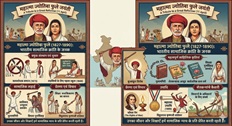
  • The birth anniversary of the great social reformer, philosopher, and writer Jyotiba Phule was observed on April 11; this year marked his 200th birth anniversary.

Related Facts:


  • Birth: He was born on April 11, 1827, into the 'Mali' community in Pune, Maharashtra.
  • Title: He was conferred the title of 'Mahatma' on May 11, 1888, by social activist Vitthalrao Krishnaji Vandekar.
  • Inspiration: He was deeply influenced by Thomas Paine's famous book, *The Rights of Man*.
  • He waged a lifelong struggle against caste-based discrimination, untouchability, and injustices committed against women.

Key Institutions and Social Reforms:

  • Satyashodhak Samaj (1873): He founded this organization in Maharashtra on September 24, 1873. Its primary objective was to raise awareness among the exploited classes and women, and to liberate them from religious and social bondage.
  • Pioneer of Education: In 1848, together with his wife Savitribai Phule, he opened India's first school for girls at Bhide Wada in Pune.
  • Deenbandhu Newspaper: This was a Marathi weekly newspaper launched in 1877 by Krishnarao Pandurang Bhalekar to disseminate the ideas of the Satyashodhak Samaj.
  • Balhatya Pratibandhak Griha (1853): He established this center within his own home to facilitate safe deliveries for pregnant widows and to prevent infanticide.

Major Literary Works:

  • Gulamgiri (1873): He dedicated this book to those who were fighting against the practice of slavery in America.
  • Shetkaryacha Asud (The Farmer's Whip): This work depicts the exploitation faced by farmers.
  • Tritiya Ratna: A play centered on the importance of education.
  • Sarvajanik Satya Dharma: Published posthumously, this work expounds upon a humanist religion.
  • Jyotiba Phule is also referred to as the "Father of the Indian Social Revolution."

'World Parkinson's Day'

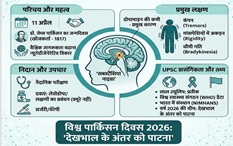
  • 'World Parkinson's Day' is observed annually on April 11th with the aim of raising awareness about Parkinson's disease.
  • This day marks the birth anniversary of Dr. James Parkinson, who was the first to identify this neurodegenerative disorder.

Parkinson's Disease:


  • It is a progressive neurodegenerative disorder that primarily affects body movements.
  • Causes: It occurs due to the degeneration of nerve cells (neurons) in the *substantia nigra* region of the brain.
  • Dopamine Deficiency: These degenerating cells produce a neurotransmitter called dopamine. A deficiency of dopamine leads to the onset of symptoms such as tremors and rigidity in the body.

Key Symptoms:

  • Motor Symptoms: Tremors, muscle rigidity, slowness of movement (bradykinesia), and impaired balance.
  • Non-Motor Symptoms: Sleep disturbances, depression, cognitive issues (such as memory loss), and difficulty speaking.
  • Other Neurological Disorders: Alzheimer's disease, Multiple Sclerosis (MS), Huntington's disease,
  • Cerebral Palsy, Guillain-Barré Syndrome.


Latest Courses