01 April, 2026
India’s First Indigenous Prototype Fast Breeder Reactor
Sun 05 Apr, 2026
Context:
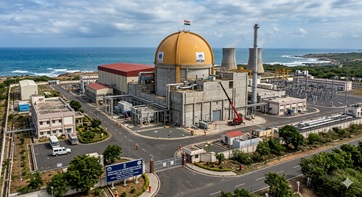
- India’s 500 MWe indigenously developed Prototype Fast Breeder Reactor (PFBR), located at Kalpakkam in Tamil Nadu, has achieved criticality for the first time.
Key Points:
- This achievement marks India’s formal entry into the second stage of its three-stage nuclear program, envisioned by Dr. Homi Jehangir Bhabha.
- Chairman of the Atomic Energy Commission (AEC), Dr. Ajit Kumar Mohanty, also described it as a symbol of entering the second stage of Bhabha’s three-stage program.
- Prime Minister Narendra Modi termed it a “landmark step in India’s civil nuclear journey.”
Stage 1:
- Main Technology: PHWR (Pressurized Heavy Water Reactor)
- Fuel: Natural Uranium (contains only 0.7% U-235, rest is U-238)
- Moderator & Coolant: Heavy water is used, which efficiently slows down neutrons, enabling a chain reaction even with natural uranium.
- Advantage: Does not require expensive uranium enrichment.
Main Output of Stage 1 – Plutonium-239:
- U-238 absorbs neutrons and converts into Plutonium-239 (Pu-239).
- Spent fuel is reprocessed to extract plutonium, which is used in Stage 2 (PFBR).
- Most operational reactors in India (Kaiga, Kakrapar, Narora) are PHWRs.
- These are operated by Nuclear Power Corporation of India Limited (NPCIL).
Stage 2:
- Key Feature: Produces more fissile fuel than it consumes (breeder technology).
- Process: Uses Pu-239 from Stage 1 as fuel, surrounded by a blanket of U-238, which converts again into Pu-239 under neutron bombardment.
Key Features of PFBR (Kalpakkam):
- Fuel: Mixed Oxide (MOX) fuel (Plutonium dioxide + Uranium dioxide)
- Neutron Speed: No moderator is used, hence called a “fast” reactor.
- Coolant: Liquid sodium is used instead of water due to its high heat absorption capacity.
Stage 3:
- Final and most important stage of India’s nuclear program for long-term energy self-reliance.
- Fuel: Thorium-232 (not fissile), used with Uranium-233 (U-233) obtained from Stage 2.
- Breeder Technology: Produces more U-233, creating a sustainable fuel cycle.
- India holds ~25% of global thorium reserves (mainly in coastal sands of Kerala and Odisha).
- Energy Security: Can meet India’s electricity needs for 300–400 years.
- Safety: Thorium reactors produce less radioactive waste and are considered safer than uranium reactors.
Advanced Heavy Water Reactor (AHWR):
- Being developed for Stage 3.
- Indigenous design using the Thorium-U-233 fuel cycle for large-scale power generation.
Technical Features of the Reactor:
- Design & Construction: Designed by Indira Gandhi Centre for Atomic Research (IGCAR) and built by BHAVINI.
- Fast Breeder Technology: Produces more fuel (Pu-239) than it consumes.
- Fuel: MOX (Uranium-Plutonium mixed oxide) fuel.
- Coolant: Liquid sodium.
Strategic and Economic Significance:
- Global Position: India will become the second country after Russia to operate a commercial fast breeder reactor.
- Energy Security: Reduces dependence on uranium imports.
- Thorium Pathway: Lays foundation for utilizing India’s vast thorium reserves.
- Environment: Supports India’s Net Zero target by 2070.
Meaning of Criticality: A state where a self-sustaining nuclear fission chain reaction begins, essential for controlled power generation.
Types of Nuclear Reactors in India
1. Pressurized Heavy Water Reactor (PHWR):
- Uses natural uranium and heavy water as coolant and moderator.
- No enrichment required.
- Most operational reactors are PHWRs.
2. Pressurized Water Reactor (PWR):
- Uses high-pressure water as coolant and moderator.
- Transfers heat to a secondary loop for steam generation.
- Kudankulam reactors are PWRs (Russian design).
3. Boiling Water Reactor (BWR):
- Water boils directly in the core to produce steam.
- Tarapur has two operational BWR units.
4. Fast Breeder Reactor (FBR):
- Uses fast neutrons and liquid sodium coolant.
- Produces more fuel than it consumes.
- PFBR at Kalpakkam has achieved criticality.
5. Small Modular Reactor (SMR):
- Compact, factory-built modular reactors.
- Not yet operational in India; designs like BSNR-200 and SMR-55 under development.
6. Advanced Reactors:
- Includes high-temperature gas-cooled and molten salt reactors.
- Under research or conceptual stage in India.
Note: PHWRs are the backbone of India’s nuclear energy program.