01 April, 2026
Textiles and Clothing Market: National Household Survey 2024
Tue 07 Apr, 2026
Context:
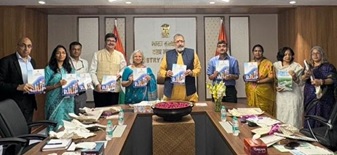
- The Ministry of Textiles has released the report “Textiles and Clothing Market: National Household Survey 2024.”
Key Points:
- This survey assesses domestic consumption on a large scale for the first time.
- Earlier, the focus was more on exports, but now the domestic market is considered the key driver of growth.
- The report will help policymakers make informed decisions.
- The government can formulate new policies to boost production, employment, and investment.
- It serves as a data-driven guide for the textile industry.
- Companies can plan strategies by understanding consumer demand, trends, and market expansion.
- India’s T&C sector is a major source of employment generation.
- Rising domestic demand will boost GDP contribution and industrial growth.
- The report will help in long-term strategic planning.
- It will strengthen initiatives like Make in India and Atmanirbhar Bharat.
According to the Report:
- Strong growth in domestic demand for clothing has been observed over the past 15 years.
- Market Size: India’s textile market grew from ₹4.89 lakh crore in 2010 to ₹14.95 lakh crore in 2024, reflecting a CAGR of 8.3%.
- Domestic Market: Out of the total, the domestic market size is ₹12.02 lakh crore, with household demand accounting for ₹8.77 lakh crore.
- Per Capita Demand: Increased from ₹2,119 in 2010 to ₹6,066 in 2024, showing a CAGR of 7.8%, indicating strong growth.
- Estimates also indicate significant growth in per capita clothing demand.
- Women Consumers’ Contribution: 55.5%
- Men Consumers’ Contribution: 44.5%
Type of Fiber:
- Man-Made Fiber (MMF) & Blended Fiber: Highest share at 52.2%
- Cotton: 41.2% share
- Silk & Wool: 5.2% and 1.3% respectively
- Consumer Trend: Women account for 55.5% of total textile purchases, while men account for 44.5%
- Dominance of MMF & Blended Fibers: With demand of ₹4.47 lakh crore, driven by durability and affordability
- High Growth of Cotton: Despite being second in value, it has a higher CAGR of 10.53% (compared to MMF’s 8.28%), indicating strong demand for premium and comfortable fabrics
- Diversification: Steady growth in silk (8.93%) and wool (7.02%) shows continued relevance of traditional and seasonal textiles
Key Drivers of Growth:
- Rising domestic demand due to changing lifestyles and urbanization
- Popularity of synthetic and blended fibers due to affordability and durability
- Strong contribution of women consumers
- Expansion of the fashion and apparel industry, especially branded and ready-made garments
Future Prospects:
- E-commerce and digital platforms will further boost the textile market
- Growing inclination towards sustainable fashion
- Expansion in rural markets due to rising income and awareness
Major Schemes of the Ministry of Textiles:
| Scheme | Launch | Key Features / Objectives | Vision / Impact |
| PM MITRA | 2021 | 7 Mega Integrated Textile Parks; end-to-end value chain at one place | 5F Vision: Farm → Fibre → Factory → Fashion → Foreign |
| PLI Scheme (Textiles) | 2021 | ₹10,683 crore incentive for MMF & Technical Textiles | Enhance global competitiveness and attract investment |
| National Technical Textiles Mission (NTTM) | 2020 | R&D in Meditech, Agrotech, Geotech; boost exports | Make India a global leader in technical textiles |
| SAMARTH | 2017 | Skill development; training over 1 million people | Improve employability |
| ATUFS | 2016 | Capital subsidy on machinery; modernization | Improve technology and quality |
| Silk Samagra-2 | 2021-22 | Strengthen silk production and seed system | Reduce import dependence |
| NHDP | 2015-16 | Support to artisans in design, marketing, infrastructure | Preserve traditional crafts and increase income |
| Handloom & Village Industry Promotion | Ongoing | Subsidized yarn and advanced looms for weavers | Boost rural economy and women empowerment |