National News
NCERT Granted 'Deemed University' Status
- The Ministry of Education has granted 'Deemed University' status to the National Council of Educational Research and Training (NCERT).
- Following this decision, NCERT will now be able to directly award degrees by conducting Undergraduate (UG), Postgraduate (PG), Doctoral, and various diploma courses.
National Council of Educational Research and Training (NCERT):
- An autonomous organization.
- Established: September 1, 1961
- Type: Autonomous Body (It has recently been granted the status of a 'Deemed-to-be University').
- Objective: To improve the standard of school education, publish educational materials, and conduct research.
- Autonomy: It is an autonomous body functioning under the Ministry of Education.
- Headquarters: New Delhi
- Key Functions: Formulating the curriculum, publishing textbooks (NCERT Books), and training teachers.
- Governing Body: The Union Education Minister serves as its Chairperson.
|
7 Railway Stations Transferred from East Coast Railway Zone
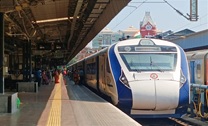
- The Railway Board has issued an official order to transfer 7 railway stations from the Khurda Road Division of the East Coast Railway Zone to the Visakhapatnam-based South Coast Railway Zone.
- These stations will now form part of the South Coast Railway Zone, headquartered in Visakhapatnam.
Key Details:
- Transfer: 7 stations from the Khurda Division (East Coast Railway) will now fall under the jurisdiction of the Visakhapatnam Division (South Coast Railway).
- Location: These stations are situated along the Ichchapuram–Palasa section.
- Administrative Change: This move has been undertaken to consolidate the operational scope of the South Coast Railway Zone (SCoR) and to streamline administrative functions.
East Coast Railway (ECoR):
- Establishment: It was announced in 1996 but became fully operational on April 1, 2003.
- Headquarters (HQ): Bhubaneswar, Odisha.
- Origin: It was formed by bifurcating the erstwhile South Eastern Railway.
- Its network primarily extends across three states: Odisha (covering almost the entire state), Andhra Pradesh (northern districts such as Srikakulam and Vizianagaram), and Chhattisgarh (Bastar and Dantewada districts).
|
Jan Vishwas (Provisions Amendment) Bill, 2026
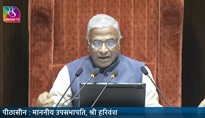
- Parliament passed the Jan Vishwas (Provisions Amendment) Bill, 2026.
- The objective of this Bill is to decriminalize 717 minor offenses by amending 784 provisions across 79–80 central laws falling under 23 ministries.
Central Armed Police Forces (General Administration) Bill, 2026
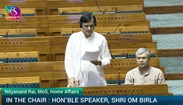
- Parliament has passed the Central Armed Police Forces (General Administration) Bill, 2026.
- The Bill provides for filling 50 percent of the posts of Inspector General in the Central Armed Police Forces (CAPF) through deputation.
- A minimum of 67 percent of the posts of Additional Director General shall be filled through deputation.
- All posts of Special Director General and Director General shall be filled exclusively through deputation.
Andhra Pradesh Reorganization (Amendment) Bill, 2026

- Parliament passed the Andhra Pradesh Reorganization (Amendment) Bill, 2026, in April 2026, which amends the original Act of 2014.
- Through this Bill, Amaravati has been accorded statutory recognition as the sole and permanent capital of Andhra Pradesh, thereby ending the uncertainty surrounding the state's capitals.
Key Features:
- Permanent Capital Status: This Bill amends Section 5 of the Andhra Pradesh Reorganization Act, 2014, to grant statutory recognition to Amaravati as the sole capital of the state.
- Retrospective Effect: This legislation shall be deemed effective from June 2, 2024—the date marking the conclusion of the 10-year period during which Hyderabad served as the shared capital with Telangana.
- End of the 'Three Capitals' Proposal: This amendment completely nullifies the concept of having three capitals (Visakhapatnam, Kurnool, and Amaravati), a proposal put forth by the previous government.
- Background: On March 28, 2026, the Andhra Pradesh Legislative Assembly passed a resolution requesting the Central Government to amend the 2014 Act to officially recognize Amaravati as the capital. Chief Minister N. Chandrababu Naidu has hailed the passage of this Bill as a historic achievement for the state.
- Constitutional Precedent: This marks the first instance in the history of independent India where a specific Bill has been introduced in Parliament solely for the purpose of designating a particular city as the permanent capital of a state.
Article 3: Formation of New States and Alteration of Areas:
- To form a new state by separating territory from any state or by uniting two or more states.
- To increase or decrease the area of any state.
- To alter the boundaries or the name of any state.
- Note: The Andhra Pradesh Reorganization Act, 2014, was enacted under this very Article, and the 2026 amendment also falls within the scope of this same legislative power.
Article 4: Supplementary and Consequential Matters:
- This Article empowers Parliament to make necessary amendments to the First Schedule (names of States) and the Fourth Schedule (allocation of seats in the Rajya Sabha) in order to give effect to laws enacted under Articles 2 and 3.
- Important: Laws passed under Article 4 are not deemed to be "Constitutional Amendments" within the meaning of Article 368. They can be passed by a Simple Majority.
Determination of the Capital:
- The Constitution does not explicitly specify who shall determine the capital; however, during the reorganization of a State under Article 3, Parliament possesses the power to make temporary or permanent arrangements regarding the capital.
- Under Section 5 of the original Act of 2014, Hyderabad was designated as the 'Joint Capital' for a period of 10 years.
Articles 163 and 167 (Role of the State):
- Although Parliament holds the ultimate power, in the spirit of Cooperative Federalism, the President seeks the views of the concerned State Legislature before introducing a Bill.
- In this instance, the Andhra Pradesh Legislative Assembly passed a resolution in favor of Amaravati in March 2026, which the Centre accepted and subsequently gave legislative effect to.
- Seventh Schedule:
- Entry 5 (Local Government) and Entry 18 (Land) of the State List empower the State to undertake development within its capital; however, when the matter involves a dispute between two States or an amendment to a Reorganization Act, Parliament's intervention (under the Union List/Concurrent powers) becomes decisive.
|
Agreement between UIDAI and MapmyIndia
- The Unique Identification Authority of India (UIDAI) has entered into an agreement with MapmyIndia.
- The primary objective of this partnership is to assist citizens in easily locating their nearest authorized Aadhaar centers.
Key Highlights:
- Integration on the Mappls App: MapmyIndia will integrate Aadhaar center information provided by UIDAI into its 'Mappls' app and platform.
- Digital Mapping and Verification: All authorized and verified Aadhaar centers (ASKs) across India will undergo digital mapping, thereby reducing the risk of citizens visiting fraudulent centers.
- Accurate Information: Using the Mappls app, citizens will be able to identify which specific services—such as adult enrollment, child enrollment, or address/mobile updates only—are being offered by a particular center.
- Digital Public Infrastructure (DPI): This collaboration marks a step towards strengthening India's Digital Public Infrastructure.
|
International News
Russia's First Deputy Prime Minister Visits India
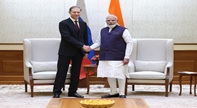
- Russia's First Deputy Prime Minister, Denis Manturov, arrived in New Delhi on April 2–3, 2026, for a two-day visit to India, aimed at strengthening bilateral ties in trade, energy, fertilizers, and defense.
- Manturov met with Prime Minister Modi and discussed the progress made regarding the outcomes of the 23rd India-Russia Summit held in December 2025.
Key Highlights:
- High-Level Meetings: In addition to Prime Minister Narendra Modi, Denis Manturov met with External Affairs Minister Dr. S. Jaishankar, Finance Minister Nirmala Sitharaman, and National Security Advisor (NSA) Ajit Doval.
- Bilateral Mechanism: Manturov serves as the Co-Chair of the India-Russia Inter-Governmental Commission (IRIGC-TEC), a key platform for cooperation in trade, economics, science, technology, and culture.
- Key Discussion Areas: Both nations focused on reducing the trade deficit, fertilizer supplies, energy, connectivity, and enhancing cooperation in new technologies and critical minerals.
Russia:
- The world's largest country by area.
- Extent: Spans Eastern Europe and Northern Asia.
- It covers 11 time zones.
- Borders: It shares land borders with 14 countries (e.g., China, Ukraine, Belarus, Kazakhstan, Finland, etc.).
- Currency: Russian Ruble (RUB).
- Major Mountains: Ural Mountains (separates Europe and Asia) and Altai Mountains.
- Major Rivers: Volga (Europe's longest river), Ob, Yenisei, and Lena.
- Lakes: Lake Baikal (the world's deepest lake and the largest freshwater lake by volume).
- Highest Peak: Mount Elbrus (Europe's highest peak).
- Capital: Moscow.
- President: Vladimir Putin.
- Parliament: Federal Assembly, comprising two houses:
- State Duma: The Lower House.
- Federation Council: The Upper House.
|
Economy and Banking
Continuous Growth Recorded in the Country's Seafood Exports

- India's seafood exports have demonstrated sustained strength over the past 11 years, recording an average annual growth rate of approximately 7%.
- Driven by this growth, export figures have more than doubled—rising from ₹30,000 crore in 2013–14 to exceed ₹62,000 crore in 2024–25.
- India currently exports over 350 distinct products to more than 130 countries.
Production from Captive and Commercial Mines in FY 2025-26
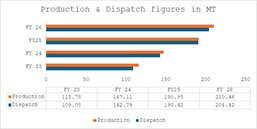
- The country recorded a coal production of 210.46 million tonnes from captive and commercial mines during the financial year 2025-26.
Key Highlights:
- Annual Growth: A robust growth of 10.22% in production was recorded compared to the previous financial year (190.95 MT).
- Coal Dispatch: Coal dispatch from the mines also increased by 7.35%, reaching 204.61 MT, up from 190.42 MT in FY 2024-25.
- Operationalization of New Mines: During this financial year, 12 new coal blocks were granted permission to commence operations, thereby adding over 86 MT to the annual production capacity. Of these, 7 blocks actually began production within the same year.
|
Four Years of the India-Australia ECTA
- The India-Australia Economic Cooperation and Trade Agreement (ECTA) completed four years on April 2, 2026, since its entry into force.
- This agreement has boosted bilateral trade, resulting in an increase in India's exports to Australia from $4 billion in FY21 to over $8.5 billion in FY25, with total trade reaching $24.1 billion.
Key Facts:
- During 2024-25, total bilateral trade stood at US$ 24.1 billion.
- India's exports to Australia recorded an increase of 8% compared to the previous year.
- In the financial year 2025-26 (up to February), India's total trade with Australia amounted to US$ 19.3 billion.
- Under the India-Australia ECTA, India granted preferential market access on 70.3% of its tariff lines—covering 90.6% of trade value—while Australia granted preferential market access on 100% of its tariff lines, equivalent to 100% of imports from India.
- Of these, 98.3% of tariff lines became duty-free immediately upon implementation, while the remaining 1.7% (113 tariff lines) are being phased out over a period of five years. From January 1, 2026, all Indian exports will be eligible for zero-duty market access in Australia.
- The benefits under the ECTA have become widespread across various sectors, with significant growth observed in the exports of textiles, pharmaceuticals, chemicals, and agricultural products.
- A significant milestone in bilateral cooperation between India and Australia was achieved on September 24, 2025, with the signing of a Mutual Recognition Agreement (MRA) on organic products.
|
UPI Transactions in March 2026

- In March 2026, UPI recorded transactions exceeding ₹29.53 lakh crore—its highest level to date.
Key Highlights:
- Transaction Value: Total transactions in March 2026 amounted to ₹29.53 lakh crore, representing an increase of approximately 10% over February's figure of ₹26.84 lakh crore.
- Transaction Volume: A total of 22.64 billion transactions were processed, marking an 11.02% increase compared to February.
- Daily Average: In March, an average of 73 crore transactions were conducted per day.
- FY26 Performance: For the financial year 2026, a total of 241.6 billion transactions were recorded, with a cumulative value of approximately ₹308 lakh crore.
- Contributing Factors: This record growth is attributed to increased spending during festivals such as Holi and Eid, as well as financial year-end activities.
|
Projected Decline in West Asia's GDP
- According to a UNDP report, the ongoing conflicts in West Asia could lead to a severe decline of 3.7% to 6% in the regional GDP.
- This economic contraction could amount to a loss of approximately $120 billion to $194 billion (USD).
Key Facts:
- The report estimates that over 3 million jobs will be lost and unemployment will rise by 4 percentage points—a figure exceeding the total number of jobs projected to be created in the region in 2025.
- The report states that approximately 4 million people will be affected by this.
- The report calls for immediate economic diversification and robust regional cooperation.
|
Appointments
Lieutenant General Dhiraj Seth
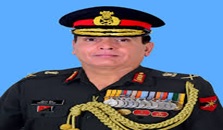
- Lieutenant General Dhiraj Seth has assumed charge as the 49th Vice Chief of Army Staff (VCOAS).
- He succeeds Lieutenant General Pushpendra Pal Singh, who has now been entrusted with the responsibility of the Western Army Command.
Related Facts:
- Previous Post: Prior to becoming the Vice Chief, he served as the General Officer Commanding-in-Chief of the Southern Command.
- Experience: Commissioned into the Armoured Corps in December 1986, General Seth possesses extensive military experience spanning nearly 40 years.
- Key Achievements: He has commanded critical units, including an Armoured Regiment in desert terrain, a Counter-Insurgency Force in Jammu & Kashmir, and the 'Sudarshan Chakra Corps'.
- Honours: For his distinguished service, he has been conferred with the Param Vishisht Seva Medal (PVSM), Uttam Yudh Seva Medal (UYSM), and Ati Vishisht Seva Medal (AVSM).
|
Science and Technology
Artemis II Mission

- On April 1, 2026, NASA launched the manned mission Artemis II from the Kennedy Space Center, Florida.
Artemis II:
- Launch Date: April 1, 2026
- Launch Site: Kennedy Space Center, Florida
- It is the first manned mission of the Artemis program.
- Since Apollo 17 in 1972, this marks the first time humans have ventured close to the Moon.
- Mission Objective: To test the life support systems of the 'Orion' spacecraft in lunar orbit.
- Rocket: Space Launch System (SLS)
- Mission Duration: 10 days (does not include landing on the Moon).
Crew Members:
- Reid Wiseman: Mission Commander
- Victor Glover: Pilot (The first Black person to venture into deep space)
- Christina Koch: Mission Specialist (The first woman to venture into deep space)
- Jeremy Hansen: Mission Specialist from the Canadian Space Agency (The first non-American to travel to the Moon)
|


 Don't Have an Account?