15 April, 2026
Global Education Monitoring (GEM) Report 2026
Tue 31 Mar, 2026
Context :
- UNESCO has released the Global Education Monitoring Report 2026: Access and Equity (GEM Report 2026), which is the first part of the “Countdown to 2030” series.
According to the Report :
- Theme: “Access and Equity – Countdown to 2030”
- Inequality and Access: Only 2/3 of students are able to complete secondary education. Access to education is lowest in rural, poor and conflict-affected regions.
Global Enrollment and Progress (Revised Presentation):
- • In 2024, global enrollment reached around 1.4 billion, which is 327 million (30%) higher than in 2000.
- • Enrollment at the pre-primary level has increased by 45% since 2000.
- • Enrollment in higher education has increased by 161%.
- • The rate of new admissions is equivalent to about 25 children entering school every minute.
Completion Rates (Education):
- Primary Education: 77% → 88%
- Secondary Education: 60% → 78%
- Upper Secondary Education: 37% → 61%
- It is estimated that 95% completion rate will be achieved by 2105, which is about 75 years behind the SDG-4 (2030 target).
Analysis of Global Education (Revised Presentation):
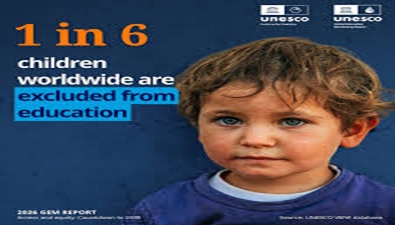
- Around 273 million children are out of school globally, indicating not only an educational crisis but also policy failure, despite a 30% increase in enrollment since 2000.
- At the current pace, the 95% completion target will only be achieved by 2105, pushing the SDG-4 (2030) goal about 75 years behind (indicating failure across generations).
- Although higher education has seen a rapid growth of 161%, it hides deep inequalities, as it mainly benefits the less disadvantaged sections.
- Conflict and instability are major barriers: particularly in West Asia, an additional 13 million children are deprived, showing that geopolitical instability directly affects education.
- The gap between enrollment and completion is serious: despite 1.4 billion enrollments, only about two-thirds complete secondary education.
- India’s role is significant: due to its large school-age population, India’s data directly impacts global trends; schemes like PM Poshan, RTE Act 2009, and NIPUN Bharat are key structural responses.
- The report focuses on “Access and Equity”: the goal is not just enrollment, but ensuring equal completion of education, especially for girls, minorities, and conflict-affected populations.
- The 45% growth in pre-primary education is a positive sign, highlighting that early childhood education is considered the most effective investment.
Sustainable Development Goal 4 (SDG-4)
- It is related to “Quality Education”.
- It is an important part of the United Nations 2030 Agenda.
- Goal: “Ensure inclusive and equitable quality education and promote lifelong learning opportunities for all.”
- Core Philosophy: Education is seen as a fundamental human right and a key driver of sustainable development.
- Symbol: An open book and pencil on a red background.
- Key Targets under SDG-4 (by 2030):
- Primary and Secondary Education: Ensure free, equitable and quality primary and secondary education for all girls and boys.
- Early Childhood Development: Access to quality pre-primary education.
- Technical, Vocational and Higher Education: Equal access for all, including universities.
- Skill Development: Increase skills (technical and vocational) for employment and entrepreneurship.
- Gender Equality and Inclusion: Eliminate gender disparities and ensure equal access for vulnerable groups, including persons with disabilities and indigenous people.
- Literacy: Ensure literacy and numeracy.
- Teacher Training: Increase the supply of qualified teachers, especially in developing countries.
India & SDG-4 Implementation:
- National Education Policy (NEP) 2020: Directly aligned with SDG-4, focusing on restructuring and transforming education.
- NITI Aayog: Monitors progress of states through the SDG India Index.
Key Achievements (2023–24):
- Adjusted Net Enrollment Rate (ANER) in elementary education is 96.5%.
- 88.65% of schools have electricity and drinking water facilities.
- Progress towards gender parity in higher education (18–23 years).
- According to the Sustainable Development Report (SDR) 2025 by the UN SDSN, India ranks 99th out of 167 countries with a score of 67. This is the first time India has entered the top 100, improving from 109th rank in 2024.