16 March, 2026
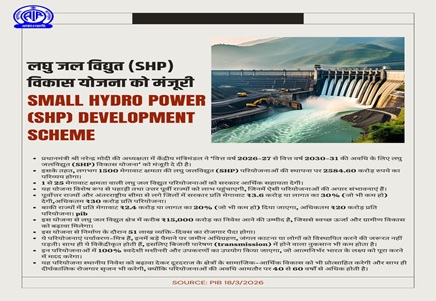
Approval of ‘Small Hydro Power Development Scheme’
Fri 20 Mar, 2026
Context:
- The Union Cabinet has approved the ‘Small Hydro Power (SHP) Development Scheme’ for the period from FY 2026-27 to 2030-31.
Key Points:
- Duration: FY 2026-27 to 2030-31
- Cost: Central outlay of ₹2,584.60 crore
- Target: Installation of 1500 MW of Small Hydro Power (SHP) capacity
- Investment: Around ₹15,000 crore investment is expected in this sector
- Objective: To promote clean energy, rural development, employment generation, and use of 100% indigenous equipment under “Atmanirbhar Bharat”
- Project Scope: Supports projects with a capacity of 1 MW to 25 MW. In India, hydro projects up to 25 MW are classified as Small Hydro Power (SHP)
- Nodal Ministry: Ministry of New and Renewable Energy (MNRE) (large hydro projects fall under the Ministry of Power)
- Run-of-the-River Technology: These projects use the natural flow of rivers, avoiding the need for large dams and minimizing ecological impact
- Atmanirbhar Bharat: 100% domestic procurement of plant and machinery is mandatory
- Future Planning: ₹30 crore provision for preparing Detailed Project Reports (DPRs) for about 200 upcoming projects
- Economic Impact: Expected to attract around ₹15,000 crore private investment and generate about 51 lakh person-days of employment during construction
Central Financial Assistance (CFA) Structure:
- For North-Eastern States and districts along international borders: ₹3.6 crore per MW or 30% of project cost (whichever is lower), with a maximum limit of ₹30 crore per project
- For other States: ₹2.4 crore per MW or 20% of project cost (whichever is lower), with a maximum limit of ₹20 crore per project
Small Hydro Power (SHP):
- SHP is considered a clean and reliable source of energy in India
- Hydropower projects with an installed capacity of up to 25 MW are classified as SHP
- Technology: Primarily based on Run-of-the-River, utilizing natural river flow without large dams
Benefits of Small Hydro Power Projects:
- Environmental Benefits: Less land acquisition, reduced deforestation, minimal displacement
- Economic Development: Employment generation, long project life (40–60 years)
- Social Benefits: Electricity access in rural areas, improved local livelihoods, contribution to energy security