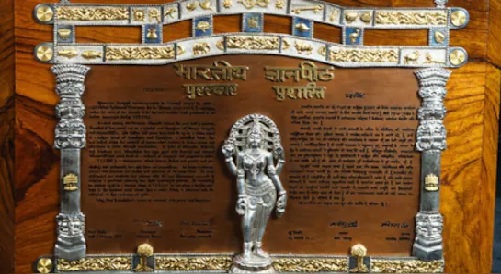
60th Jnanpith Award
 
  • Mobile Menu
HOME BUY MAGAZINEnew course icon
LOG IN SIGN UP

Sign-Up IcanDon't Have an Account?


SIGN UP


Login Icon

Have an Account?


LOG IN
 

or
By clicking on Register, you are agreeing to our Terms & Conditions.


or


60th Jnanpith Award

Wed 18 Mar, 2026

Context:

  • Tamil poet, lyricist, and novelist R. Vairamuthu has been selected for the 60th Jnanpith Award (for the year 2025).

Key Points:

  • He is the third Tamil writer to receive this highest literary honor. Earlier, it was awarded to Akilan (1975) and Jayakanthan (2002).
  • In a career spanning over four decades, he has written more than 37 books and won 7 National Film Awards.
  • He also won the Sahitya Akademi Award (2003) for his novel Kallikattu Ithikasam.
  • He was honored with the Padma Shri (2003) and Padma Bhushan (2014).
  • Major works: Kallikattu Ithikasam, Karuvachi Kaviyam, Thanneer Desam, Moondram Ulagap Por (Third World War)

Jnanpith Award:

  • It is the highest literary honor in India, established in 1961 by the Bharatiya Jnanpith.
  • It is regarded as the “Nobel Prize of Indian Literature.”
  • The award was instituted through Bharatiya Jnanpith, a cultural organization founded in 1944 by industrialist Sahu Shanti Prasad Jain and his wife Rama Jain.
  • The first award (1965) was given to Malayalam poet G. Sankara Kurup for his work Odakkuzhal.
  • The first woman awardee was Ashapurna Devi (1976), and the first English language winner was Amitav Ghosh (2018).
  • The award is not given posthumously.
  • Objective: To honor literary excellence in Indian languages.
  • Award components: ₹11 lakh, a bronze statue of Goddess Saraswati (Vagdevi), and a citation.

Selection Process & Eligibility:

  • Languages: 22 languages listed in the 8th Schedule of the Constitution (English included since 2013).
  • Selection criteria: Overall literary contribution of the author (earlier awarded for a single work before 1982).

Notable Winners:

  • Sumitranandan Pant (1968, Hindi), Mahadevi Verma (1982, Hindi)
  • 2023 Winners: Jagadguru Rambhadracharya and Gulzar
  • 2024 Winner: Vinod Kumar Shukla (first winner from Chhattisgarh)

Some Important Facts:

  • Initially (1950), only 14 languages were included.
  • Sindhi was added in 1967 (21st Amendment).
  • Konkani, Manipuri, Nepali were added in 1992 (71st Amendment).
  • Bodo, Dogri, Maithili, Santhali were added in 2003 (92nd Amendment).

Latest Courses