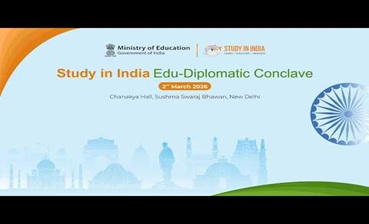
‘Study in India Edu-Diplomatic Conclave 2026’
 
  • Mobile Menu
HOME BUY MAGAZINEnew course icon
LOG IN SIGN UP

Sign-Up IcanDon't Have an Account?


SIGN UP


Login Icon

Have an Account?


LOG IN
 

or
By clicking on Register, you are agreeing to our Terms & Conditions.


or


‘Study in India Edu-Diplomatic Conclave 2026’

Fri 06 Mar, 2026

Context:

  • The Study in India Edu-Diplomatic Conclave 2026 was organized in New Delhi by the Ministry of Education.

Key Points:

  • Venue: Sushma Swaraj Bhawan
  • Chief Guest: Union Education Minister Dharmendra Pradhan
  • Participation: Ambassadors, High Commissioners, and diplomatic representatives from more than 50 countries
  • Main Objective: To establish India as a Global Education Hub and strengthen international academic cooperation.

Sessions in the Conclave Focused on the Following Themes:

  • Indian Knowledge System as a global academic offering
  • Academic partnerships through SPARC and GIAN
  • Artificial Intelligence and advanced technologies
  • UGC Regulations 2023 for foreign university campuses in India
  • International branch campuses and supporting infrastructure
  • Internationalization of India’s skill ecosystem
  • India Innovates 2026

Major Announcements and Initiatives:

  • Establishment of Foreign University Campuses: Under the University Grants Commission (UGC) Regulations 2023, globally ranked universities have been invited to establish campuses in India.
  • Process of 19 Foreign Universities: Union Minister Dharmendra Pradhan stated that around 19 foreign universities are moving forward to establish campuses in India.
  • Implementation of NEP 2020: The National Education Policy 2020 emphasizes flexibility, multidisciplinary education, and global engagement.
  • Collaborative Model: India clarified that it aims to build a collaborative model to address shared global challenges such as climate change rather than imposing an “Indian model.”
  • Three Main Pillars: The Indian education framework is based on Quality, Innovation, and Affordability.

National Education Policy 2020 (NEP 2020)

Introduction:

  • The National Education Policy 2020 was announced by the Government of India on 29 July 2020.
  • It is the first major reform in India’s education policy after the 1986 education policy.
  • The policy aims to transform India into a global knowledge superpower and make education inclusive, holistic, flexible, and aligned with the needs of the 21st century.
  • The policy is based on the recommendations of a committee chaired by K. Kasturirangan.

New Structure of School Education (5+3+3+4) :

  • The traditional 10+2 structure has been replaced with the 5+3+3+4 academic framework.
  • Stage Duration Age Group Description
  • Foundational 5 Years 3–8 Years Anganwadi/Pre-School (3 years) + Classes 1–2 (2 years); focus on play-based learning
  • Preparatory 3 Years 8–11 Years Classes 3–5; emphasis on play, discovery, and interactive classroom learning
  • Middle 3 Years 11–14 Years Classes 6–8; introduction of coding and vocational training
  • Secondary 4 Years 14–18 Years Classes 9–12; flexibility in subject choices and focus on critical thinking

Key Features and Targets :

  • Gross Enrolment Ratio (GER): Target to achieve 100% GER in school education by 2030 and 50% GER in higher education by 2035.
  • Language Policy: Emphasis on mother tongue or regional language as the medium of instruction at least until Class 5 (preferably up to Class 8).
  • Multidisciplinary Education: Students can choose subjects across streams, such as science with music or commerce with history.
  • PARAKH: Establishment of a national assessment center named PARAKH to evaluate conceptual understanding instead of rote learning.
  • Higher Education Reforms: Introduction of 4-year undergraduate programs, multiple entry and exit options, and discontinuation of the M.Phil program.
  • GDP Investment: Commitment to increase public investment in education to 6% of GDP.

Five Foundational Pillars of the Policy :

1. Access: Availability of education for all

2. Equity: Equal opportunities without discrimination

3. Quality: High standards of education

4. Affordability: Affordable and accessible education

5. Accountability: Transparency and responsibility in the education system.

Latest Courses