National News
Agreement between DHE and IMD
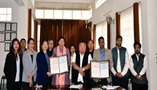
- The Department of Higher Education (DHE) of Nagaland and the India Meteorological Department (IMD) signed a landmark Memorandum of Understanding (MoU) aimed at strengthening weather forecasting and atmospheric research in the state.
Related Facts:
- Mission Mausam: Under this agreement, an X-band Polarimetric Doppler Weather Radar (DWR) will be installed at Dimapur Government College under the Central Government's 'Mission Mausam' scheme.
- Term: The agreement will be valid for 20 years, ensuring the development of meteorological infrastructure over the long term.
- Significance: This partnership will be instrumental in providing accurate local weather data for disaster management, policy planning, and public safety in a hilly state like Nagaland.
'Mission Mausam':
- Announcement: By the Union Cabinet in September 2024
- Launch: January 14, 2025
- Implementation Period: Between 2024-2026
- Timeline: Two years
- Budgetary Allocation: Two thousand crore rupees
- Goal: To be prepared for all weather conditions and make India a climate-smart nation
- Nodal Agency: Three key institutions of the Ministry of Earth Sciences -
- India Meteorological Department (IMD)
- National Centre for Medium-Range Weather Forecasting (NCMRWF)
- Indian Institute of Tropical Meteorology (IITM)
Key Technical Components:
- Observation Network: Installation of over 70 Doppler Weather Radars (DWR), 10 Wind Profilers, and 10 Radiometers across the country.
- Advanced Modeling: Development of 'Weather GPT' and use of AI (Artificial Intelligence) and Machine Learning for forecasting.
- Cloud Simulation: Establishment of a 'Cloud-Simulation Chamber' at IITM to understand and control rainfall and hailstorms.
- Supercomputing: Strengthening high-performance computing (HPC) systems to increase data processing speed.
India Meteorological Department (IMD):
- Establishment: It was established on January 15, 1875.
- 150 years: The department completed 150 years of its service on January 15, 2025, which was celebrated as 'Golden Jubilee' across the country.
- Headquarters History: Its first headquarters was in Calcutta (now Kolkata). Later, it was shifted to Shimla (1905), then to Pune (1928), and finally to New Delhi (Mausam Bhawan) in 1944.
- Nodal Ministry: It functions under the Ministry of Earth Sciences (MoES).
- Regional Centres: It has 6 Regional Meteorological Centres (RMCs): Mumbai, Chennai, New Delhi, Kolkata, Nagpur and Guwahati.
|
Jetty Development Approved at Paradip Port
- The Ministry of Ports, Shipping and Waterways approved the jetty development, including associated facilities, for handling green hydrogen, ammonia, and other liquid cargo at Paradip Port.
Related Facts:
- Estimated Cost: ₹797.17 crore
- Annual Capacity: 4 million tonnes (green hydrogen, ammonia, and liquid cargo)
- Implementing Agency: Paradip Port Authority (on a Build-Operate-Transfer/BOT basis)
- Capital Assistance: 20% (₹159.43 crore) assistance during the construction phase by Paradip Port Authority
- Project Objective: To provide infrastructure for green energy products, strengthen export logistics, and promote industrial investment in Odisha.
- Timeframe: Planned to be completed within 24 months.
- Financial Assistance: The Paradip Port Authority (PPA) will provide 20% of the project cost (approximately ₹159.43 crore) during construction.
Paradip Port:
- It is a major port on the east coast of India, located at the confluence of the Mahanadi River and the Bay of Bengal in the Jagatsinghpur district of Odisha.
- Established: 1962 by the Government of Odisha.
- It is located at the confluence of the Mahanadi River and the Bay of Bengal.
- In 1965, the Government of India took over ownership and management of the port from the Government of Odisha.
- On April 18, 1966, the Government of India declared Paradip Port as the 8th major port of India.
- The Paradip Port Trust is an autonomous corporation under the Port Trusts Act, 1963.
- It functions under the Ministry of Ports, Shipping and Waterways.
|
New National President of NCP

- Maharashtra's first female Deputy Chief Minister, Sunetra Pawar, was elected as the National President of the Nationalist Congress Party (NCP).
- Sunetra Pawar became the first female Deputy Chief Minister of Maharashtra on January 31, 2026.
- She assumed the position following the death of her husband and former Deputy Chief Minister, Ajit Pawar, (January 28, 2026, plane crash).
- She is the third and first female National President to hold this position, after Sharad Pawar and Ajit Pawar.
Maharashtra:
- Capital: Mumbai
- Sub-Capital (Winter): Nagpur
- Borders: Arabian Sea to the west, Gujarat and Dadra and Nagar Haveli to the northwest, Madhya Pradesh to the north, Chhattisgarh to the east, Telangana to the southeast, Karnataka to the south, and Goa to the southwest.
- Major Mountains: Sahyadri (Western Ghats) and Satpura mountain range to the north.
- Highest peak: Kalsubai (1,646 m). Major rivers: Godavari (Maharashtra's longest river), Krishna, Tapi, and Narmada.
- Establishment: May 1, 1960 (division of Bombay State along linguistic lines).
- Legislature: Bicameral (Legislative Assembly: 288 seats, Legislative Council: 78 seats).
|
Canadian Prime Minister on Four-Day Visit to India

- Canadian Prime Minister Mark Carney is on a four-day official visit to India from February 27 to March 2, 2026.
Related Facts:
- Mumbai (February 27-28): Carney began his visit in Mumbai, where he held meetings with Indian and Canadian CEOs, industry experts, and Canadian pension fund representatives.
- He will arrive in Delhi on March 1 and hold delegation-level talks with Prime Minister Modi at Hyderabad House on March 2.
- India was Canada's seventh-largest trading partner in 2024, with bilateral trade totaling $30.8 billion.
- Both leaders have set a target of reaching $50 billion in bilateral trade by 2030.
- Mark Carney took office as Canada's 24th Prime Minister in March 2025. This is his first official visit to India.
Canada:
- Capital: Ottawa
- Administrative division: Canada is divided into 10 provinces and 3 territories
- Official languages: Both English and French are official languages
- Currency: Canadian dollar
|
Exchange of MoUs between India and Israel
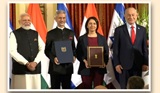
- India and Israel elevated their bilateral relations to the level of a "Special Strategic Partnership for Peace, Innovation and Prosperity" during Prime Minister Narendra Modi's visit to Israel.
- A total of 17 agreements and memorandums of understanding (MoUs) were exchanged between the two countries during this historic visit, covering a wide range of cultural, technical, and economic cooperation.
Key Agreements:
- Cultural Exchange: A Cultural Exchange Program (CEP) was signed for the period 2026-2029.
- Geophysical Exploration: An MoU was signed for cooperation in the exploration of mineral resources using advanced geophysical and artificial intelligence (AI) technologies.
- Fisheries and Aquaculture: A comprehensive framework for cooperation in this area was agreed upon, covering advanced aquaculture, disease management, mariculture, and seaweed cultivation.
- UPI Use: A landmark agreement has been signed between NPCI International (NIPL) and Israel's Masav to use India's Unified Payments Interface (UPI) in Israel.
- Artificial Intelligence (AI) in Education: A specific agreement was signed to promote the use of AI in education.
- Central and Emerging Technologies (iCET): The two countries have launched the 'India-Israel Partnership on Critical and Emerging Technologies' to collaborate in areas such as AI, quantum technologies, and critical minerals.
- Cyber Security: A Letter of Intent (LoI) was signed to establish a Cyber Center of Excellence (CoE) in India.
- Lothal Maritime Heritage: An agreement has been reached between the two countries to develop the National Maritime Heritage Complex (NMHC) in Lothal, Gujarat.
- Agricultural Innovation: An MoU has been signed between the Indian Council of Agricultural Research (ICAR) and Israel's Masav to establish the India-Israel Agricultural Innovation Center (IINCA).
|
ANVESH-2026 International Conference Inaugurated
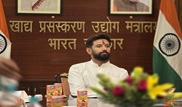
- Union Food Processing Industries Minister Chirag Paswan inaugurated the three-day international conference, ANVESH-2026, at the National Institute of Food Technology (NIFTEM-K), Kundli, Sonipat.
Related Facts:
- Conference Name: 'Advanced Next-Generation Approaches for Emerging and Sustainable Healthy Foods' (ANVESH-2026)
- Objective: To promote innovation in sustainable food systems, food technology, and value-added processing
- Global Participation: Experts, researchers, and policymakers from over 25 countries
|
International News
Winner in Gorton and Denton, England

- The Green Party of England has won a historic victory in the special parliamentary by-election for the Gorton and Denton constituency in Greater Manchester.
- This is the Green Party's first parliamentary by-election victory.
Related Facts:
- Candidate: Green Party candidate Hannah Spencer, a plumber and local councillor, won the seat. She received a total of 14,980 votes (40.7%).
- Labour Party Defeat: Prime Minister Keir Starmer's center-left Labour Party slipped to third place in the election. Labour candidate Angeliki Stogia received only 9,364 votes.
- Reform UK in Second Place: Matt Goodwin, candidate of the right-wing party Reform UK, came in second with 10,578 votes.
|
'Operation Ghazab Lil Haq'

- Pakistan's military launched 'Operation Ghazab Lil Haq' against Afghanistan, which Pakistan's Defense Minister declared a state of "open war" between the two countries.
Related Facts:
- Purpose and Meaning: 'Ghazab Lil Haq' means 'righteous anger' or 'righteous wrath.' Pakistan described it as a retaliatory action in response to alleged "unprovoked attacks" by the Afghan Taliban on border posts.
- Key Targets: Pakistani air force and ground forces targeted Taliban military bases, ammunition depots, and logistics centers in major Afghan cities—Kabul, Kandahar, Paktia, and Nangarhar.
- Background: Tensions escalated after Afghanistan claimed to have captured 19 Pakistani military posts and a key headquarters near the Durand Line and killed 55 Pakistani soldiers.
- Strategic importance: The conflict is based on the disputed Durand Line and Pakistan's accusation that the Taliban regime is harbouring groups like the TTP.
|
Reports & Indices
Global Residence Program Index 2026

- Greece retained its first place with a score of 73 in the Global Residence Program Index 2026, released by Henley & Partners.
- The United Arab Emirates (UAE) has entered the top three best-residence countries in the world for the first time.
- The UAE has jumped from fifth place to joint second.
Global Residence Program Index 2026:
- First place: Greece (score: 73)
- Joint second place: Italy, Switzerland, and the United Arab Emirates (UAE) (each with a score: 72)
- Third place: Portugal (score: 71)
- Fourth place: Australia (score: 69)
- Joint fifth place: Canada and Uruguay (each with a score: 68)
|
Defense News
India's First President to Fly as a Co-Pilot
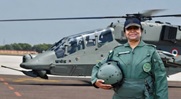
- President Draupadi Murmu flew a flight in the indigenous Light Combat Helicopter (LCH) 'Prachand' at the Jaisalmer Air Force Station.
- She became the first President of the country to fly as a co-pilot in a combat helicopter.
Related Facts:
- During the approximately 25-minute flight, the President conducted an aerial survey of the Jaisalmer Fort and Gadisar Lake and also observed a rehearsal of an attack on a tank target.
- Command: The mission was commanded by pilot Group Captain N.S. Bahua took over
- Self-reliant India: The President described the 'Prachanda' as a strong symbol of India's defense capabilities and self-reliance
- Military exercise: The flight was conducted as part of the Indian Air Force's largest-ever firepower demonstration, 'Vayu Shakti-2026,' held at the Pokhran range in Jaisalmer.
- Previous achievements: President Murmu has previously flown the Sukhoi-30 MKI (2023) and Rafale (2025) fighter jets.
- LCH Prachanda:
- Developed by Hindustan Aeronautics Limited (HAL), it is the world's only combat helicopter that can land and take off with weapons at an altitude of 5,000 meters (16,400 feet), making it suitable for areas like Siachen.
|
Important Days
95th Death Anniversary of Chandrashekhar Azad

- The death anniversary of the great revolutionary Chandrashekhar Azad is observed every year on February 27th, which this year marked his 95th death anniversary.
Related Facts:
- Born: July 23, 1906, in Alirajpur district, Madhya Pradesh
- Balidaan divas: He died on February 27, 1931, at Alfred Park (now called Chandrashekhar Azad Park) in Allahabad (now Prayagraj).
- Organization: He was the Commander-in-Chief of the Hindustan Socialist Republican Association (HSRA).
- The HSRA was founded in 1928 at Feroz Shah Kotla in New Delhi by Chandrashekhar Azad, Ashfaqulla Khan, Bhagat Singh, Sukhdev Thapar, and Jogesh Chandra Chatterjee.
- Key events: They played an active role in planning the Kakori train robbery (1925) and the assassination of J.P. Saunders (1928) to avenge the death of Lala Lajpat Rai.
|
Marathi Language Pride Day
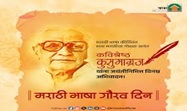
- Marathi Language Pride Day is celebrated every year on February 27th, commemorating the birthday of Marathi poet Vishnu Vaman Shirwadkar (Kusumagraj).
Related Facts:
- This day is celebrated to honor the richness of Marathi literature, language, and cultural heritage.
- It has been officially recognized by the Maharashtra government since 2013.
- In October 2024, the central government recognized Marathi as a 'Classical Language' of India (along with Pali, Prakrit, Assamese, and Bengali).
- Constitutional Status: Marathi is one of the 22 official languages listed in the Eighth Schedule of the Indian Constitution.
- Note that there is a difference between 'Marathi Language Pride Day' (February 27th) and 'Marathi Official Language Day' (May 1st). 'Official Language Day' is celebrated on May 1st to commemorate the establishment of the state of Maharashtra.
Vishnu Vaman Shirwadkar (Kusumagraj):
- was a renowned Marathi poet, playwright, and novelist.
- Born: February 27, 1912, in Pune, Maharashtra.
- Pseudonym: Kusumagraj
- Significance: He is considered one of the greatest poets and writers of modern Marathi literature, writing for freedom, justice, and social reform.
Major Achievements:
- Jnanpith Award (1987): The highest Indian literary honor.
- Sahitya Akademi Award (1974): For the play "Natsamrat."
- Padma Bhushan (1991): Awarded by the Government of India.
- Plays: "Natsamrat" (a milestone in Marathi theater), "Rajmukut" (an adaptation of Shakespeare's Macbeth).
- Social Contributions: He championed the rights of Dalits and the underprivileged and founded the "Lokhitwadi Mandal" (1950).
- Died: March 10, 1999, in Nashik. In
|
Nanaji Deshmukh's 16th Death Anniversary

- The death anniversary of Bharat Ratna awardee Nanaji Deshmukh, a renowned social worker and politician, is observed annually on February 27th, which this year marked his 16th death anniversary.
- He passed away on February 27th, 2010, in Chitrakoot, Uttar Pradesh, at the age of 93. In keeping with his life's ideals, he willed his body to AIIMS for medical research.
Related Facts:
- Born: October 11, 1916, in Hingoli district, Maharashtra
- He received higher education from the Birla Institute of Technology and Science (BITS) and, influenced by the nationalist ideas of Lokmanya Tilak, became a propagator of the Rashtriya Swayamsevak Sangh (RSS).
- Saraswati Shishu Mandir: In 1950, he established India's first Saraswati Shishu Mandir in Gorakhpur.
- Rashtradharma and Panchjanya: He played a key role in publishing magazines like Rashtradharma and Panchjanya, along with Atal Bihari Vajpayee.
- He was elected as a Member of Parliament from Balrampur (Uttar Pradesh) in the 1977 Lok Sabha elections.
- In recognition of his national service, he was nominated to the Rajya Sabha in 1999.
- Total Revolution: He was the chief strategist of the 1974 JP Movement (Jayaprakash Narayan). During the Emergency, he worked underground to restore democracy.
- Renouncing power: When the Janata Party formed the government in 1977, he was offered a cabinet minister position, which he declined to focus on organizational work. In 1980, at the age of 60, he announced his retirement from active politics.
- Chitrakoot Project: He worked on the model of 'Gramodaya' and 'Swavalamban' in Chitrakoot. His goal was to make 500 villages completely self-reliant.
- The country's first rural university: He established Mahatma Gandhi Chitrakoot Gramodaya University in Chitrakoot in 1991.
- Social Restructuring: He introduced the concept of 'dispute-free villages', where villagers could resolve their disputes through mutual consent instead of going to court.
Major Achievements and Honors:
- Padma Vibhushan: Awarded to him in 1999 for his social work.
- Bharat Ratna: In 2019, the Government of India posthumously awarded him the country's highest civilian honor.
- Body Donation: He decided to donate his body to AIIMS for the advancement of medical science.
|
Person In News
Defense Expert Maroof Raza Passes Away

- Maroof Raza, a former Indian Army Major and renowned defense expert, has passed away at the age of 67.
- He had been battling serious illnesses, including cancer and a lung infection, for some time and was undergoing treatment at Fortis Hospital in Gurugram.
Related Facts:
- He served in the Grenadiers Regiment of the Indian Army and was part of counter-insurgency operations in Northeast India.
- He authored several important books, including "Kashmir's Untold Story" and "Contested Lands," and hosted acclaimed military documentary series like "Line of Duty."
|


 Don't Have an Account?