23 February, 2026
Approval for Renaming of Kerala State
Thu 26 Feb, 2026
Context:
- The Union Cabinet, chaired by Narendra Modi, approved the proposal to rename the state of Kerala as “Keralam.”
- Background and Rationale:
- Linguistic Origin: In the Malayalam language, the state has always been referred to as “Keralam.” The word ‘Kera’ means coconut tree and ‘Alam’ means land, collectively meaning “Land of Coconut Trees.”
- Legislative Resolution: In June 2024, the Kerala Legislative Assembly unanimously passed a resolution urging the Centre to amend the First Schedule of the Constitution to officially change the name.
- Historical Context: The state was formed on 1 November 1956 during the linguistic reorganization of states, but the official English name remained “Kerala.”
Historical Evolution and Origin of the Name “Keralam”
Ancient Historical Evidence (Ancient Period):
- Ashokan Inscriptions: The earliest written reference to the region dates back to the 3rd century BCE. In Major Rock Edict II of Emperor Ashoka, the rulers of this region were referred to as “Keralaputra” (associated with the Cheras).
- Cultural Roots: Ancient texts referred to this land as “Keralam,” often interpreted as “Land of Coconuts” (Kera: coconut, Alam: land).
Aikya Kerala Movement (Early 20th Century):
- Linguistic Unification: During the 1920s and 1940s, the “Aikya Kerala Movement” emerged as a strong socio-political campaign.
- Objective: The movement aimed to unite Malayalam-speaking populations spread across Malabar (under British rule), and the princely states of Travancore and Cochin into a single administrative unit. This movement laid the ideological and political foundation for modern Keralam.
Administrative Reorganization (Post-Independence):
- Formation of Travancore-Cochin: On 1 July 1949, the princely states of Travancore and Cochin merged to form the Travancore-Cochin state.
- States Reorganization (1956): Finally, on 1 November 1956, under the States Reorganisation Act, the Malabar region was added, and the present state of Kerala came into existence.
Constitutional Provisions for Renaming a State
- The power to change the name of a state lies entirely with Parliament.
- • Article 3: Empowers Parliament to alter the name, boundaries, or create a new state.
- • Presidential Recommendation: Any Bill for renaming a state must be introduced in Parliament only after the recommendation of the President.
- • Opinion of the State Legislature: Before introduction, the President refers the Bill to the concerned State Legislature for its views within a specified time. However, the Legislature’s opinion is not binding on Parliament.
- • Parliamentary Approval: The Bill must be passed by a simple majority in both Houses of Parliament (Lok Sabha and Rajya Sabha).
- • Article 4 and Constitutional Amendment: After passage and Presidential assent, amendments are made to the First and Fourth Schedules of the Constitution. Under Article 4, such changes are not considered amendments under Article 368.
General Information about Kerala
- Capital: Thiruvananthapuram (also known as Trivandrum)
- Area: Approximately 38,863 sq km (about 1.18% of India’s total area)
- Official Language: Malayalam
- Other Languages: English, Tamil, Hindi (widely understood)
- State Formation: 1 November 1956 (merger of Travancore, Cochin, and Malabar)
- Nicknames: God’s Own Country, Spice Garden of India
- Neighbors: Karnataka (North), Tamil Nadu (East), Arabian Sea (West)
- Major Cities: Thiruvananthapuram, Kochi (Ernakulam), Kozhikode (Calicut), Thrissur, Kollam
Physiographic Divisions:
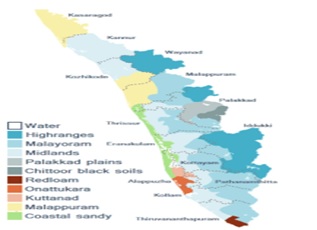
- Highland Region (Western Ghats): Anamudi (2,695 m), the highest peak in Peninsular India.
- Midland Region: Paddy fields, coconut groves, rubber, tea, and coffee plantations.
- Coastal Region: 580+ km coastline, backwaters (such as Alappuzha), lagoons, and beaches like Kovalam Beach, Varkala Beach, and Fort Kochi.
- Classical Dance: Kathakali and Mohiniyattam
- Martial Art: Kalaripayattu (one of the oldest martial arts in the world)
- Festivals: Onam and Vishu
Major Rivers:
- Periyar River (longest)
- Bharathapuzha
- Pamba River
Lakes:
- Vembanad Lake (longest lake in India)
- Ashtamudi Lake
National Parks of Kerala
- Eravikulam National Park (Idukki District) – Famous for shola grasslands, the endangered Nilgiri tahr, and the Neelakurinji flower (blooms once every 12 years) – Area: 97 sq km.
- Periyar National Park (Idukki and Pathanamthitta Districts) – Famous for Periyar Lake, tigers, elephants, and boat safaris – Area: 305 sq km.
- Silent Valley National Park (Palakkad District) – Famous for tropical evergreen forests and the lion-tailed macaque – Area: 89.52 sq km.