National News
Three Multitracking Projects Covering Eight Districts
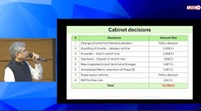
- The Cabinet Committee on Economic Affairs approved three multitracking projects covering eight districts in Maharashtra, Madhya Pradesh, Bihar, and Jharkhand.
Key Details of the Projects:
- Estimated Cost: ₹9,072 crore
- Network Expansion: This will add approximately 307 kilometers to the existing Indian Railways network.
- Timeframe: Targeted for completion by 2030-31
Key Projects:
- Gondia-Jabalpur Doubling (Maharashtra and Madhya Pradesh)
- Punarkh-Kiul 3rd and 4th Lines (Bihar)
- Gamharia-Chandil 3rd and 4th Lines (Jharkhand)
|
Development of the proposed civil enclave at Srinagar International Airport approved

- The Cabinet Committee on Economic Affairs approved the development of the proposed civil enclave at Srinagar International Airport.
Key Features:
- Estimated cost: Approximately ₹1,677 crore
- New Terminal Building: The new terminal will be built on an area of 71,500 square meters, of which 20,659 square meters will be the existing structure.
- Passenger Capacity: It is designed to handle 2,900 passengers during peak hours, with an annual capacity of 10 million (10 MPPA).
- Parking and Infrastructure: This includes the construction of a multi-level parking for 1,000 cars and barracks for security personnel.
- Expansion: The civil enclave will be spread over 73.18 acres of land and will now have a total of 15 aircraft parking bays (9 existing and 6 proposed) with the apron expansion.
- Sustainability: The project aims to achieve a 5-star GRIHA rating, with water harvesting and use of local eco-friendly materials.
|
Approval to extend the North-South Corridor from GIFT City to Shahpur
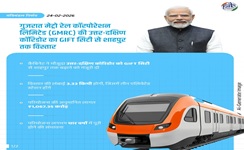
- The Cabinet Committee on Economic Affairs approved the extension of the existing North-South Corridor from GIFT City to Shahpur by Gujarat Metro Rail Corporation Limited.
Key Features:
- Extension: GIFT City to Shahpur (3.33 km)
- Cost: ₹1,067.35 crore
- Stations: 3 elevated stations
- Timeframe: 4 years
- Benefits: Expected daily passenger traffic of approximately 23,702 by 2029 and 58,059 by 2041
- Implementation: Gujarat Metro Rail Corporation (GMRC), a 50:50 joint venture between the Governments of India and Gujarat
|
Minimum Support Price for Jute Approved
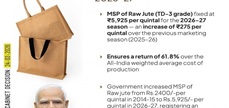
- The Cabinet Committee on Economic Affairs approved the Minimum Support Price for raw jute for the 2026-27 marketing season.
Key Highlights:
- New Support Price: The MSP for raw jute (TD-3 grade) has been fixed at ₹5,925 per quintal for the 2026-27 marketing season.
- Price Increase: This is an increase of ₹275 per quintal compared to ₹5,650 in the previous season (2025-26).
- Benefits to Farmers: This new price ensures a return of 61.8% over the all-India weighted average cost of production.
- Policy Basis: This decision is in line with the government's 2018-19 Budget promise to keep the MSP at least 1.5 times the cost of production.
- Nodal Agency: The Jute Corporation of India (JCI) will continue to function as the central government's nodal agency for price support operations.
Jute:
- The second most important fiber crop in India.
- Uses: Manufacture of sacks, ropes, carpets, rugs, tarpaulins, and other items.
- Temperature: Jute requires high temperatures between 25°C and 35°C for growth.
- Rainfall: Heavy and well-distributed rainfall, between 120 cm and 150 cm, is required.
- It is usually sown in February and harvested in October (as the crop takes 8-10 months to mature).
- Alluvial soils (light sandy or clay loamy soils) are considered most suitable for this crop.
- More than 99% of India's total jute production is concentrated in just five states: West Bengal, Bihar, Assam, Andhra Pradesh, and Odisha.
National Jute Board:
- Established: Under the National Jute Board Act, 2008.
- Ministry: An autonomous statutory body under the Union Ministry of Textiles.
- Headquarters: Kolkata, West Bengal
|
Approval of the proposal to change the name of the state of Kerala to Keralam
- The Union Cabinet approved the proposal to change the name of the state to Keralam.
- Following this approval, the President will send the 'Kerala (Alteration of Name) Bill, 2026' to the Kerala Legislative Assembly for its opinion.
Constitutional provisions for changing the name of a state:
- The power to change the name of a state lies solely with Parliament.
- Article 3: Empowers Parliament to change the name of any state, alter its boundaries, or create a new state.
- Presidential Recommendation: The President's recommendation is mandatory before any bill changing the name can be introduced in Parliament.
- State Legislative Assembly's Opinion: Before a bill is introduced in Parliament, the President sends it to the Legislative Assembly of the concerned state for its opinion. The Assembly must give its opinion within a specified timeframe. However, this opinion is not binding on Parliament.
- Passage in Parliament: The bill must be passed by a simple majority in both Houses of Parliament (Lok Sabha and Rajya Sabha).
- Article 4 and Constitutional Amendments: After the bill is passed and receives the President's assent, changes are made to the First and Fourth Schedules of the Constitution. According to Article 4, such changes are not considered "constitutional amendments" under Article 368.
- The Kerala Legislative Assembly passed a resolution on June 24, 2024, to change the state's name to Keralam.
Kerala:
- Location: On the southwestern coast of India
- Foundation Day: November 1, 1956 (under the States Reorganization Act, 1956)
- Capital: Thiruvananthapuram
- Official Language: Malayalam
- State Animal: Indian Elephant
- State Bird: Great Horned Hornbill
- State Tree: Coconut
- State Flower: Kanikkonna
- Major Rivers: Periyar, Bharathapuzha, Pamba
|
'My Bharat Budget Quest 2026' Contest
- Rajouri, a border district in Jammu and Kashmir, topped the national rankings in the 'My Bharat Budget Quest 2026' contest.
- A total of 14,402 youth from Rajouri district participated in this online quiz contest, the highest number of entries from any district in the country.
National Rankings:
- First Place: Rajouri (Jammu and Kashmir)
- Second Place: New Delhi District (11,097 entries)
- Third Place: East Delhi (8,307 entries)
Objective of the Contest: Organized by the Union Ministry of Youth Affairs and Sports, this initiative aimed to promote awareness and financial literacy among youth about the Union Budget 2026. The contest was held on the MY Bharat Portal from February 3 to February 22, 2026.
|
ECI and SEC's 'National Roundtable Conference'
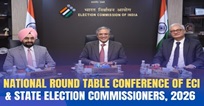
- The 'National Roundtable Conference' of the Election Commission of India (ECI) and State Election Commissioners (SECs) was held at Bharat Mandapam in New Delhi.
Related Facts:
- Historical Break: This conference was held after a gap of 27 years; the last conference was held in 1999.
- Chairmanship: Chief Election Commissioner Gyanesh Kumar chaired the conference. Election Commissioners Dr. Sukhbir Singh Sandhu and Dr. Vivek Joshi were also present.
- Participants: State Election Commissioners, Chief Electoral Officers (CEOs) from all 36 states and union territories, and their legal and technical experts participated.
Election Commission of India (ECI):
- Established: January 25, 1950
- Headquarters: New Delhi
- Constitutional Basis: Under Articles 324 to 329 of the Indian Constitution
- Nature: An independent and constitutional body
- Initially a single-member body
- Since 1993, a multi-member commission (1 Chief Election Commissioner + 2 Election Commissioners)
- National Voters' Day: January 25
- The 61st Amendment amended Article 326, reducing the voting age from 21 to 18.
- Part XV (15) of the Indian Constitution contains provisions relating to elections and the Election Commission, from Articles 324 to 329.
- Article 324: The superintendence, direction, and control of elections vests in the Election Commission.
- Article 325: No person shall be ineligible for inclusion in the electoral roll, nor shall he claim inclusion in any special electoral roll, on grounds of religion, race, caste, or sex.
- Article 326: Elections to the Lok Sabha and State Legislative Assemblies are held on the basis of adult suffrage. Currently, the minimum voting age is 18 years.
- Article 327: Power of Parliament to make provisions for elections to the Legislatures.
- Article 328: Power of the Legislature of a State to make provisions for elections to the Legislature of that State.
- Article 329: Bar to interference by courts in electoral matters. According to this, after the completion of the election, the election can only be challenged through an election petition.
- Article 243K: Elections for Panchayats
- Article 243ZA: Elections for Municipalities
- (The State Election Commission (SEC) is constituted under both these articles)
State Election Commission (SEC):
- It is an autonomous constitutional body responsible for conducting elections to local bodies in India.
- Constitutional Provisions:
- Article 243K: Superintendence, direction, and control of elections to Panchayats (Gram Panchayat, Kshetra Panchayat, Zila Panchayat).
- Article 243ZA: Conduct of elections to Municipalities (Municipal Corporation, Municipal Council, Nagar Panchayat).
- These were given constitutional status through the 73rd and 74th Constitutional Amendments (1992).
- It consists of a State Election Commissioner, appointed by the Governor of the respective state.
- The procedure for its removal from office is the same as for the removal of a High Court judge, which ensures its independence.
Main Functions:
- Local Elections: Conducting free and fair elections to urban and rural local bodies.
- Electoral Rolls: Preparing and updating the electoral rolls for local bodies.
- Delimitation: Delimiting wards and constituencies for local bodies.
- Code of Conduct: Enforcing the Model Code of Conduct during local elections.
- Difference from the ECI: The Election Commission of India (ECI) conducts elections to Parliament and State Legislative Assemblies, while the State Election Commissions (SECs) are responsible only for local bodies (panchayats and municipalities).
|
Launch of 'The Teacher App 2.0'

- Education Minister Dharmendra Pradhan launched 'The Teacher App 2.0', powered by AI, in collaboration with Bharti Airtel and CK12 Foundation.
- The app serves as an AI-based technological companion for school teachers, assisting them with teaching methods, content, and class preparation.
'The Teacher App 1.0':
- Launched in November 2024 by Union Education Minister Dharmendra Pradhan in New Delhi.
- Initially, it focused primarily on curriculum and teaching materials for classes 1 to 5 (primary).
|
The 'Vanjeevi Didi' Initiative
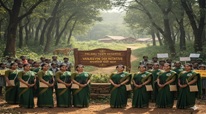
- Palamau Tiger Reserve (PTR), Jharkhand, has launched the 'Vanjeevi Didi' initiative.
Related Facts:
- Objective: To make local women active participants in forest and wildlife conservation and to raise awareness among communities about poaching and deforestation.
- Selection: Under this scheme, approximately 18 educated women from 17 selected villages have been selected as 'Vanjeevi Didi'.
- Role: These women will act as 'Conservation Ambassadors' in the village and raise awareness among families.
- Additional Responsibilities: They will also promote primary education, increase school enrollment, and disseminate information about government schemes.
- Incentive: Each Vanjeevi Didi will receive a monthly incentive of ₹3,000.
Palamau Tiger Reserve:
- Location: Located in the western part of the Chota Nagpur Plateau in the Latehar and Garhwa districts of Jharkhand.
- Structured Area: It includes parts of Betla National Park, Palamu Wildlife Sanctuary and Mahuadanr Wolf Sanctuary.
|
First National Counter-Terrorism Policy and Strategy, 'Prahaar'
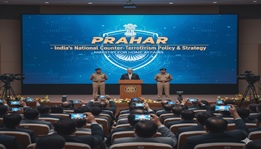
- The Union Home Ministry unveiled India's first national counter-terrorism policy and strategy, 'Prahaar'.
Prahaar stands for:
- P (Prevention): Intelligence-based prevention to prevent terrorist attacks
- R (Response): Prompt and proportionate response to threats
- A (Aggregating): Integration of internal capabilities through a 'whole-of-government' approach
- H (Human Rights): Processes based on human rights and the rule of law
- A (Attenuating): Reducing conditions that foster terrorism, including radicalization
- A (Aligning): Synergizing with international efforts against terrorism.
- R (Recovery): Building recovery and resilience through whole-of-society cooperation
|
International News
Netherlands' Youngest Prime Minister
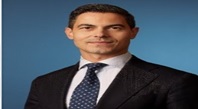
- 38-year-old Rob Jetten was sworn in as Prime Minister of the Netherlands, becoming the country's youngest and first openly LGBT Prime Minister.
Related Facts:
- Electoral Victory: His party, Democrats 66 (D66), won the October 2025 elections, defeating Geert Wilders' right-wing Freedom Party (PVV) in a close contest.
- Coalition Government: He is leading a minority coalition government, which includes D66, the Christian Democratic Appeal (CDA), and the People's Party for Freedom and Democracy (VVD).
- Predecessor: He replaced Dick Schoof, whose government fell after only 11 months.
Netherlands:
- Capital: Amsterdam (constitutional capital)
- Currency: Euro (€)
- Official Language: Dutch
- Continent: Europe
- Borders: East In – Germany, in the south – Belgium, in the north and west – North Sea
|
Economy and Banking
'National Monetization Plan 2.0'
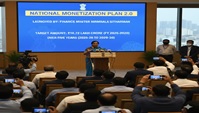
- Finance Minister Nirmala Sitharaman launched the 'National Monetization Pipeline 2.0' (NMP 2.0) for central ministries and public sector undertakings (PSUs).
- The plan provides an ambitious asset monetization roadmap for the five-year period from FY 2026 to 2030.
'National Monetization Plan 2.0':
- Target Amount: ₹16.72 lakh crore over the five years from 2025-26 to 2029-30
- Duration: FY 2026 to 2030
- Private Investment: Private sector investment of ₹5.8 lakh crore
- Key Sectors: It covers 12 infrastructure sectors, with roads (26%), railways (16%), ports (16%), and power (17%) being the main contributors.
- Methodology: The government retains ownership of the assets; only their revenue rights are leased to private entities for a fixed period (typically 15-35 years).
- Annual Target: The monetization target for FY 2026 has been set at ₹2.49 lakh crore.
National Monetization Pipeline 1.0:
- Launch: August 2021
- Key Objective: To capture value from existing infrastructure assets of the central government.
- Timeframe: FY 2022 to FY 2025 (4 years).
- Total Target: ₹6 lakh crore
- Achievement: Achieved approximately 89-90% (approximately ₹5.3 lakh crore) of the ₹6 lakh crore target in 4 years.
|
India's Economy in the Third Quarter of the Current Financial Year
- According to an SBI report, the country's economy grew by 8.1% in the third quarter of the current financial year.
Related Facts:
- Strong Growth: The Indian economy maintained its growth momentum, growing at 8.1% in the third quarter of fiscal year 2026 (FY26).
- Consumption Situation: Rural consumption remained strong due to positive trends in both the agricultural and non-agricultural sectors, while urban consumption also increased following the festive season.
- Sectoral Performance: Strong performance in manufacturing and other sectors boosted growth, which remained resilient amid global uncertainties.
- Base Year Change: This data comes at a time when India is revising its gross domestic product (GDP) base year from 2011-12 to 2022-23, with the new series due on February 27, 2026.
|
Indian Postal Department
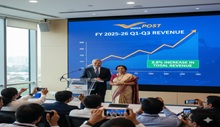
- The Indian Postal Department has recorded an 8.8% increase in its total revenue in the first three quarters of the financial year 2025-26.
Related Facts:
- This is an impressive achievement for the Indian Postal Department. According to data from India Post's official website, this 8.8% growth can be attributed primarily to the expansion of parcel business, e-commerce services, and digital banking (IPPB).
- Along with traditional postal services, the department's focus on financial inclusion and logistics has established it as a modern service provider.
|
India's Largest Single Export: 2025

- Apple iPhones became India's largest single export product in 2025.
- It overtook long-time leader diesel (Automotive Diesel Fuel) to achieve this position.
Related Facts:
- Total Export Value: iPhones worth approximately $23 billion (approximately ₹1.9 lakh crore) were exported from India during 2025 (January-December).
- Market Share: Apple alone accounted for 76% of India's total smartphone exports ($30.13 billion).
- Major Destination: The largest share of iPhones manufactured in India was exported to the United States (USA).
- Growth Rate: iPhone exports saw a significant jump compared to 2024; they jumped from $11.5 billion to $23 billion.
- PLI Scheme: The Indian government's Production-Linked Incentive (PLI) scheme has encouraged Apple to manufacture locally on a large scale.
|
Sports News
Rio Open 2026

- Argentina's Tomás Martín Echeverri won his first ATP Tour title by defeating Chile's Alejandro Tabilo at the Rio Open 2026.


 Don't Have an Account?