


 Don't Have an Account?




SSC Foundation Eklavya - 2 Offline Cum Online Batch Lucknow Branch
10 September, 2026



Enter your Email ID and we'll send you a link to get back into your account.

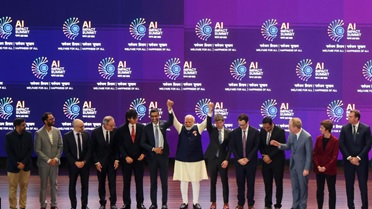

AI Impact Summit 2026
Sun 22 Feb, 2026
Why in News?
The AI Impact Summit 2026 was held in New Delhi from February 16–20, 2026, bringing together global political leaders, technology firms, researchers, and international organisations to deliberate on the future governance, accessibility, and economic impact of Artificial Intelligence (AI). The summit witnessed participation of lakhs of visitors and culminated in the adoption of the New Delhi Declaration on AI by 88 countries and organisations.
Background of Global AI Summits
International AI summits have been organised annually since 2023. The first meeting at Bletchley Park (UK) focused primarily on AI safety. Subsequent editions in Seoul (2024) and Paris (2025) expanded discussions toward innovation, investment, and global cooperation. The 2026 New Delhi summit marked a shift toward inclusive and development-oriented AI governance, especially addressing the needs of emerging economies and the Global South. These summits operate through a rotating host-country mechanism without a permanent institutional framework.
Major Objectives of the AI Impact Summit 2026
1. Democratisation of AI:
India emphasised that AI capabilities should be widely accessible rather than concentrated among a few nations or corporations. Special focus was placed on improving representation of under-resourced languages in large language models and ensuring developing countries benefit from AI tools.
2. Safe and Trusted AI:
The summit stressed building reliable AI systems with shared benchmarks, transparency standards, and risk-management practices to ensure secure deployment.
3. Positioning India as an AI Hub:
Domestically, the government aimed to attract global investments, strengthen computing infrastructure, and accelerate AI adoption in sectors such as healthcare, agriculture, education, and governance.
Working groups were constituted on themes such as human capital development, social empowerment, resilient AI systems, innovation efficiency, and economic growth through AI.
Key Outcomes of the Summit
New Delhi Declaration on AI
The principal outcome was the New Delhi Declaration, signed by 88 participating countries and organisations including major AI powers. The declaration adopted voluntary, non-binding commitments to encourage broader global participation.
Key proposals include:
The declaration highlighted global consensus that AI should serve economic growth, innovation, and social welfare.
Investment Announcements and Strategic Partnerships
Technology Launch: India’s Domestic LLM
Operational Challenges
Significance for India and the World
Major MOUs, Agreements & Investment Announcements (Summit 2026)
| Organisation / Partner | Commitment / Agreement |
| Reliance Industries | ₹10 lakh crore investment in domestic AI ecosystem |
| Adani Group | Comparable mega investment in AI infrastructure |
| Expansion of existing $15B India AI + data centre projects and India-US subsea cable | |
| OpenAI – Tata Group | 100 MW data-centre leasing + enterprise AI deployment |
| Anthropic – Infosys | Collaboration on advanced enterprise AI integration |
| Yotta Data Services | $2B GPU-based data centre expansion using Nvidia processors |
| India joining Pax Silica initiative | Cooperation on supply chains for electronics & critical minerals |
About Artificial Intelligence — Genesis
The field formally began at the Dartmouth Conference (1956) and has progressed from rule-based systems to machine learning, and now to Generative AI and Large Language Models (LLMs).
Indian Government AI Initiatives
| Initiative | Year | Description |
| National Strategy for AI (NITI Aayog) | 2018 | Blueprint for AI adoption in healthcare, agriculture, education, smart mobility |
| Digital India Programme | 2015 | Digital infrastructure expansion enabling AI ecosystem |
| Bhashini (National Language Translation Mission) | 2022 | AI-based multilingual translation platform for Indian languages |
| IndiaAI Mission x | 2024 | National program for AI compute infrastructure, datasets, startup funding |
| FutureSkills PRIME (MeitY + NASSCOM) | 2020 | Large-scale AI and digital workforce reskilling initiative |
10 September, 2026
24 August, 2026
06 August, 2026
28 July, 2026
27 July, 2026
22 July, 2026
20 July, 2026
26 May, 2026
08 May, 2026
20 April, 2026
