


 Don't Have an Account?




SSC Foundation Eklavya - 2 Offline Cum Online Batch Lucknow Branch
10 September, 2026



Enter your Email ID and we'll send you a link to get back into your account.

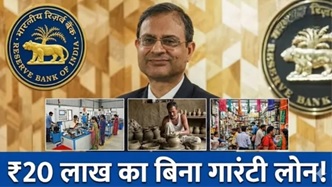

Collateral-Free Loan Limit for MSE Increased to ₹20 Lakh
Tue 10 Feb, 2026
Context:
The Reserve Bank of India (RBI) has doubled the collateral-free loan limit for Micro and Small Enterprises (MSEs) from ₹10 lakh to ₹20 lakh.
Key Provisions and Changes:
Positive Impact:
1. Improved Access to Credit : Most micro and small enterprises do not possess assets like land or property to offer as collateral. The earlier ₹10 lakh limit had become less effective due to inflation and rising business costs. Increasing the limit to ₹20 lakh will enable small traders, manufacturers, and service providers to access formal bank credit more easily instead of relying on expensive informal sources such as moneylenders.
2. Boost to Entrepreneurship and Employment : This step will promote small enterprises, especially in rural and semi-urban areas. Increased formal credit leads to higher investment, greater production, and more job creation. It aligns well with government initiatives such as Atmanirbhar Bharat and Make in India.
3. Benefits for Banks : Under schemes like CGTMSE, a significant portion of the credit risk (often 75–85%) is covered. This enables banks to expand lending more confidently in the MSE segment.
4. Impact on Women, SC/ST, and Young Entrepreneurs : Several government schemes (such as Stand-Up India and PMEGP) already provide collateral-free provisions. The increased limit under general MSE loans will further benefit these groups and encourage inclusive entrepreneurship.
Reserve Bank of India (RBI) :
10 September, 2026
24 August, 2026
06 August, 2026
28 July, 2026
27 July, 2026
22 July, 2026
20 July, 2026
26 May, 2026
08 May, 2026
20 April, 2026
