09 February, 2026
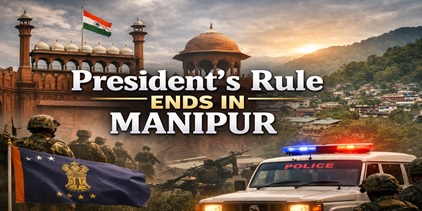
President’s Rule Ends in Manipur
Sun 08 Feb, 2026
Context :
President Droupadi Murmu officially announced the end of President’s Rule in Manipur.
Key Points :
- President’s Rule imposed: From 13 February 2025, after the resignation of the then Chief Minister N. Biren Singh
- Reason: Deterioration of law and order due to ethnic violence between the Meitei and Kuki-Zo communities
- Constitutional provision for imposition: Under Article 356; it was later extended for six months
Meaning of President’s Rule :
- The state government is suspended and the administration of the state is taken over directly by the Central Government
- The Governor functions as the constitutional head, while administration is carried out in the name of the President
- The State Legislative Assembly may either be dissolved or kept in a state of “suspended animation”
Constitutional Basis :
- Article 355: Empowers the Union Government to ensure that states function in accordance with the Constitution
- Article 356: If a state government fails to function constitutionally, the President may impose President’s Rule on the recommendation of the Governor or at the President’s discretion
- Article 365: If a state fails to comply with the directions of the Union, the President may declare that the constitutional machinery of the state has failed
- Duration: President’s Rule initially lasts for six months and can be extended up to three years with parliamentary approval every six months
- Extension beyond three years: Requires a constitutional amendment (e.g., the 67th and 68th Amendments for Punjab during militancy)
- Revocation: The President can revoke President’s Rule at any time without parliamentary approval
- Fundamental Rights: President’s Rule does not curtail the Fundamental Rights of citizens
Other Grounds for Imposition of President’s Rule
S.R. Bommai Case (1994) – ‘Justifiable’ Grounds :
- Hung Assembly: When no party or coalition is able to form a government after elections
- Loss of majority: When the ruling party loses majority and no alternative government is possible
- Violation of secularism: When the state government acts against the basic structure of the Constitution (e.g., secularism)
- Administrative breakdown: When the state government completely fails to control internal disturbances or insurgency, leading to administrative paralysis
‘Unjustifiable’ Grounds (President’s Rule cannot be imposed on these bases) :
- Maladministration: Mere administrative inefficiency or allegations of corruption are not sufficient grounds
- Defeat in Lok Sabha elections: Loss of the ruling party in parliamentary elections cannot be a basis for dissolving the State Assembly
- Internal party disputes: Article 356 cannot be used to resolve internal conflicts within the ruling party
- Note: The decision to impose President’s Rule is subject to Judicial Review. If the court finds the grounds to be mala fide, it can restore the dismissed government
Duration and Extension :
- Initial period: Six months after parliamentary approval
- Maximum period: Can be extended up to three years with parliamentary approval every six months
- Conditions for extension beyond one year (44th Constitutional Amendment):
- A National Emergency must be in operation in the whole of India or in the concerned state
- The Election Commission must certify that holding elections in the state is difficult
Legislative Powers of the State during President’s Rule :
- With the proclamation of President’s Rule, the legislative powers of the State Legislature vest in Parliament
- Laws on State List: Parliament is empowered to legislate on subjects in the State List for that state
- State Budget: The annual financial statement (budget) of the state is also passed by Parliament
Delegation of Legislative Powers :
- Due to the heavy workload of Parliament, Article 357 provides for delegation of legislative powers
- Power to the President: Parliament may delegate its power to make laws for the state to the President or any other authority specified by him
- President’s Acts: Laws made by the President under this power are called “President’s Acts”
- Ordinance-making power: If Parliament is not in session, the President may issue ordinances for the administration of the state (a power normally exercised by the Governor)
- Expenditure from the Consolidated Fund: When the Lok Sabha is not in session, the President may authorize expenditure from the state’s Consolidated Fund, subject to later parliamentary approval
Judiciary of the State during President’s Rule :
- While the executive and legislative powers of the state vest in the Centre, the constitutional position and powers of the High Court remain unaffected
- Constitutional provision: Article 356 grants extensive powers regarding state administration but clearly states that the President cannot suspend or assume the powers of the High Court
- Judicial independence: The powers, jurisdiction, and functioning of the High Court remain exactly the same as before the imposition of President’s Rule
- Judicial Review: The proclamation of President’s Rule is subject to judicial review. The High Court or Supreme Court may examine whether it was imposed on mala fide grounds
- In the S.R. Bommai case (1994), the Supreme Court held that if President’s Rule is imposed arbitrarily or unconstitutionally, the court can strike it down and revive the dissolved assembly
Formation of New Government in Manipur
- On 4 February 2026, immediately after the withdrawal of President’s Rule, a new elected government was formed in Manipur under the leadership of senior BJP leader and former Speaker Yumnam Khemchand Singh
- Yumnam Khemchand Singh took oath as the 13th Chief Minister of Manipur
- The oath of office was administered by Governor Ajay Bhalla
- Deputy Chief Ministers: To ensure balance and inclusive governance among different ethnic communities, two Deputy Chief Ministers were appointed:
- Nemcha Kipgen: She became Manipur’s first woman Deputy Chief Minister, representing the Kuki-Zo community. She took oath virtually from Manipur Bhavan, New Delhi
- Losii Dikho: Leader of the Naga People’s Front (NPF), representing the Naga community, sworn in as the second Deputy Chief Minister
Manipur: General Information
- Known as the “Jewel of India”
- Also referred to as the “Orchid Basket of India”
- Merged with India in 1947, became a Union Territory in 1956, and attained full statehood on 21 January 1972
- Capital: Imphal
- Location: One of the “Seven Sisters” states of North-East India
- Boundaries: Nagaland (north), Mizoram (south), Assam (west), and shares an international border with Myanmar (east)
- Official language: Manipuri (Meitei)
- Major festivals: Kut, Cheiraoba, Yaoshang, Kang Chingba
- Major rivers: Imphal, Iril, Nambul, and Barak
Loktak Lake:
- The largest freshwater lake in North-East India
- Home to the world’s only floating national park — Keibul Lamjao National Park
- Manipuri Dance: One of the classical dance forms of India, known for its grace and “Ras Leela”
- Ima Keithel: Located in Imphal, it is the world’s only market run entirely by women
Social Structure :
- Meitei: Primarily inhabit the valley regions
- Naga: Major tribal communities residing in the hill areas
- Kuki: Major tribal communities residing in the hill areas
Wildlife :
- State animal: Sangai (Brow-antlered Deer)
- State bird: Mrs. Hume’s Pheasant
- State flower: Shirui Lily