India Semiconductor Mission 2.0
 
  • Mobile Menu
HOME BUY MAGAZINEnew course icon
LOG IN SIGN UP

Sign-Up IcanDon't Have an Account?


SIGN UP


Login Icon

Have an Account?


LOG IN
 

or
By clicking on Register, you are agreeing to our Terms & Conditions.


or


India Semiconductor Mission 2.0

Tue 03 Feb, 2026

Context:

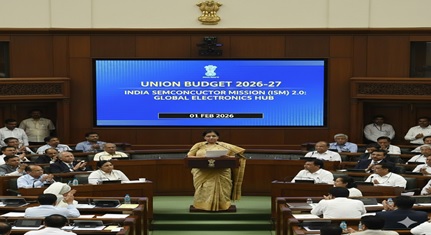
  • The Union Finance Minister Nirmala Sitharaman, while presenting the Union Budget 2026–27 in Parliament on 1 February 2026, formally announced the launch of the India Semiconductor Mission (ISM) 2.0 with the objective of making India a global electronics hub.

Key Points:

  • Primary Objective:To develop India as a comprehensive semiconductor ecosystem, rather than limiting it only to chip assembly, and to expand the Indian semiconductor market to USD 100–110 billion by 2030.
  • Key Goals:To promote domestic production of semiconductor equipment and raw materials, develop Indian Intellectual Property (IP), and establish a robust supply chain.
  • Financial Allocation:An initial provision of ₹1,000 crore has been made for the financial year 2026–27.
  • Nodal Ministry:Ministry of Electronics and Information Technology (MeitY)
  • Research & Development (R&D):Industry-led research and training centres will be established under this mission to develop a skilled workforce.
  • Support to Fabless Startups:The government aims to support at least 50 fabless chip companies through the Design Linked Incentive (DLI) Scheme.
  • Technological Advancement:The mission will focus on advanced technology nodes such as 3-nanometer (3nm) and 2-nanometer (2nm).
  • Strategic Aim:To make India a key player in the global semiconductor supply chain and reduce dependence on China and Taiwan.
  • Focus Area:The focus has shifted beyond fabrication (Fab) to include equipment manufacturing, material production, and promotion of Indian IP-based design.
  • Investment:The government has allocated ₹40,000 crore for the Electronics Component Manufacturing Scheme (ECMS).
  • Skill Development:Industry-based research and training centres will be set up to create a skilled workforce.

India Semiconductor Mission 1.0

  • Launch:December 2021, with a total outlay of ₹76,000 crore
  • Main Objective:To build a self-reliant semiconductor and display manufacturing ecosystem and position India as a global electronics manufacturing hub.
  • Nodal Ministry:Ministry of Electronics and Information Technology (MeitY)

Major Schemes under ISM

  • Semiconductor Fabs Scheme: Up to 50% financial assistance for wafer fabrication units.
  • Display Fabs Scheme: Up to 50% support of project cost for display fabrication units.
  • Design Linked Incentive (DLI) Scheme:Financial assistance across design, development, and deployment stages.
  • Semicon India: A flagship platform connecting industry, policymakers, academia, and startups to promote collaboration and investment.

Major Achievements

  • Large Investments & Projects: Approval granted for 10+ semiconductor, display fabs, and OSAT units across 6 states.
  • Key Investments: Major investments by Micron (₹22,516 crore), Tata Electronics with PSMC (₹91,000 crore), Tata Semiconductor Assembly & Test (₹27,000 crore), and CG Power (₹7,600 crore).
  • Indigenous Chip: India’s first indigenous semiconductor chip ‘Vikram’ was developed by ISRO.
  • Data & AI Capacity Building: More than 67,000 students across 315+ academic institutions have been trained in chip design.
  • Startup Promotion: Under the DLI Scheme, 24 startups received support and 14 startups secured venture capital funding.
  • Infrastructure Development: India’s first end-to-end OSAT pilot line was launched in Sanand, Gujarat.

What is a Semiconductor?

  • Semiconductors are materials whose electrical conductivity is lower than conductors (such as copper and aluminium) but higher than insulators (such as glass and rubber).
  • Their key feature is that their electrical conductivity can be altered by temperature, light, or other external factors.

Properties of Semiconductors

  • Conductivity: Intermediate conductivity between conductors and insulators.
  • Temperature Dependence: Conductivity increases with an increase in temperature.
  • Effect of Impurities: Conductivity can be controlled by adding small amounts of impurities.
  • Effect of Light: Some semiconductors generate electric current when exposed to light.

Types of Semiconductors

  • Intrinsic Semiconductors: Pure semiconductors such as silicon and germanium.
  • Extrinsic Semiconductors: Semiconductors formed by adding impurities, such as n-type and p-type semiconductors.

Uses of Semiconductors :

Semiconductors form the backbone of electronic devices and are used in:

  • Transistors:For amplification, switching, and signal processing.
  • Diodes:To allow current to flow in only one direction.
  • Integrated Circuits (ICs):Containing millions of transistors, used in computers, mobile phones, and other electronic devices.
  • Solar Cells: Convert sunlight directly into electrical energy.

Latest Courses