Context
The Pax Silica initiative has emerged as a new multilateral framework aimed at securing critical technology supply chains, particularly those related to semiconductors, Artificial Intelligence (AI), and rare earth elements (REEs). The initiative gained global attention after the United States convened the inaugural Pax Silica Summit on December 12, 2025, highlighting the growing urgency to protect advanced manufacturing ecosystems from coercive dependencies and geopolitical disruptions.
About Pax Silica
The term “Pax Silica” combines Pax (Latin for peace) and Silica (a core input in semiconductor manufacturing), symbolising the idea that stable and trusted technology supply chains are essential for peace, prosperity, and economic security in the 21st century. The Pax Silica Declaration emphasised three core objectives:
- Reducing coercive dependencies
- Securing global tech and AI supply chains
- Building trusted digital infrastructure
Why Pax Silica Matters
- The global economy is undergoing a structural transformation. While traditional North–South divides in income and resource consumption persist, new frontier technologies—semiconductors and AI—have become the engines of economic power. These technologies influence everything from healthcare and finance to defence, logistics, and governance.
- However, these advanced technologies are heavily dependent on rare earth elements (REEs) and complex global supply chains. China’s dominance in REEs, both in extraction and processing, has emerged as a strategic vulnerability for many countries. In recent years, China has demonstrated its willingness to weaponise supply chains, including suspending REE exports in response to geopolitical disputes. India itself experienced disruptions in the import of rare-earth magnets, affecting its automobile and electronics sectors.
- The COVID-19 pandemic further exposed the fragility of over-concentrated supply chains, reinforcing the need for diversification and resilience. Pax Silica is therefore best understood as a strategic response to these systemic risks, rather than a purely economic or technological initiative.
Membership and Strategic Composition
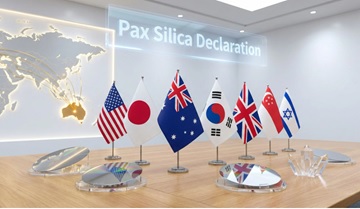
The Pax Silica grouping brings together countries with complementary strengths across the technology value chain.
- The United States and Japan are global technology leaders.
- Australia is a major exporter of lithium and holds significant REE reserves.
- The Netherlands, through firms like ASML, dominates advanced semiconductor lithography.
- South Korea is a global leader in memory chip manufacturing.
- Singapore has long been integrated into global chip manufacturing networks.
- Israel excels in AI software, defence technologies, and cybersecurity.
- The United Kingdom has the world’s third-largest AI market.
- Qatar and the UAE bring deep capital pools and ambition to build AI-driven economies.
|
Entities such as Canada, the European Union, the OECD, and Taiwan participated as observers, indicating the initiative’s potential future expansion.
India’s Position: Opportunities and Constraints
Although India was not invited to the inaugural Pax Silica Summit, the new U.S. Ambassador to India, Sergio Gor, has indicated that India will soon be invited to join. India’s interest in Pax Silica is driven by several factors:
Opportunities
- India possesses robust digital public infrastructure and a rapidly expanding AI market.
- The government has launched Semiconductor and AI Missions with substantial financial allocations.
- Private players such as the Tata Group, along with foreign investors like Micron, have begun building semiconductor capacity in India.
- India’s growing pool of highly trained engineers, many educated in the U.S., could power future AI and chip ecosystems.
- India already collaborates with Pax Silica members such as Japan, Singapore, and Israel in semiconductor supply chains.
Challenges
India would be the first developing country and the first non-U.S. ally to join Pax Silica. This creates potential expectation gaps, particularly regarding:
- Strategic alignment with U.S. geopolitical priorities
- Export control regimes
- Industrial policies such as subsidies, preferential procurement, and import regulations
India will be keen to ensure that strategic autonomy is not diluted, especially as it seeks policy space to nurture its infant semiconductor and AI industries.
Geopolitical and Economic Implications
- Pax Silica signals the emergence of two parallel global supply chains—one centred around China and another around Pax Silica countries.
- China has shown little inclination to build REE supply chains sensitive to the needs of emerging economies. Given India’s long history of collaboration with Western technology firms, it may gradually gravitate toward the Pax Silica ecosystem.
- However, given ongoing trade frictions and policy divergences with the U.S., India is likely to adopt a calibrated and cautious approach, engaging in dialogue to shape Pax Silica’s evolution rather than passively joining it.
Conclusion
- Pax Silica reflects a broader shift from globalisation to strategic interdependence, where supply chains are no longer purely economic but deeply political.
- For India, participation could accelerate its ambitions in AI and semiconductors, but only if managed carefully to protect policy autonomy and developmental priorities.


 Don't Have an Account?