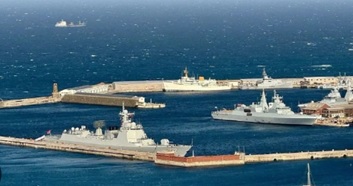
BRICS Naval Drill – South Africa-Led ‘Will for Peace 2026’
 
  • Mobile Menu
HOME BUY MAGAZINEnew course icon
LOG IN SIGN UP

Sign-Up IcanDon't Have an Account?


SIGN UP


Login Icon

Have an Account?


LOG IN
 

or
By clicking on Register, you are agreeing to our Terms & Conditions.


or


BRICS Naval Drill – South Africa-Led ‘Will for Peace 2026’

Sun 18 Jan, 2026

Context

Recently, India’s Ministry of External Affairs (MEA) clarified that the “Will for Peace 2026” naval exercise, held in South African waters, was not an official or institutional activity of the BRICS grouping. Instead, it was a South Africa–led independent initiative, conducted at the national level. This clarification assumes importance in the context of expanding BRICS membership, evolving geopolitical alignments, and India’s calibrated approach to multilateral security engagements.

Background of the Exercise

  • The “Will for Peace 2026” was a week-long naval drill hosted by South Africa, involving navies from China, Russia, Iran, Egypt, Indonesia, Saudi Arabia, and the United Arab Emirates (UAE).
  • Despite South Africa being a BRICS member, the exercise was not conducted under the BRICS framework. Both India and Brazil opted out of participation.
  • India’s MEA emphasized that India’s structured maritime cooperation with Brazil and South Africa takes place under the IBSAMAR naval exercise, a trilateral arrangement involving the navies of India, Brazil, and South Africa.
  • This distinction was crucial to avoid conflating an ad-hoc multinational drill with formal BRICS security cooperation.

Why India Opted Out

  • India’s decision to stay away reflects its consistent diplomatic position that BRICS is not a military or security alliance. Participation in a naval exercise involving countries such as Iran and Russia—at a time of heightened geopolitical tensions—could have led to misinterpretations regarding India’s strategic posture.

By opting out, India reinforced three key principles:

  1. Strategic Autonomy – India avoids alignment with military groupings that could compromise its independent foreign policy.
  2. Issue-based Engagement – India prefers clearly defined platforms like IBSAMAR for maritime cooperation.
  3. Civilian Nature of BRICS – BRICS primarily focuses on economic cooperation, development finance, global governance reform, and South-South cooperation.

Brazil’s decision to opt out echoed similar concerns, highlighting internal diversity within BRICS regarding security engagements.

Implications for BRICS

  • The episode underscores that BRICS lacks an institutionalized defence or military dimension. Unlike NATO or QUAD, BRICS remains a loosely coordinated intergovernmental platform, where members retain full autonomy over defence and security choices.
  • With the recent expansion of BRICS to include countries from West Asia and Africa, the grouping has become more diverse but also more complex. Divergent strategic priorities make consensus on military cooperation unlikely. India’s clarification helps preserve BRICS’ identity as a development-centric and reform-oriented grouping, rather than a geopolitical bloc.

India’s Role as BRICS Chair (2026)

India assumed the BRICS Chairmanship on January 1, 2026, and is hosting the 18th BRICS Summit. As Chair, India is expected to emphasize:

  • Reform of global financial institutions
  • Strengthening South-South cooperation
  • Inclusive and sustainable development
  • Technological cooperation and digital public infrastructure
  • By distancing BRICS from unofficial military exercises, India aims to maintain the credibility and neutrality of the grouping, especially in the Global South.

Conclusion

  • The South Africa-led “Will for Peace 2026” naval drill highlights the limits of BRICS as a security platform and the importance of clear diplomatic signaling. India’s response reinforces its commitment to strategic autonomy, rule-based multilateralism, and non-militarization of BRICS. As BRICS expands and India leads the grouping in 2026, such clarity will be essential to preserve unity amid diversity.

BRICS: Key Factual Information

Nature Intergovernmental organization of emerging economies
Objective South-South cooperation, global governance reform
Original Members Brazil, Russia, India, China (2006); South Africa (2010)
New Members (Jan 1, 2024) Egypt, Ethiopia, Iran, UAE
Latest Member Indonesia (joined January 6, 2025)
Partner Country Category Introduced in 2024
Current Partners Belarus, Bolivia, Cuba, Kazakhstan, Malaysia, Nigeria, Thailand, Uganda, Uzbekistan, Vietnam
2025 Chair Brazil
2025 Theme “Strengthening Global South Cooperation for More Inclusive and Sustainable Governance”
2026 Chair India
2026 Event India hosting the 18th BRICS Summit
Security Alliance? No (BRICS is not a military bloc)

Latest Courses