15 December, 2025
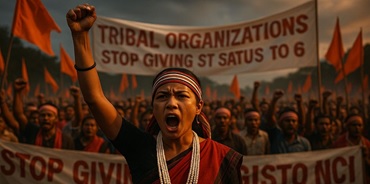
Opposition by the Coordination Committee of Tribal Organisations of Assam (CCTOA)
Tue 06 Jan, 2026
Context:
- The apex body of major tribal organisations in Assam, the Coordination Committee of Tribal Organisations of Assam (CCTOA), has strongly opposed a recommendation made by the Group of Ministers (GoM) of the Assam government.
Key Points:
- The report recommends granting Scheduled Tribe (ST) status to six communities: Tai Ahom, Chutia, Moran, Matak (Motok), Koch-Rajbongshi, and Tea Garden Tribes (Tea Tribes/Adivasis).
Main Reasons for CCTOA’s Opposition:
1. Constitutional and Legal Grounds:
-
- CCTOA argues that the proposal is unconstitutional and illegal, as these communities do not meet the criteria laid down by the Lokur Committee (1965), such as primitive traits, distinct culture, geographical isolation, and backwardness.
2. Historical Evidence:
- The Constitution (Scheduled Tribes) Order, 1950 and the Bordoloi–Thakkar Sub-Committee Report (1947) did not include these communities under STs.
- Communities like Tai Ahom, Chutia, Moran, and Matak were considered part of the mainstream Assamese society.
3. Koch–Rajbongshi Issue:
- According to CCTOA, Koch and Rajbongshi are separate communities.
- In West Bengal, Koch community has Scheduled Caste (SC) status; therefore, granting ST status to them in Assam is not justified.
4. Tea Tribes Issue:
- Tea garden workers were brought from outside Assam.
- Several committees (including those of 1947 and 1965) refused to recognise them as STs.
5. Political Motive Allegation:
- CCTOA alleges that the demand is mainly for political reservation (from Panchayats to the State Assembly), as OBCs are not entitled to political reservation.
6. Impact on Existing ST Rights:
- Granting ST status to these communities would dilute the rights of existing STs, affecting their reservation benefits, jobs, education, and political representation.
Criteria for Scheduled Tribe (ST) Status:
- The Indian Constitution does not explicitly define ST criteria, but they are based on the recommendations of the Lokur Committee (1965).
- Under Article 342, the President notifies communities as STs through a public notification.
1. Traditional Economy:
- Ancient livelihoods such as hunting, gathering, and food collection
- Pre-modern socio-economic characteristics (limited modernisation)
2. Distinct Culture and Isolation:
- Separate language, dialect, or mode of communication
- Unique customs, religious practices, and traditions
- Geographical/social isolation (residence in hilly or forest areas)
3. Social and Educational Backwardness:
- Lower literacy rates compared to the mainstream population
- Economic vulnerability (low income, high poverty)
- History of exploitation
Procedure for Inclusion in the ST List:
1. Recommendation by the State Government:
- The concerned state government submits a proposal to the Centre.
2. Approval by the Registrar General of India (RGI):
- RGI examines the community based on prescribed criteria.
3. Consultation with the National Commission for Scheduled Tribes (NCST):
- NCST’s opinion is sought.
4. Parliamentary Approval:
- Finally, the community is included in the ST list through a law passed by Parliament, followed by a Presidential Order.