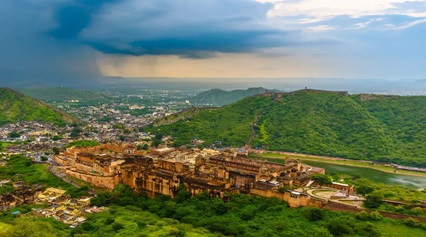
Supreme Court Takes Suo Motu Cognizance of the Conservation of the Aravalli Hills
 
  • Mobile Menu
HOME BUY MAGAZINEnew course icon
LOG IN SIGN UP

Sign-Up IcanDon't Have an Account?


SIGN UP


Login Icon

Have an Account?


LOG IN
 

or
By clicking on Register, you are agreeing to our Terms & Conditions.


or


Supreme Court Takes Suo Motu Cognizance of the Conservation of the Aravalli Hills

Mon 29 Dec, 2025

Context

  • The Supreme Court of India has taken suo motu cognizance of concerns arising from the recent change in the definition of the Aravalli Hills, particularly the adoption of a height-based criterion of 100 metres.

Key Points

  • Date of Hearing: 29 December 2025
  • Bench: Vacation Bench comprising
    • Chief Justice Suryakant
    • Justice J.K. Maheshwari
    • Justice A.G. Masih
  • Reason for Suo Motu Action:
    • Environmentalists and the general public have raised strong objections, warning that the revised definition could open large areas of the Aravalli region to mining and ecological degradation.
    • In view of the urgency, the Supreme Court constituted a Vacation Bench to hear the matter.
  • Cause for Concern:
    • In November 2025, the Supreme Court accepted a new elevation-based definition of the Aravalli Hills (land rising more than 100 metres above local relief).
    • As a result, over 90% of smaller hills, hillocks, and slopes were excluded from the definition, potentially making them available for mining and other activities, thereby posing a serious environmental threat.
  • Significance of the Aravallis:
    • The Aravalli range plays a crucial role in preventing desertification, conserving groundwater, and preserving biodiversity in north-western India.
    • It acts as a natural ecological shield for the Delhi–NCR region.
  • Future Course of Action:
    • The Court will examine the matter to consider the adoption of uniform and scientifically sound criteria applicable across states and to explore measures for an effective ban on mining in ecologically sensitive areas.

Background

  • In May 2024, the Supreme Court constituted a committee under the leadership of the Ministry of Environment, Forest and Climate Change (MoEFCC).
  • The committee included representatives from State Governments, the Forest Survey of India (FSI), the Geological Survey of India (GSI), and the Central Empowered Committee (CEC).
  • The committee submitted its report in October 2025.
  • On 20 November 2025, a Bench headed by the then Chief Justice of India Justice B.R. Gavai accepted the committee’s recommendations.

New Definitions

  • Aravalli Hill:
    • Any landform rising 100 metres or more above the local relief, along with its associated slopes and contiguous areas.
  • Aravalli Range:
    • A group of two or more such hills located within a radius of 500 metres of each other.

Concerns Raised

  • Environmentalists, experts, and opposition parties allege that the new definition excludes nearly 90% of the Aravalli region from protection.
  • Most smaller hills, slopes, and hillocks are less than 100 metres in height, thereby losing statutory safeguards.

Potential Consequences

  • Increased desertification, including the eastward expansion of the Thar Desert.
  • Severe impact on groundwater recharge, aggravating water scarcity in Delhi–NCR.
  • Loss of biodiversity and wildlife corridors.
  • Escalation in mining and real estate activities.

Protective Directions Issued by the Supreme Court

(Order dated 20 November 2025)

  • Complete ban on new mining leases until a Sustainable Mining Plan for the Aravallis (MPSM) is prepared.
  • Prohibition of mining in core/inviolable zones, including protected areas, eco-sensitive zones, tiger reserves, wetlands, etc. (with limited exceptions for critical minerals).
  • ICFRE directed to prepare the MPSM, including identification of additional protected areas.
  • Strict monitoring of existing mines and mandatory compliance with environmental norms.
  • Central Government’s stand: More than 90% of the Aravalli area remains protected, and the new definition is map-verifiable.

Response of the Central Government

  • 24 December 2025:
    • MoEFCC wrote to the Chief Secretaries of Haryana, Rajasthan, and Gujarat, directing the enforcement of a complete ban on new mining leases and expansion of protected areas.
  • Statement by Environment Minister Bhupender Yadav:
    • “No relaxation has been granted; over 90% of the area remains protected. Misleading narratives are being spread.”

The Aravalli Range

Meaning and Geological Significance

  • The term ‘Aravalli’ is derived from Sanskrit, meaning “line of mountains.”
  • It is among the oldest mountain ranges in the world and a key geographical feature of India.
  • Formed during the Proterozoic Era (around 2–3 billion years ago), the range has undergone extensive erosion and now exists largely as residual hills.

Location and Extent

  • Region: North-western India
  • Extent: Stretches from Palanpur in Gujarat in a south-west to north-east direction through Rajasthan and Haryana, up to Delhi.
  • Total Length: Approximately 692 km
  • Major Share: About 80% (around 550 km) lies in Rajasthan.
  • Delhi Ridge: The Raisina Hills, on which the Rashtrapati Bhavan stands, are part of the Aravalli system.
  • Highest Peak: Guru Shikhar, Mount Abu (Sirohi district, Rajasthan)
    • Height: 1,722 metres (5,650 feet)

Major Features

  • Divided into two main sections:
    • Sambhar–Sirohi Range (southern, higher)
    • Sambhar–Khetri Range (northern, lower)
  • Rock Types: Predominantly quartzite, granite, gneiss, and schist.
  • Rivers Originating: Banas, Luni, Sabarmati, Sahibi, among others.
  • Acts as a watershed for Rajasthan.
  • Vegetation:
    • Southern part: Dense tropical dry deciduous forests
    • Northern part: Sparse shrubs and scrub vegetation

Environmental and Climatic Importance

  • Barrier Against the Thar Desert:
    • Prevents eastward expansion of the desert, protecting the Indo-Gangetic Plains from desertification.
  • Groundwater Recharge:
    • A critical aquifer recharge zone for Delhi–NCR and Rajasthan.
  • Biodiversity:
    • Supports key wildlife corridors, including the Leopard Corridor (Sariska–Delhi), Sariska Tiger Reserve, and Mount Abu Wildlife Sanctuary.
    • Home to leopards, hyenas, diverse bird species, and rich flora.
  • Climatic Role:
    • Influences monsoon patterns and acts as a barrier against cold winds from Central Asia during winters.

Latest Courses