Context
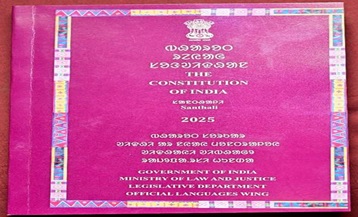
- On 25 December 2025, the President of India, Droupadi Murmu, released the official translation and digital version of the Constitution of India in the Santali language (Ol Chiki script) at Rashtrapati Bhavan.
- The event was attended by several dignitaries, including Vice President C. P. Radhakrishnan and Minister of State for Law and Justice Arjun Ram Meghwal.
Key Highlights
- The translation was published for the first time by the Legislative Department of the Ministry of Law and Justice.
- The release marks a significant step towards linguistic inclusion and accessibility of constitutional knowledge for tribal communities.
Santali Language
- Santali is one of the oldest living languages of India, primarily spoken by the Santhal tribal community.
- It is mainly spoken in Jharkhand, Odisha, West Bengal, Bihar, and Assam.
- According to the 2011 Census, Santali is spoken by over 7 million people.
- Santali belongs to the Austro-Asiatic language family.
Ol Chiki Script
- The Ol Chiki script was developed in 1925 by Pandit Raghunath Murmu.
- 2025 marks the centenary year (100 years) of the Ol Chiki script, which was specially mentioned by the President.
- The characters of the script are inspired by natural forms and Santali words.
Fifth and Sixth Schedules of the Constitution
- Fifth Schedule: Deals with the administration and control of Scheduled Areas and Scheduled Tribes, excluding the states of Assam, Meghalaya, Tripura, and Mizoram.
- Sixth Schedule: Provides for the administration of tribal areas in Assam, Meghalaya, Tripura, and Mizoram, under Article 244(2) and Article 275(1) of the Constitution.
Inclusion in the Eighth Schedule
- Santali was included in the Eighth Schedule through the 92nd Constitutional Amendment Act, 2003, along with Bodo, Dogri, and Maithili.
- The amendment came into force in 2004, making Santali one of the 22 officially recognized languages of India.
Languages in the Eighth Schedule (22 Languages)
Assamese, Bengali, Bodo, Dogri, Gujarati, Hindi, Kannada, Kashmiri, Konkani, Maithili, Malayalam, Manipuri (Meitei), Marathi, Nepali, Odia, Punjabi, Sanskrit, Santali, Sindhi, Tamil, Telugu, and Urdu.
Constitutional Provisions Related to the Eighth Schedule
- The Eighth Schedule is referred to in Articles 344(1) and 351 of the Constitution.
- Article 344(1): Empowers the President to constitute a commission on official languages.
- Article 351: Directs the promotion and development of Hindi so that it may serve as a medium of expression of India’s composite culture.
Evolution of the Eighth Schedule
- Original Constitution (1950): Contained 14 languages.
- Present Status: Expanded to 22 languages through constitutional amendments.
Major Amendments
- 21st Amendment Act, 1967: Added Sindhi.
- 71st Amendment Act, 1992: Added Konkani, Manipuri, and Nepali (Mnemonic: KMN).
- 92nd Amendment Act, 2003: Added Bodo, Dogri, Maithili, and Santali (Mnemonic: BDMS), effective from 2004.
Additional Important Points
- English is not included in the Eighth Schedule, though it is used as an official language of India.
- Classical Languages among Eighth Schedule languages include Tamil, Sanskrit, Telugu, Kannada, Malayalam, and Odia.
- Recently (2024–25), languages such as Marathi, Pali, Prakrit, Assamese, and Bengali were also granted classical language status.
- The Sahitya Akademi Awards are given in 24 languages, including the 22 Eighth Schedule languages, as well as English and Rajasthani.


 Don't Have an Account?