Context
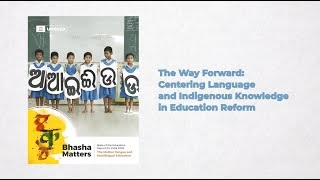
- UNESCO released the seventh edition of its annual flagship report in New Delhi, titled
“Bhasha Matters: Mother Tongue and Multilingual Education.”
Key Highlights
- The report focuses on the role of language in education in India and emphasizes the promotion of Mother Tongue-Based Multilingual Education (MTB-MLE).
- It has been prepared in collaboration with the British Council India and UNICEF India.
- The report is fully aligned with the spirit of the National Education Policy (NEP) 2020, which recommends teaching in the mother tongue/home language at least up to Grade 5, and preferably up to Grade 8.
Core Focus and Significance of the Report :
- India is one of the most linguistically diverse countries in the world, with 1,369 languages spoken.
- However, millions of children begin schooling in a language different from their mother tongue, creating learning barriers.
- The central argument of the report is:
-
- Children learn best when education begins in a language they understand.
- Mother tongue-based education:
-
- Improves reading comprehension, classroom participation, and conceptual understanding
- Builds a strong foundation for lifelong learning
- It is essential for:
-
- Inclusive education
- Preservation of linguistic diversity
- Improved learning outcomes
- The report includes case studies from tribal and rural areas, such as material development in Santali, Gondi, Saora, Kui, Bhili, Khasi, and Mizo.
- These case studies show that using the home language:
-
- Reduces dropout rates
- Increases participation of girls and children with disabilities
Key Findings
- Impact of language barriers:
Starting education in a non-home language weakens foundational learning and increases dropout rates, especially among girls in remote areas and children with special needs.
Measurable improvements in reading comprehension, classroom participation, and conceptual understanding when instruction is in the mother tongue.
Although NEP 2020 and the National Curriculum Framework (2022–2023) recognize multilingualism, implementation on the ground is weak due to:
-
- Lack of teacher training
- Shortage of learning materials
- Insufficient funding
- Role of technology:
Digital tools such as translation systems, speech technology, and AI can support multilingual education, but the digital divide must be addressed.
Integrating local knowledge systems and oral traditions into education helps preserve cultural heritage.
Key Recommendations :
- National Mission on MTB-MLE:
A strong framework with effective Centre–State coordination.
- State-level language policies:
Policies aligned with local linguistic realities.
- Teacher capacity building:
Recruitment and training of multilingual teachers; strengthening pre-service and in-service training.
- Multilingual content development:
High-quality textbooks, assessments, and learning resources for all grades.
Platforms for multilingual teaching, mentoring, and resource sharing.
Involving local communities in content creation and curriculum design.
Sustainable financing and robust monitoring mechanisms.
Positive Impact and Broader Context :
The report strengthens NEP’s three-language formula and emphasis on the mother tongue.
Inspired by UNESCO’s Global Guidance on Multilingual Education (2025), which highlights that 40% of the world’s population does not receive education in their own language.
MTB-MLE can promote equity, reduce dropouts, and help preserve cultural and linguistic heritage.
UNESCO
- Full Name: United Nations Educational, Scientific and Cultural Organization
- Established: 1945
- Headquarters: Paris, France
- Main Objective:
- To promote peace and sustainable development through education, science, culture, and communication.
- The World Heritage Convention (1972) is an international treaty formulated by UNESCO.
- Latest addition to UNESCO World Heritage List:
- Moidams of Assam (burial mound system of the Ahom dynasty), inscribed in July 2024.
- World Heritage Day:
- Celebrated annually on 18 April
“Heritage under Threat from Disasters and Conflicts: Preparedness and Learning from 60 Years of ICOMOS Actions”
National Education Policy 2020 (NEP 2020)
Introduction
- The National Education Policy 2020 was announced by the Government of India on 29 July 2020.
- It represents the first major reform in education policy since 1986.
- The policy aims to make India a global knowledge superpower and to ensure education that is inclusive, holistic, flexible, and aligned with 21st-century needs.
Key Objectives
- Achieve 100% Gross Enrolment Ratio (GER) by 2030.
- Increase public expenditure on education to 6% of GDP.
- Provide quality, inclusive, and equitable education for all.
- Promote holistic development of students (physical, mental, social, and ethical).
- Encourage technical, vocational, and skill-based education.
Major Features
School Education
- 5+3+3+4 structure for ages 3–18
- Emphasis on mother tongue/local language instruction up to at least Grade 5
- Focus on Early Childhood Care and Education (ECCE)
- Reducing dropouts and ensuring universal access to education
Higher Education
- Multiple entry–exit system
- 3- or 4-year undergraduate programmes with certificates/diplomas for early exit
- A single regulator under the Higher Education Commission of India (HECI)
- Promotion of research and innovation
Language Policy
- Three-language formula
- At least two Indian languages mandatory
- Priority to mother tongue
Teacher Training
- Improved systems for teacher training and evaluation
- Emphasis on teacher quality and capacity building
Other Initiatives
- Digital education, virtual labs, and technology integration
- Introduction of vocational education from the school level
- Special provisions for inclusive and equitable education
Structure of 5+3+3+4
- 5 years: Foundational Stage
- (3 years pre-primary + Classes 1–2)
- 3 years: Preparatory Stage (Classes 3–5)
- 3 years: Middle Stage (Classes 6–8)
- 4 years: Secondary Stage (Classes 9–12)


 Don't Have an Account?