Reference:
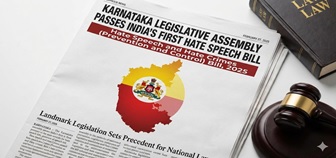
- The Karnataka Legislative Assembly passed the Hate Speech and Hate Crime (Prevention and Control) Bill, 2025, making it India’s first dedicated law to specifically address hate speech and hate crimes.
Key Points:
- The Bill aims to regulate hate-inciting speeches, books, and electronic media.
- Primary objective: To prevent expressions that spread hatred against an individual or group based on religion, caste, gender, sexual orientation, place of birth, language, or disability.
- Karnataka Government’s rationale: Hate speech often leads to violence and public disorder; therefore, strict legal provisions are necessary to prevent it.
Salient Features of the Bill
Definition of Hate Speech:Any expression—spoken, written, symbolic, or through electronic media—intended to create disharmony, hostility, hatred, or ill-will against an individual, group, or organization.
Grounds Covered: Religion, caste, race, gender, sexual orientation, place of birth, language, disability, etc.
Punishment Provisions:
- First offence:Imprisonment from 1 to 7 years and a fine of ₹50,000
- Repeat offence:Imprisonment from 2 to 10 years and a fine of ₹1,00,000
- All offences are cognisable and non-bailable.
Liability of Organizations:
- If any organization or institution (registered or unregistered) commits a hate crime, the persons in charge shall be held guilty.
- Defence available: The accused must prove that the offence was committed without their knowledge or that they exercised due diligence to prevent it.
Online Content Regulation:
- A designated officer of the State Government may direct social media platforms, intermediaries, or digital platforms to remove or block hateful content.
- Victim compensation: Courts may award compensation to victims based on the extent of harm suffered.
Exemptions:
- Scientific, literary, and artistic works
- Bona fide expressions for religious or cultural purposes
- Reporting or publication in public interest
Hate Speech in India:
- There is no single comprehensive law defining hate speech in India; it is regulated through multiple laws and constitutional provisions.
Constitutional Basis:
Article 19(1)(a):
- Guarantees the Fundamental Right to Freedom of Speech and Expression, including speaking, writing, printing, or expressing views through any medium.
Article 19(2): Reasonable Restrictions
Freedom of expression is not absolute. The State may impose reasonable restrictions on the following grounds:
- Sovereignty and integrity of India
- Security of the State
- Friendly relations with foreign States
- Public order
- Decency or morality
- Defamation
- Contempt of court
- Incitement to an offence
Legal Provisions under the Bharatiya Nyaya Sanhita (BNS):
- Section 196 (earlier IPC 153A): Promoting enmity between different groups on grounds of religion, caste, place of birth, residence, language, etc.
- Section 197 (earlier IPC 153B): Imputations or assertions prejudicial to national integration.
- Section 299 (earlier IPC 295A): Deliberate and malicious acts intended to outrage religious feelings.
- Section 353 (earlier IPC 505): Statements conducing to public mischief, such as spreading rumours leading to riots or rebellion.
Other Relevant Laws:
- Representation of the People Act, 1951: Hate speech based on religion or caste during elections is treated as a corrupt practice, leading to disqualification.
- Information Technology Act, 2000: Regulates online hate speech, particularly through Section 69A (power to block content).
- SC/ST (Prevention of Atrocities) Act, 1989: Prohibits hateful or abusive speech against members of Scheduled Castes and Scheduled Tribes.
Judicial Approach:
- Pravasi Bhalai Sangathan v. Union of India (2014):
Hate speech violates the right to equal dignity and seeks to exclude marginalized groups.
- Shreya Singhal v. Union of India (2015):
Distinguished between advocacy and incitement—only speech inciting violence can be restricted.
- Amish Devgan v. Union of India (2020):
Emphasized balancing free speech with public order.
- Supreme Court Directions (2023–24):
Directed all States to register FIRs suo motu in hate speech cases, even without a formal complaint.
Karnataka State – Overview
General Information:
- Karnataka is a state in south-western India, formerly known as the Mysore State.
- Renamed Karnataka on 1 November 1973.
- Statehood Day: 1 November 1956; celebrated as Karnataka Rajyotsava.
- Capital: Bengaluru (Silicon Valley of India)
- Official Language: Kannada
- Area: 191,791 sq km (5.83% of India’s total area)
- Population: Approx. 61.1 million (Census 2011)
Boundaries:
- Arabian Sea (West)
- Goa (North-West)
- Maharashtra (North)
- Telangana (North-East)
- Andhra Pradesh (East)
- Tamil Nadu (South-East)
- Kerala (South)
Physiographic Divisions:
- Coastal Region (Karavali): Coastal plains
- Malnad: Western Ghats with waterfalls like Jog Falls
- Bayaluseeme: Deccan Plateau (black soil)
Major Rivers:
- Cauvery, Krishna, Tungabhadra, Sharavathi
State Symbols:
- State Animal: Indian Elephant
- State Bird: Indian Roller
- State Flower: Lotus
- State Tree: Sandalwood
Administration and Politics:
- Legislature: Bicameral (Legislative Assembly and Legislative Council)
- Assembly Seats: 224
- Council Seats: 75
- Lok Sabha Seats: 28
- Rajya Sabha Seats: 12
UNESCO World Heritage Sites:
- Hampi (Remains of Vijayanagara Empire)
- Group of Monuments at Pattadakal
- Western Ghats (selected sites)
- Hoysala Temples (Belur, Halebidu, and Somanathapura)
Major Tourist Attractions:
- Mysore Palace
- Jog Falls
- Coorg (Scotland of India)
- Gokarna Beaches
Culture and Art:
- Dance Forms: Yakshagana, Veeragase, Dollu Kunitha
- Music: Birthplace of Carnatic Classical Music
- Literature: Kannada literature has received the highest number of Jnanpith Awards (8) in India.
Physical Features:
- Rivers: Krishna, Cauvery, Tungabhadra, Sharavathi, Malaprabha
- Mountain Ranges: Western Ghats (Malnad region) and Baba Budan Hills (origin of coffee cultivation in India)
- National Parks: Bandipur, Nagarhole, Bannerghatta, and Kali Tiger Reserve (earlier Anshi National Park)
Brief History:
- Ancient Period: Mauryas, Satavahanas, Kadambas, Gangas
- Medieval Period: Chalukyas, Rashtrakutas, Hoysalas, Vijayanagara Empire (Hampi)
- Modern Period: Mysore Wodeyars, Hyder Ali–Tipu Sultan, British rule
- Post-Independence: State reorganization on linguistic basis in 1956


 Don't Have an Account?