15 December, 2025
Repealing and Amending Bill, 2025
Thu 18 Dec, 2025
Reference:
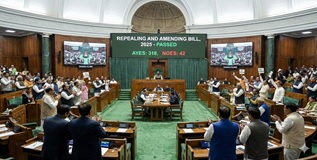
- The Lok Sabha has passed the Repealing and Amending Bill, 2025.
Key Points:
- Objective of the Bill: To repeal obsolete, unnecessary, and colonial-era legal provisions and make necessary amendments, thereby keeping India’s statute book clean and streamlined.
- The Bill repeals laws that are obsolete, unnecessary, or ineffective and makes minor amendments to certain existing laws.
- The Bill was introduced in the Lok Sabha by Union Minister for Law and Justice, Arjun Ram Meghwal, on 15 December 2025.
- The Lok Sabha passed it by voice vote on 16 December 2025, and the Rajya Sabha also approved it by voice vote on 17 December 2025.
- It will become law after receiving the President’s assent.
Major Provisions and Legislative Changes:
- The Bill primarily works on two fronts: repealing outdated laws and amending existing laws.
Repeal of Obsolete Laws:
- The Bill repeals a total of 71 Acts, including 65 amendment Acts, as their provisions are already incorporated into the principal Acts, making their independent existence unnecessary.
Key Repealed Laws:
- Indian Tramways Act, 1886: A colonial-era law with no current relevance.
- Levy Sugar Price Equalization Fund Act, 1976: Economically obsolete.
- BPCL (Conditions of Service) Act, 1988: Repealed for administrative convenience.
Important Amendments:
- The Bill makes amendments in 4 major Acts to make them contemporary:
| Act | Key Amendment/Change |
| General Clauses Act, 1897 | Updated terms related to ‘Registered Post’ to align with modern communication methods. |
| Code of Civil Procedure (CPC), 1908 | Improved procedural terminology to speed up legal processes. |
| Indian Succession Act, 1925 | Reduced the requirement of probate verification for Hindus, Buddhists, Sikhs, Jains, and Parsis in Kolkata, Madras, and Mumbai. |
| Disaster Management Act, 2005 | Corrected a technical error by replacing “Prevention” with “Preparedness”. |
Impact and Benefits:
- Citizen-Centric Policy: Relaxation in probate requirements will reduce the burden on citizens in court processes.
- Ease of Doing Business: Reduced compliance burden will facilitate investment in India.
- Judicial Efficiency: Repeal of unnecessary laws will reduce pending cases in courts.
Parliamentary Discussion and Opposition Response:
- The Bill was non-controversial and passed by voice vote in both Houses.
- Some opposition members (e.g., Lalji Verma from Samajwadi Party) questioned why certain laws from 2016–2023 were being repealed. The government clarified that these were mostly amendment Acts that had served their purpose.
- Some members raised other issues (e.g., Anti-Defection Law or UAPA), but consensus was maintained on this Bill.
- The Law Minister described it as a step toward “liberation from colonial mindset.”
Positive Outcomes:
- The legal framework will become simpler and more modern.
- Judicial processes will be faster (e.g., removal of discriminatory probate requirements).
- Administrative burden will reduce with the repeal of unnecessary laws.
- Aligns with the policy of “Minimum Government, Maximum Governance.”
- No negative impact: Repeal does not affect ongoing cases or rights, as the laws were already ineffective.