Context:
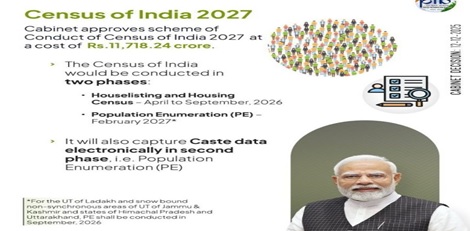
- The Union Cabinet has approved a budget of ₹11,718.24 crore for India’s 16th Census (Census of India 2027), which will be the first fully digital census in the country.
Key Highlights:
- Budget: ₹11,718.24 crore
- Nature: First fully digital census
- Objective:
– To collect data in a faster, safer, and more reliable manner
– To provide accurate data up to the village/ward level for effective policy formulation
Phases of Census 2027:
The Census will be conducted in two major phases:
- House Listing and Housing Census (April–September 2026):
– Collection of information related to houses and living conditions
- Population Enumeration (February 2027):
– Collection of individual-level data such as age, gender, education, caste, language, occupation, etc.
– Uttarakhand, Himachal Pradesh, Ladakh, and Jammu & Kashmir
- The Census is conducted by the Office of the Registrar General and Census Commissioner of India, which functions under the Ministry of Home Affairs.
- The 2027 Census will be the 16th Census since 1872 and the 8th Census after Independence.
- The Government has decided to simultaneously collect data for the Census, Caste Census, and the National Population Register (NPR).
Major Digital and Technological Innovations
– Enumerators will collect data using a mobile application on smartphones (Android and iOS) instead of traditional paper forms.
– Citizens will be given the option to self-enumerate through a dedicated digital platform.
– A dedicated online portal named the Census Management and Monitoring System (CMMS) has been developed for real-time monitoring of the entire process.
– The HLB Creator web map application will be used by Charge Officers to organize House Listing Blocks (HLBs).
– Robust security measures have been ensured for this large-scale digital operation.
Census Management and Monitoring System (CMMS)
Objective:
- To provide a centralized digital portal for monitoring, managing, and coordinating all census-related activities.
Development:
- Developed by the Office of the Registrar General and Census Commissioner of India, Government of India.
Key Features:
- Real-time monitoring of work progress for Enumerators and Supervisors
- Dashboard-based system to ensure data quality and timeliness
- Availability of multilingual information and training materials
- Facility to track the status and progress of Enumeration Blocks
Usage:
- Assists enumerators, supervisors, and administrators in training, data verification, and process management.
Significance:
- Digital Transformation: Plays a crucial role in India’s first digital census by reducing paperwork
- Training Support: Provides effective assistance through national and state-level training institutions
- Data Security: Ensures data privacy; no third-party data sharing
Impact:
- Enables availability of accurate, reliable, and timely data for policy-making, delimitation, and social welfare schemes
Delimitation in India
Meaning:
• Delimitation is the process of redrawing boundaries of Lok Sabha and State Legislative Assembly constituencies to ensure equal representation, based on the principle of “one vote, one value.”
Constitutional Basis and History:
| Article |
Provision |
| Article 82 |
Empowers Parliament to enact a Delimitation Act after every Census |
| Article 170 |
Provides for division of states into territorial constituencies after each Census |
- Four Delimitation Commissions have been constituted so far under the Delimitation Commission Act, 1952.
- These Commissions were formed in 1952, 1963, 1973, and 2002.
Composition and Powers of the Delimitation Commission:
- Chairperson: A serving or retired Judge of the Supreme Court
- Ex-officio Member: Chief Election Commissioner (or a nominated Election Commissioner)
- Ex-officio Member: State Election Commissioner of the concerned state
Freezing of Seats and Constitutional Amendments:
- 42nd Constitutional Amendment Act, 1976:
– Froze delimitation until 2001
- 84th Constitutional Amendment Act, 2001:
– Froze the number of Lok Sabha and State Assembly seats based on the 1971 Census until the first Census after 2026
– Aimed at encouraging population control measures
- 87th Constitutional Amendment Act, 2003:
– Allowed readjustment and rationalization of constituency boundaries using data from the 2001 Census
Last Delimitation Exercise (2002–2008):
- Conducted by the Delimitation Commission constituted in 2002
- Duration: July 2002 to 31 March 2008
- Number of seats: No change (frozen on the basis of the 1971 Census)
- Work: Only boundary reorganization of existing Lok Sabha and Assembly constituencies
- Reservation: Re-determination of SC/ST reserved seats based on the 2001 Census
- Exception: Four North-Eastern states—Arunachal Pradesh, Assam, Manipur, and Nagaland—were excluded
Objectives of Delimitation:
- Equal Representation: Ensuring equal representation for equal population segments
- Geographical Fairness: Preventing undue advantage to any region or political party
- Encouraging Population Control: Protecting states that successfully implemented population control measures
- Adjustment of Reserved Seats: Rational allocation of SC/ST reserved constituencies in proportion to population


 Don't Have an Account?