Increase in Minimum Support Price (MSP) of Copra
 
  • Mobile Menu
HOME BUY MAGAZINEnew course icon
LOG IN SIGN UP

Sign-Up IcanDon't Have an Account?


SIGN UP


Login Icon

Have an Account?


LOG IN
 

or
By clicking on Register, you are agreeing to our Terms & Conditions.


or


Increase in Minimum Support Price (MSP) of Copra

Sat 13 Dec, 2025

Context:

  • The Cabinet Committee on Economic Affairs (CCEA) has approved a higher Minimum Support Price (MSP) for copra for the year 2026 with the objective of increasing farmers’ income and encouraging production.

Key Points:

  • To provide remunerative prices to farmers, the Government announced in the Union Budget 2018–19 that the MSP of all mandated crops would be fixed at least at 1.5 times the average cost of production at the all-India level.

MSP 2026 (per quintal):

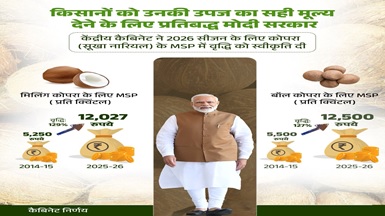
  • For the 2026 season, the MSP for Milling Copra of Fair Average Quality (FAQ) has been fixed at ₹12,027 per quintal, and for Ball Copra at ₹12,500 per quintal.

Increase over the Previous Season:

  • For the 2026 season, the MSP has increased by ₹445 per quintal for Milling Copra and by ₹400 per quintal for Ball Copra compared to the previous season.

Historic Increase in MSP from 2014 to 2026:

  • The Government has increased the MSP of Milling Copra and Ball Copra from ₹5,250 per quintal and ₹5,500 per quintal respectively in the 2014 marketing season to ₹12,027 per quintal and ₹12,500 per quintal respectively in the 2026 marketing season, representing an increase of 129 percent and 127 percent respectively.
  • The National Agricultural Cooperative Marketing Federation of India Limited (NAFED) and the National Cooperative Consumers’ Federation (NCCF) will continue to function as Central Nodal Agencies (CNAs) for procurement of copra under the Price Support Scheme (PSS).

Copra

  • Copra (also known as khopra) is essentially the dried kernel of coconut.
  • Origin: It is prepared by extracting the inner white kernel from mature coconuts and drying it in the sun or in kilns.
  • Main Purpose: Copra is primarily used for the extraction of coconut oil. Dried copra contains a high oil content.
  • Processing: Traditionally, copra is sun-dried and then crushed in ghanis or machines to extract oil. The residue left after oil extraction is called oil cake, which is used as animal feed.

Main Types of Copra:

Type Description Main Use Production Regions
Milling Copra Exists in the form of dried coconut pieces (Cup Copra). It is processed for oil extraction. Production of coconut oil. Major oil-producing states such as Kerala and Tamil Nadu
Ball Copra Whole, unbroken dried coconut. It is dried slowly and has a ball-like shape. Consumed as edible copra, used in sweets (e.g., copra pak) and in religious rituals. Regions such as Karnataka

Coconut (Cocos nucifera)

Coconut, botanically known as Cocos nucifera, is an extremely useful and versatile plant, often referred to as the “Kalpavriksha” (wish-granting tree).

Coconut (Cocos nucifera):

Feature Description
Botanical Name Cocos nucifera
Family Arecaceae (Palm family)
Common Names Coconut, Shreephal
Distribution Mainly found in tropical and subtropical coastal regions
Major Producing States in India Kerala, Tamil Nadu, Karnataka, Andhra Pradesh, West Bengal, and coastal regions of Maharashtra

Agricultural Conditions:

  • Climate: Best growth in warm, humid tropical regions with temperatures of 20–32°C and annual rainfall of 100–300 cm.
  • Soil and Water: Well-drained sandy loam or laterite soil with adequate moisture, but without waterlogging.
  • Top Producers:
  • Globally: Indonesia, Philippines, India, Sri Lanka, Brazil.
  • In India: Headquarters of the Coconut Development Board is located in Kochi, Kerala.

Minimum Support Price (MSP)

  • MSP is a form of market intervention by the Government of India to insure agricultural producers against any sharp fall in agricultural prices.

Current Mechanism for MSP Determination:

  • MSP is determined under the purview of the Commission for Agricultural Costs and Prices (CACP), which was initially established in 1965 as the Agricultural Prices Commission and later renamed in 1985.
  • While determining MSP, CACP considers various factors such as cost of production, demand and supply, market price trends, inter-crop price parity, etc.

Types of Cost of Production Estimated by CACP:

  • For each crop, CACP estimates three types of production costs at the state and all-India average levels:
  • A2: Includes all paid-out costs incurred by farmers in cash and kind, such as seeds, fertilizers, pesticides, hired labour, leased-in land, fuel, irrigation, etc.
  • A2+FL: Includes A2 plus the imputed value of unpaid family labour (FL).
  • C2: A more comprehensive cost that, in addition to A2+FL, accounts for the rental value of owned land and interest on owned fixed capital assets.
  • While recommending MSP, CACP considers both A2+FL and C2 costs; however, for ensuring returns over cost, it considers only A2+FL.
  • Working within the Ministry of Agriculture and Farmers’ Welfare, CACP submits its recommendations to the Cabinet Committee on Economic Affairs (CCEA), chaired by the Prime Minister of India, which takes the final decision on MSP levels.

Crops Covered under MSP:

At present, CACP recommends MSP for 22 commodities, including 14 Kharif crops, 6 Rabi crops, and 2 other commercial crops:

Category Crops
7 Cereals Paddy, wheat, maize, jowar, bajra, barley, ragi (finger millet)
5 Pulses Gram (chana), tur/arhar (pigeon pea), moong (green gram), urad (black gram), lentil (masoor)
7 Oilseeds Groundnut, rapeseed–mustard, soybean, sesame, sunflower, safflower, niger
3 Commercial Crops Copra, cotton, raw jute

Note:

  • For sugarcane, the Government announces a Fair and Remunerative Price (FRP).

Latest Courses