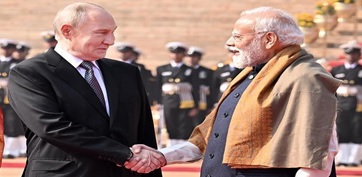
Putin’s Recent Visit to India
 
  • Mobile Menu
HOME BUY MAGAZINEnew course icon
LOG IN SIGN UP

Sign-Up IcanDon't Have an Account?


SIGN UP


Login Icon

Have an Account?


LOG IN
 

or
By clicking on Register, you are agreeing to our Terms & Conditions.


or


Putin’s Recent Visit to India

Sun 07 Dec, 2025

Russian President Vladimir Putin’s latest visit to India marks one of the most strategically significant diplomatic engagements of recent years. The visit took place at a time when the global geopolitical order is witnessing rapid shifts—intensifying U.S.–China rivalry, the prolonged Russia–Ukraine conflict, and the resurgence of minilateral groupings like QUAD and BRICS+. Against this backdrop, India and Russia reaffirmed their long-standing partnership and sought to modernize their cooperation across defence, energy, technology, and connectivity.

Historical Background of India–Russia Relations

India and Russia share a partnership often termed as a “Special and Privileged Strategic Partnership.”

Key historical pillars include:

Cold War Legacy

  • The Soviet Union remained one of India’s closest partners, providing diplomatic support during the 1971 Indo–Pakistan War.
  • Defence and technology cooperation deepened with platforms such as the MiG and Sukhoi fighter aircraft.

Post-Soviet Engagement

  • After 1991, India & Russia recalibrated ties and signed the 1993 Treaty of Friendship and 2000 Strategic Partnership Agreement.
  • Annual summits began in 2000, institutionalizing high-level dialogue.

Defence Cooperation

  • Russia has been India’s largest defence supplier for decades.
  • Joint programmes include BrahMos, S-400 missile systems, AK-203 rifles, INS Vikramaditya aircraft carrier, and nuclear submarine leasing agreements.

Putin’s 2025 visit continues this legacy while adapting to new global realities.

Key Outcomes of the Recent Visit

(A) Defence and Security Cooperation Strengthened

  • Agreement to expand joint production under “Make in India,” including advanced ammunition, missile systems, and naval equipment.
  • Renewed discussions on additional S-400 systems, upgrade of Su-30 MKI fighters, and future joint development projects.
  • Enhanced collaboration on counter-terrorism intelligence sharing, cyber security, and Indo-Pacific maritime safety.

(B) Energy and Nuclear Cooperation Expanded

  • Russia reaffirmed long-term crude oil supply guarantees at discounted rates.
  • India and Russia advanced cooperation on Kudankulam Nuclear Power Plant (Units 5 & 6).
  • New agreements explored in LNG, petrochemicals, and Arctic energy corridors.

(C) Connectivity: Boost to INSTC & Chennai–Vladivostok Route

  • Both leaders reviewed progress on the International North-South Transport Corridor (INSTC) connecting India to Central Asia and Europe via Iran.
  • Discussion on operationalizing the Chennai–Vladivostok Maritime Corridor to reduce logistics time and costs.

(D) Trade & Economic Commitments

  • New target: $100 billion annual bilateral trade by 2030.
  • Cooperation in pharmaceuticals, IT, space, agriculture, and rare-earth minerals.
  • Russia invited greater Indian investments in the Far East under the “Act Far East” initiative.

(E) Space & Technology Cooperation

  • Russia offered advanced training modules for Indian astronauts and collaboration on future lunar missions.
  • Agreements signed in quantum computing, AI, and scientific research exchanges.

Geopolitical Significance of the Visit

(A) India’s Strategic Autonomy Reasserted: Despite Western pressure due to the Ukraine war, India continues balanced diplomacy—buying Russian oil, engaging in BRICS, and maintaining QUAD commitments.

Putin’s visit signals that India will not be forced into geopolitical camps.

(B) Russia’s Pivot to Asia: Sanctions have pushed Russia toward non-Western partners. India’s growing global stature makes it a key pillar in Russia’s Asia strategy.

(C) Impact on China–Russia–India Triangle: While Russia deepens ties with China, Moscow remains sensitive to India’s concerns, especially regarding border tensions with China. India leverages this relationship to maintain strategic leverage.

(D) Eurasian Security & Multipolarity: Both leaders endorsed a multipolar world order, supporting platforms like BRICS+, SCO, and G20 reforms. They emphasized peaceful resolution of global conflicts and opposed unilateral sanctions.

India–Russia Trade Snapshot

Current Trade (2024–25 estimates):
  • Total trade crossed $65–70 billion, driven mainly by crude oil imports.
  • India imports: oil, coal, fertilizers, defence equipment.
  • India exports: pharmaceuticals, machinery, tea, coffee, chemicals, textiles.
Challenges:
  • Trade imbalance favoring Russia.
  • Payment settlement issues due to sanctions.
  • Need for diversification beyond energy & defence.


Conclusion

  • Putin’s visit to India reaffirms the resilience and relevance of India–Russia relations amid shifting global power dynamics. Both countries remain important partners in defence, energy, space, and multipolar diplomacy.
  • While challenges remain—sanctions, payment systems, and Russia–China proximity—the latest summit highlights a shared commitment to deepening strategic cooperation.
  • India’s foreign policy continues to reflect strategic autonomy, allowing it to engage major powers simultaneously while protecting national interests.

Latest Courses