08 December, 2025
Nanoplastics Released from Single-Use PET Bottles Pose a Threat to Human Health: INST Mohali Study
Thu 04 Dec, 2025
Reference:
- According to a study conducted by scientists at the Institute of Nano Science and Technology (INST), Mohali, nanoplastics released from single-use PET bottles damage gut bacteria and human cells.
Key Points:
- Team: The study was led by Prof. Manish Singh, Prashant Sharma, and Sakshi Dagaria from the Chemical Biology Unit of INST.
- Objective: To understand the biological impacts of nanoplastics (PBNPs) released from single-use PET bottles, particularly on the gut microbiome, blood cells, and general cellular responses.
Process:
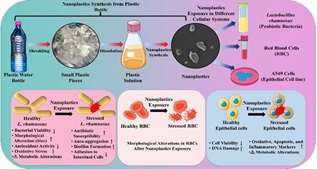
- INST prepared nanoplastics (50–850 nanometers) from PET bottles in the laboratory to replicate real environmental conditions.
- These nanoplastics were tested on three biological models:
- Lactobacillus rhamnosus: A beneficial gut probiotic bacterium.
- Red Blood Cells: To assess blood compatibility.
- A549 Human Epithelial Cells: A model for general cellular responses.
Impact on Gut Bacteria (Gut Microbiome)
Effects on Lactobacillus rhamnosus:
- Reduced Growth: Exposure for 16 days caused dose- and time-dependent reductions in bacterial viability and proliferation.
- Membrane Damage: Confocal microscopy confirmed damage to bacterial membranes.
- Decline in Protective Functions: Antioxidant and antibacterial activities decreased, affecting the bacterium’s ability to protect the gut.
- Biofilm & Autoaggregation: Nanoplastics increased biofilm formation and autoaggregation, indicating dysbiosis.
- Antibiotic Sensitivity: Increased sensitivity to antibiotics, complicating antibiotic resistance (AR) dynamics.
- Reduced Colonization: Adhesion to colon epithelial cells decreased, reducing colonization capability.
Spread of Antibiotic Resistance (AR):
- Nanoplastics promote AR gene transfer through two mechanisms:
- Direct Transformation: PBNPs transport AR plasmids across bacterial membranes, enabling gene transfer from E. coli to L. acidophilus.
- OMV-Induced Transfer: Nanoplastics trigger oxidative stress and membrane damage, activating stress genes and increasing secretion of outer membrane vesicles (OMVs).
- These OMVs carry AR genes and transfer them to unrelated bacteria.
- This mechanism may turn beneficial bacteria into reservoirs of AR genes, which may later transfer to pathogenic bacteria, intensifying the global AR crisis.
Impact on Human Cells
Red Blood Cells:
- At high concentrations, nanoplastics caused membrane damage and hemolytic changes (premature cell destruction).
- This may affect oxygen-carrying capacity and overall blood stability, potentially leading to anemia-like conditions.
A549 Epithelial Cells:
Short-term exposure:
- Minimal effects observed.
- Long-term exposure:
- DNA Damage: Genotoxic effects leading to DNA damage (γH2AX marker).
- Oxidative Stress: Increased reactive oxygen species (ROS), causing cellular damage.
- Apoptosis: Increased markers of programmed cell death.
- Inflammation: Enhanced pro-inflammatory signaling (IL-6, TNF-α), potentially causing chronic inflammation.
- Metabolic Changes: Alterations in glucose metabolism, amino acid balance, and lipid pathways affecting energy and nutrient metabolism.
- Mutagenic Potential: No direct mutagenicity in Ames test, but mutagenic potential increased after metabolic activation, indicating bioactivation-dependent genotoxicity.
Characteristics and Risks of Nanoplastics:
- Size & Bioavailability: PBNPs (50–850 nm) are small enough to penetrate cell membranes, gut walls, and tissues. They may be 1000 times more toxic than microplastics.
- Trojan Horse Effect: Nanoplastics carry harmful chemicals (phthalates, bisphenols, heavy metals), increasing toxicity.
- Environmental Relevance: INST generated nanoplastics from real PET bottles, replicating environmental pollutants more accurately.
- PET bottles release nanoplastics through sunlight exposure, heat, and mechanical stress.
- Antibiotic Resistance Risk: Nanoplastics promote AR gene spread, worsening global health challenges.
Plastics
- Plastics are a broad category of synthetic or semi-synthetic organic compounds used to make various products.
- The word “plastic” comes from the Greek word plastikos, meaning “capable of being molded.”
Classification of Plastics
Based on Structure:
Thermoplastics:
- Soften on heating and harden on cooling; the process is reversible.
- Ideal for recycling.
- Examples: Polyethylene (PE), Polypropylene (PP), Polyvinyl Chloride (PVC), Polystyrene (PS), PET.
Thermosetting Plastics:
- Become permanently hard upon heating; cannot be softened again.
- Difficult to recycle.
- Examples: Bakelite, Melamine, Epoxy resins.
Types of Plastics and Recycling Codes (Resin Identification Codes):
These codes help identify plastics based on their chemical composition for recycling purposes.
| Code | Abbreviation | Full Name | Common Uses |
| 1 | PET or PETE | Polyethylene Terephthalate | Water/soda bottles, food jars, clothing fibers |
| 2 | HDPE | High-Density Polyethylene | Milk bottles, detergent containers, toys |
| 3 | PVC | Polyvinyl Chloride | Pipes, window frames, cable insulation, medical devices |
| 4 | LDPE | Low-Density Polyethylene | Plastic bags, wrapping films, squeeze bottles |
| 5 | PP | Polypropylene | Yogurt containers, medicine bottles, microwave containers, car parts |
| 6 | PS | Polystyrene | Disposable cups, foam packaging, cutlery |
| 7 | OTHER | Other | Polycarbonate (PC), nylon, mixed plastics |